Zigbee’s disadvantages include limited indoor range (10-100 meters) with signal degradation through walls, vulnerability to Wi-Fi and Bluetooth interference, and security weaknesses in its key management system. You’ll face compatibility issues between different manufacturers’ devices, requiring multiple hubs. Its slow data transmission rate (250 kBit/s) makes it unsuitable for high-bandwidth applications, and implementation costs can reach up to $200,000 for manufacturers. These limitations will impact your smart home planning considerably.
Network Range and Interference Limitations
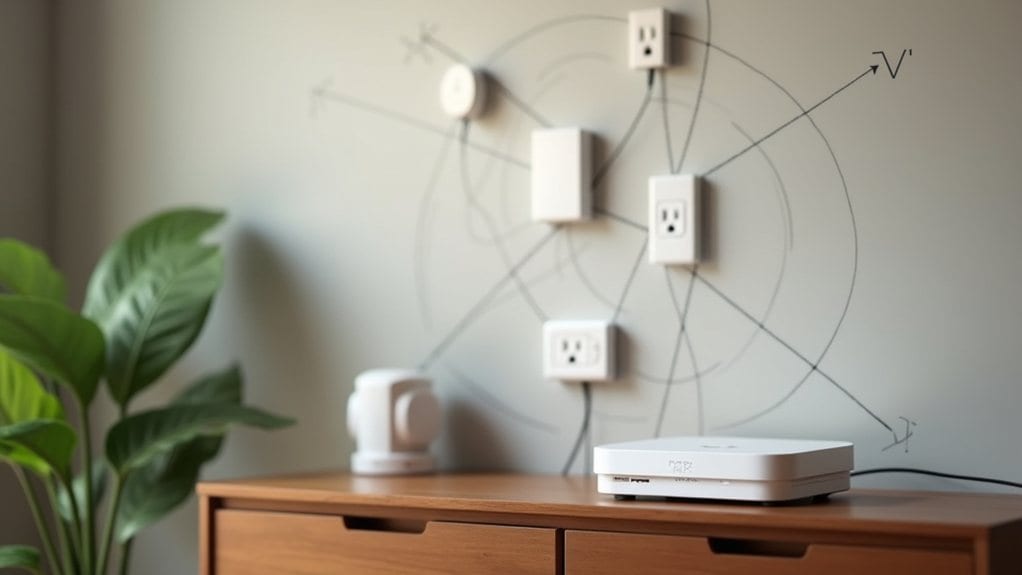
While Zigbee offers many benefits for smart home integration, its network range presents notable limitations for users with larger homes or complex layouts. Indoor Zigbee signals typically reach only 10-100 meters, with reliable strong signals rarely extending beyond 30 meters.
Physical obstacles like walls and furniture greatly reduce signal quality. Beyond 75 meters indoors, signals become weak or very weak, regardless of theoretical capabilities. Outdated Zigbee adapters or those with poor antennas can further diminish the already limited range. Strategic placement of mesh routers can help overcome these limitations by creating additional signal paths.
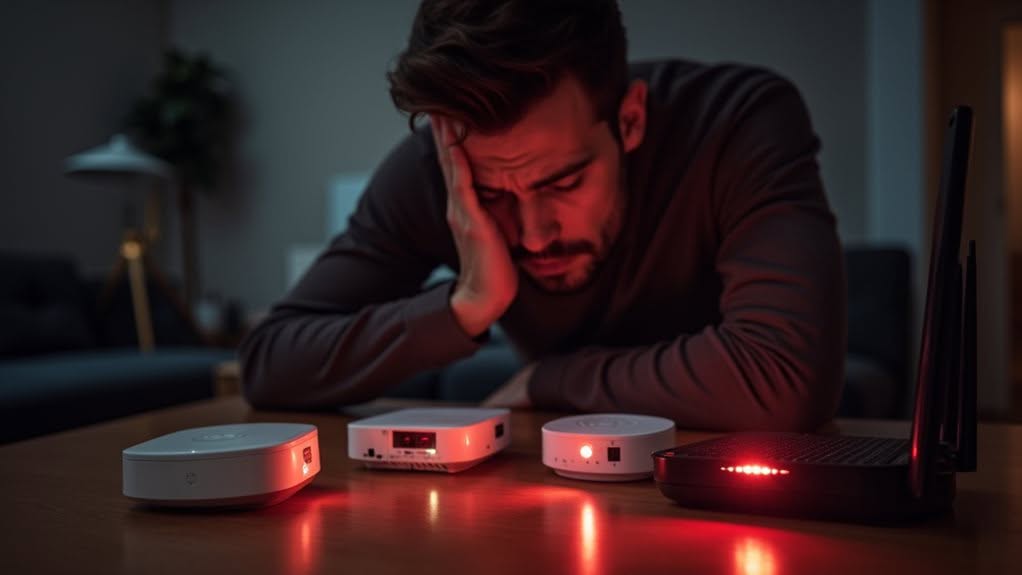
Zigbee’s operation in the 2.4 GHz band makes it particularly vulnerable to interference from common household devices. Wi-Fi routers, Bluetooth devices, and even microwave ovens can disrupt Zigbee communications, resulting in transmission loss and device disconnections. Many users find that implementing a home security system with Zigbee requires careful planning to avoid interference issues.
USB 3.x devices positioned near Zigbee adapters can also create electromagnetic interference that blocks signals, requiring careful placement and sometimes shielding for dependable operation.
Security Vulnerabilities and Encryption Challenges
Despite its widespread adoption in smart home ecosystems, Zigbee presents several concerning security vulnerabilities that users should understand before implementation.
The protocol relies on 128-bit AES encryption, but its key management system is particularly weak. Many devices use publicly known default link keys, making networks susceptible to unauthorized access.
Worse still, these keys are sometimes transmitted unencrypted or reused across multiple devices. The ZigBee security architecture operates on an open trust model that assumes mutual trust between layers, which creates additional security risks.
Your Zigbee network remains vulnerable to denial-of-service attacks through jamming, which can block communication between devices and drain batteries through forced retransmissions. Attackers who execute Link Layer Jamming can effectively disrupt service without needing access to encryption keys.
Attackers don’t even need encryption keys to launch these disruptions.
The lack of end-to-end encryption and infrequent key rotation further compromises security, especially on resource-constrained devices.
When trust centers are breached, entire networks can be compromised, exposing sensitive data and control systems.
Device Compatibility and Ecosystem Fragmentation

Although Zigbee markets itself as a universal standard for smart home connectivity, its practical implementation reveals considerable device compatibility challenges and ecosystem fragmentation.
The promise of Zigbee’s universal standard crumbles when confronted with real-world compatibility nightmares and ecosystem chaos.
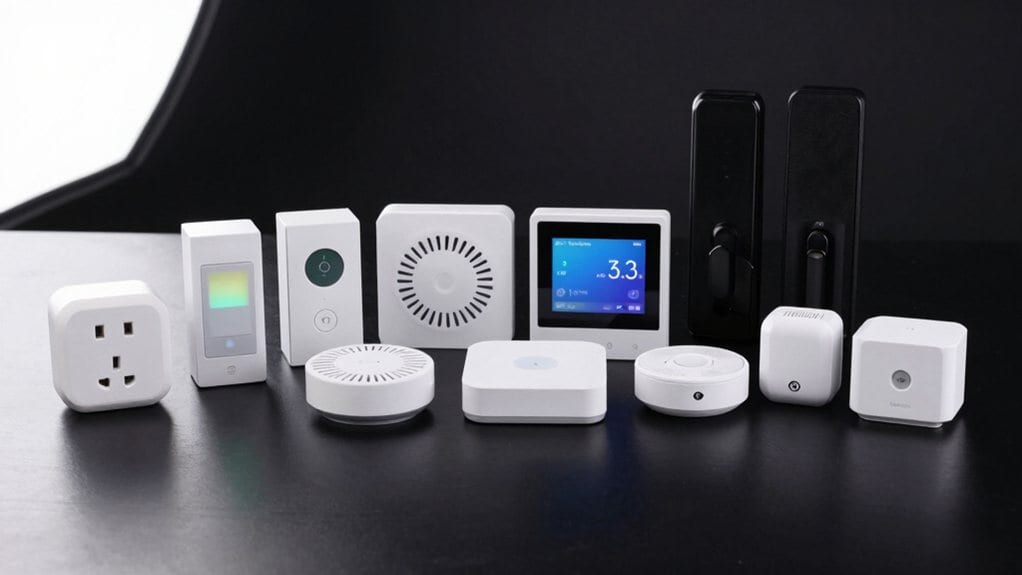
You’ll face frustrating interoperability issues when using popular devices like Xiaomi Aqara sensors, which often employ non-standard implementations requiring multiple pairing attempts.
Even officially certified Zigbee products may not communicate reliably with each other due to varying interpretations of the standard.
The ecosystem’s fragmentation is staggering, with over 5,000 devices from more than 500 vendors creating inconsistent behaviors and proprietary extensions. Setting up a robust network requires strategic placement of Zigbee router devices throughout your home to enhance coverage.
This diversity frequently requires manual tweaks and updates to maintain functionality.
Network stability suffers as certain devices cause random drop-offs and delayed command execution, with Peanut Plugs sometimes crashing after extended use.
Pairing processes are notoriously complex, often demanding numerous attempts, factory resets, and careful placement to achieve stable connections.
Licensing Costs and Economic Considerations
When considering Zigbee for your smart home ecosystem, you’ll encounter a substantial financial commitment beyond just hardware costs.
Membership fees range from free (Associate level) to $20,000 annually for Participant status, with most manufacturers needing at least the $7,000 Adopter tier.
Product certification adds another layer of expense, typically $1,500-$3,000 per product. The core stack provided by manufacturers like TI is already certified, which can reduce initial development costs. You’ll also face additional trademark fees of around $500 per product SKU.
These cumulative costs can push total Zigbee implementation expenses to $30,000-$200,000 depending on your product line’s scale.
Compared to alternatives like Matter (which has no licensing fees), Zigbee’s cost structure creates higher barriers to entry. Despite its open-source nature, the financial requirements still present significant challenges for manufacturers.
This financial burden particularly impacts smaller manufacturers and startups, potentially limiting innovation and product diversity in the market.
Technical Performance Constraints in IoT Applications
Zigbee’s technical architecture introduces several performance constraints that impact its effectiveness in IoT applications. Despite its mesh networking advantages, the protocol faces considerable technical limitations.
Power management presents a major challenge in deployments where battery replacement isn’t practical.
- Router nodes must remain continuously powered, preventing full network sleep capability and reducing energy efficiency in large-scale installations.
- Data transmission maxes out at 250 kBit/s, restricting applications to low-throughput scenarios unsuitable for multimedia or high-volume data exchange.
- Limited range (10-100 meters indoors) requires careful placement of routing nodes to avoid network gaps.
- Non-IP addressing necessitates dedicated gateways for internet connectivity, adding complexity and potential points of failure.
These constraints require careful consideration when evaluating Zigbee for IoT implementations, especially in scenarios requiring high performance or seamless integration. The technology is particularly vulnerable to channel noise and interference since it operates in the crowded 2.4 GHz frequency band shared with many other wireless technologies. While Zigbee offers excellent compatibility with smart home systems, its limited device compatibility compared to Wi-Fi creates integration challenges with some mainstream consumer electronics.
Frequently Asked Questions
Does Zigbee Work With Voice Assistants Like Alexa?
Yes, Zigbee works with Alexa if you have a compatible Echo device with a built-in Zigbee hub. You’ll be able to control your Zigbee devices using voice commands like “Alexa, turn on the light.”
Can Zigbee Networks Be Monitored Through Smartphone Apps?
Yes, you can monitor your Zigbee network through smartphone apps like Zigbee Device Control and Tuya Smart. They’ll provide real-time data, automation features, and remote access to your connected devices via a gateway.
How Does Zigbee Compare to Z-Wave for Smart Home Use?
Zigbee offers better mesh networking and supports more devices than Z-Wave, but Z-Wave provides superior wall penetration and guaranteed compatibility. Your choice depends on home size, security needs, and which devices you’ll use.
Is Zigbee Suitable for Outdoor or Industrial Environments?
Zigbee has limitations outdoors and in industrial settings. You’ll face signal range challenges, power constraints, interference from machinery, and security vulnerabilities. Its mesh network struggles with physical barriers and harsh environments common in these applications.
What Happens to Zigbee Devices if the Coordinator Fails?
If your coordinator fails, devices already on the network can still communicate locally through routers, but you’ll lose central control. New devices can’t join, and existing ones may eventually disconnect without a functioning coordinator.
Final Thoughts
While Zigbee offers compelling IoT connectivity, you’ll need to weigh its considerable limitations. Its restricted range, vulnerability to interference, potential security weaknesses, and ecosystem fragmentation can complicate your smart home implementation. You’ll also face licensing costs and technical performance constraints that might not meet your needs for high-bandwidth applications. Consider these drawbacks carefully when deciding if Zigbee is the right protocol for your connected devices.