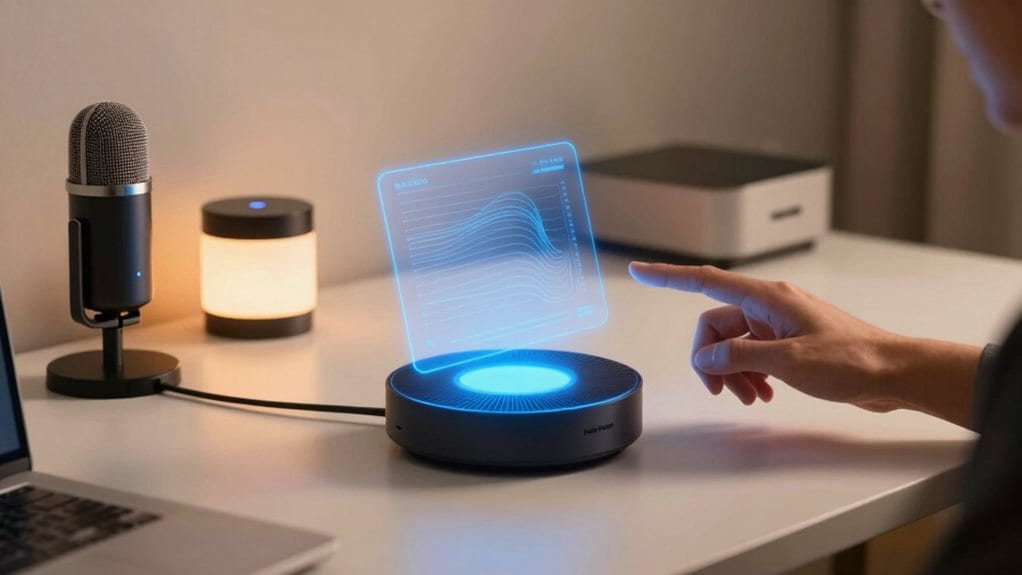
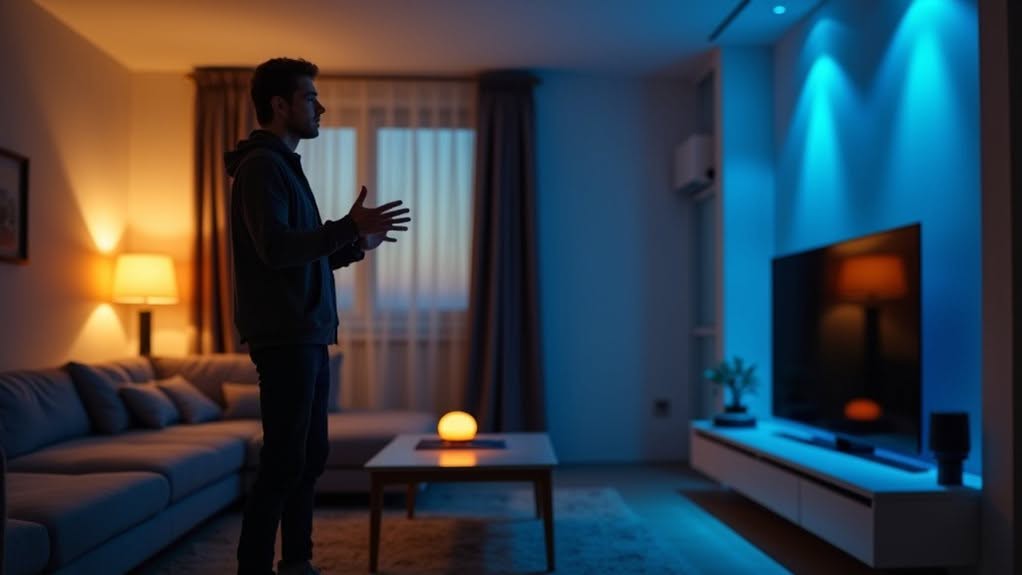
Voice commands have revolutionized smart home lighting by enabling hands-free control and personalized experiences. You can adjust brightness, color, and ambiance with simple spoken phrases, while AI systems learn your preferences over time. These technologies offer notable benefits for accessibility, particularly for elderly users with mobility challenges, and can reduce energy consumption by 30-50% through automated occupancy adjustments. The integration of protocols like Matter guarantees compatibility across over 220 million devices in today’s expanding smart home ecosystem.
The Evolution of Voice-Activated Lighting Systems
While we take modern smart lighting for granted today, the quest toward voice-activated lighting systems began long before digital assistants entered our homes.
The expedition started with Nikola Tesla’s 1898 remote control invention, which established the foundation for wireless device operation.
By the mid-1990s, the Clapper emerged as one of the earliest sound-activated lighting systems, though it struggled with false triggers from household noises. The Clapper was notoriously sensitive and would often activate with unintended sounds like sneezing or barking dogs. Early inventors were inspired by automated devices appearing in 19th-century science fiction literature.
The X10 protocol in 1975 marked a notable advancement, enabling communication over power lines for remote lighting control.
This technology coincided with expanding electric power distribution that made automated home systems possible. Modern smart speaker systems offer enhanced integration possibilities with various home automation devices.
Voice recognition technology advanced rapidly in the 2000s through Microsoft’s innovations, eventually leading to Amazon Echo in 2014 and other smart speakers that transformed how you control your home lighting with natural language commands.
How AI Enhances Voice Control for Personalized Lighting Experiences
Artificial intelligence has revolutionized voice control for smart lighting, transforming basic on/off commands into sophisticated personalized experiences. Advanced speech-to-intent engines like Picovoice Rhino can now accurately interpret nuanced requests, distinguishing “lights” from similar-sounding words to reduce control errors.
You’ll find AI systems learning your preferences over time, automatically adjusting brightness and color temperature based on your daily patterns without explicit commands. These systems process voice instructions on-device, guaranteeing real-time responses without network delays. Josh.ai’s proprietary Natural Language Processing enables users to communicate with their lighting systems in a more conversational way, using various nicknames for devices and rooms. Future iterations will likely incorporate predictive automation capabilities that anticipate your lighting needs before you voice them.
The technology extends beyond single commands, allowing you to trigger complex routines that coordinate lighting with music, security systems, and entertainment. Custom wake words and multi-language support make these systems more accessible and personalized, while energy efficiency improves as AI learns to balance your comfort preferences with power conservation.
Energy Savings Through Intelligent Voice-Controlled Illumination
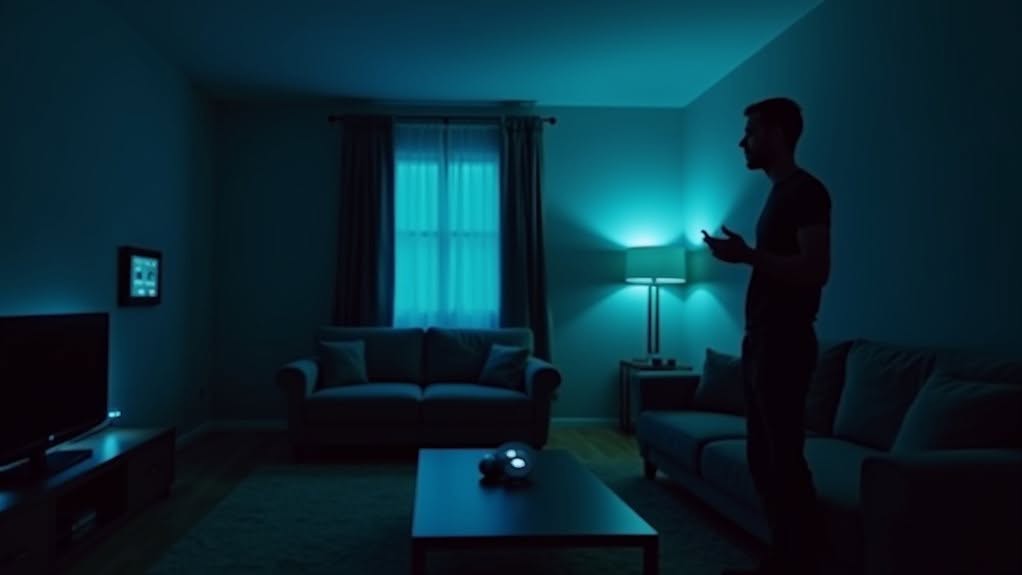
You can drastically reduce your home’s energy consumption with voice-controlled lighting systems that automatically adjust based on occupancy patterns.
When you enter or leave a room, these systems detect your presence and modify lighting levels accordingly, eliminating wasted energy in unoccupied spaces.
Daylight harvesting features further improve efficiency by analyzing natural light levels and adjusting artificial lighting in response, allowing you to maintain ideal brightness while minimizing unnecessary power usage. The integration of smart plugs with lighting systems enables precise control over connected devices, further reducing vampire power that accounts for up to 10% of household energy consumption. These systems commonly use LED bulbs that consume at least 75% less energy than traditional incandescent lighting.
Automated Occupancy Adjustments
Automated occupancy adjustments represent one of the most remarkable advancements in smart home lighting technology today.
These systems can reduce your lighting energy consumption by 30% to 50% by automatically controlling lights based on whether someone is present in a room.
When integrated with smart home systems, occupancy sensors work seamlessly with voice commands and smartphone controls to optimize lighting levels.
The technology relies on Passive Infrared (PIR), ultrasonic, or dual technology sensors to detect human presence and adjust accordingly. Modern smart homes increasingly favor PIR technology due to its 41% market share and cost-effectiveness compared to other sensor types. Industry forecasts predict the occupancy sensors market will reach approximately USD 7.5 billion by 2032 due to increasing smart home adoption.
- Your utility bills decrease considerably as lighting accounts for approximately 10% of your home’s total energy usage
- Your carbon footprint shrinks with every automated adjustment, contributing to environmental sustainability
- Your daily routine becomes more convenient as lights respond to your presence without manual intervention
Daylight Harvesting Systems
While smart lights respond to your voice commands, daylight harvesting systems work quietly in the background to maximize natural light usage throughout your home.
These systems use light sensors to detect available natural light and automatically adjust your artificial lighting accordingly. These adjustments aim to lower energy consumption and decrease carbon emissions from your home.
You’ll find two main sensor types in these systems: open-loop sensors that measure only natural light near windows, and closed-loop sensors that monitor both natural and artificial light to maintain consistent illumination levels.
With voice integration, you can set your preferred light levels and override automated settings as needed. “Dim the lights to 50%” works alongside the system’s natural light optimization.
These intelligent systems can reduce your lighting energy consumption by 20-60%, lowering utility bills while guaranteeing comfortable, consistent lighting throughout changing daylight conditions. Modern daylight harvesting systems can utilize networked wireless communication between sensors and controllers, making installation simpler and more flexible in your home.
Breaking Down Barriers: Accessibility Benefits of Voice Commands
Voice-controlled lighting systems revolutionize accessibility for elderly users who struggle with traditional switches and complex interfaces.
You’ll find that speaking commands eliminates the need to maneuver through dark rooms or reach difficult controls, providing independence for those with mobility limitations.
These systems serve as crucial tools for people with disabilities, offering hands-free operation that transforms daily routines and enables greater self-sufficiency in managing home environments.
Elder-Friendly Lighting Control
For elderly individuals with mobility challenges, voice commands offer a revolutionary approach to controlling home lighting systems.
These systems eliminate the need to physically reach light switches, greatly reducing fall risks in darkened environments.
Voice-controlled lighting provides essential safety benefits for seniors, as falls remain a leading cause of injury among older adults—claiming an elderly life every 19 minutes in the U.S.
By integrating with motion sensors, these systems can automatically adjust light levels based on time of day or activity.
- Maintain independence and dignity by managing your home environment without assistance
- Prevent dangerous nighttime navigation through darkened hallways or stairs
- Access emergency lighting instantly during health incidents or falls
The technology also supports cognitive health through reminders and routines, helping seniors maintain consistent lighting schedules that support their circadian rhythms.
Disability Access Revolution
Beyond convenience, voice-controlled lighting systems represent a transformative technology for individuals with disabilities.
These systems eliminate physical barriers by removing the need to manually operate switches, benefiting those with limited mobility or dexterity.
You’ll find that voice commands enable unprecedented independence in daily tasks. For wheelchair users and people with locomotor impairments, controlling lights through speech reduces reliance on caregivers and supports self-sufficiency.
Smart lighting systems offer customizable options that adapt to your specific needs. Speech speed, command complexity, and feedback can be adjusted to accommodate various disabilities, including speech and cognitive impairments.
The safety benefits are substantial too. You can immediately activate lights during emergencies, and some systems integrate with SOS notifications that can alert caregivers in crisis situations.
This technology creates both independence and security for users with disabilities.
Seamless Integration With Major Smart Home Ecosystems
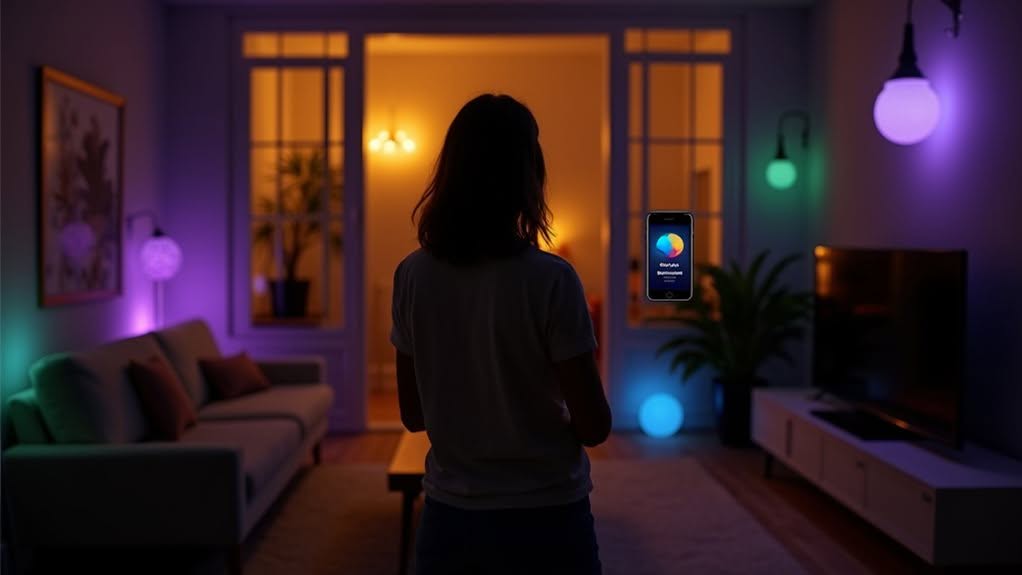
As smart home technology continues to evolve, major ecosystems have become the backbone of voice-controlled lighting systems. Your lighting can now seamlessly connect across platforms like Alexa, Google Assistant, and Siri, though integration challenges remain.
Alexa leads the pack, supporting over 100,000 smart home devices globally, while Google Assistant controls more than 50,000 different devices. Apple’s HomeKit offers fewer third-party options but provides deeper automation for Apple households.
- Feel the frustration fade away as lights respond instantly to your voice commands
- Experience the comfort of controlling your entire home’s lighting without leaving your couch
- Enjoy peace of mind knowing your system will grow with technology advancements
Despite the adoption of standards like Matter, interoperability between different platforms can still cause setup complexity.
When planning your smart lighting system, consider which ecosystem best matches your existing devices.
Beyond On/Off: Advanced Voice Commands for Lighting Scenes
Your smart lighting system can respond to your moods through voice commands that trigger pre-set scenes like “relaxing evening” or “energetic morning.”
You’ll enjoy dynamic color changes that gradually shift throughout the day, creating natural lighting patterns that match your circadian rhythm and activities.
Voice-triggered routines let you combine lighting alterations with other smart home actions, so a single command like “movie time” can dim the lights, close the blinds, and turn on your entertainment system.
Mood-Responsive Lighting Scenes
Modern smart lighting systems have evolved far beyond basic on/off functionality, now offering sophisticated scene control through simple voice commands. You can create personalized lighting scenes for activities like reading or movie watching and recall them instantly with a voice prompt.
Professional pre-made scenes integrate seamlessly with ecosystems like Philips Hue and Sonos, allowing you to transform your space with commands like “set party mode” or “activate focus lighting.” These systems process commands locally, guaranteeing privacy while delivering near-instant execution.
- Create immersive experiences by synchronizing your favorite music playlists with coordinated lighting scenes
- Customize every aspect of your environment with voice control over brightness, color temperature, and change speed
- Establish automatic mood changes that follow your daily routines while maintaining manual override options
Dynamic Color Transitions
Dynamic color changes represent the next frontier in voice-controlled smart lighting, moving far beyond basic commands to enable intricate, fluid lighting experiences.
With just your voice, you can trigger seamless shifts between hues or activate multi-zone color flows.
Modern RGB and RGBW technology allows your smart bulbs to produce millions of colors by varying the intensity of individual diodes.
When you request a “sunset fade” or “ocean wave,” these LEDs work together to create natural-looking shifts.
Multi-zone capabilities, found in products like the AuraScape™ light strips, let you customize different sections independently.
Each zone can display its own color, creating gradients or patterns throughout your space.
Your lighting can also synchronize with music or movies when activated by voice, responding to audio cues without requiring manual adjustment during your entertainment.
Voice-Triggered Routines
While standard on/off commands form the foundation of smart lighting control, voice-triggered routines elevate your system to new levels of sophistication and convenience.
These routines execute multiple lighting actions with a single phrase, transforming how you interact with your home.
You can create custom voice commands that activate pre-set scenes for specific activities or times of day. For instance, saying “movie time” could dim the living room lights, turn off kitchen lights, and add subtle accent lighting.
- Create morning routines that gradually increase brightness to wake you naturally without jarring alarms
- Set up voice-triggered security sequences when you’re away that simulate occupancy
- Establish evening wind-down scenes that automatically reduce blue light as bedtime approaches
Voice routines integrate seamlessly with other smart home devices, allowing thorough control of your entire ecosystem.
Privacy and Security Considerations in Voice-Activated Environments
As voice-activated smart home lighting systems become increasingly common in households, they introduce considerable privacy and security challenges that shouldn’t be overlooked.
Your smart devices may record background conversations without your knowledge, potentially capturing sensitive information. These recordings can sometimes be accessed by third parties, including contractors or law enforcement agencies.
Voice systems are vulnerable to hacking, voice spoofing, and malicious commands. A breach in one device can compromise your entire smart home network, potentially giving hackers control over physical aspects of your home.
To protect yourself, implement encryption and strong access controls. Keep your devices updated with the latest software, use robust passwords with two-factor authentication, and consider network segmentation.
You should also regularly delete previous recordings to maintain your privacy in an increasingly connected home environment.
Market Leaders Revolutionizing the Voice-First Lighting Experience
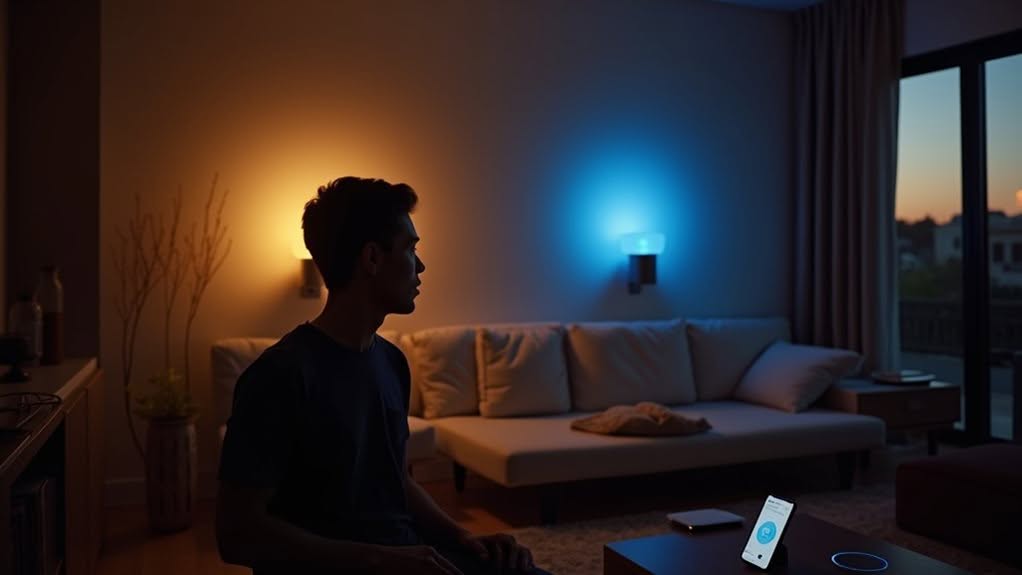
The smart lighting industry has undergone remarkable transformation since major players began integrating voice command capabilities into their product ecosystems. Lutron, Legrand, and Philips currently dominate the global market, building extensive IoT ecosystems that seamlessly integrate with voice assistants.
You’ll find the most innovative solutions coming from companies like Signify, whose upcoming Philips Hue AI assistant will let you create personalized lighting scenes through simple voice commands.
Meanwhile, Matter protocol adoption is breaking down compatibility barriers across 220+ million smart home devices.
- Experience lighting that adapts to your needs before you even realize what you want
- Control your entire home’s ambiance with just your voice, no apps or switches required
- Protect your health with circadian rhythm-based adjustments that respond naturally to your commands
From Luxury to Mainstream: The Democratization of Voice Control
Smart home voice control technology has undergone a remarkable shift from exclusive luxury to everyday necessity. The market is projected to surge from $15 billion in 2025 to over $50 billion by 2033, showing widespread adoption.
Affordable smart speakers have been instrumental in this democratization. With 93% of users reporting satisfaction, these devices are now fixtures in homes across America, with more than half placed in living rooms.
You’re part of a growing trend, as the number of U.S. voice assistant users will reach 153.5 million by 2025. Globally, voice assistants will exceed 8.4 billion by the end of 2024.
This integration with IoT devices is transforming daily habits, with up to 43% of voice-enabled device owners now using their devices for shopping.
Future Innovations: What’s Next for Voice-Controlled Lighting
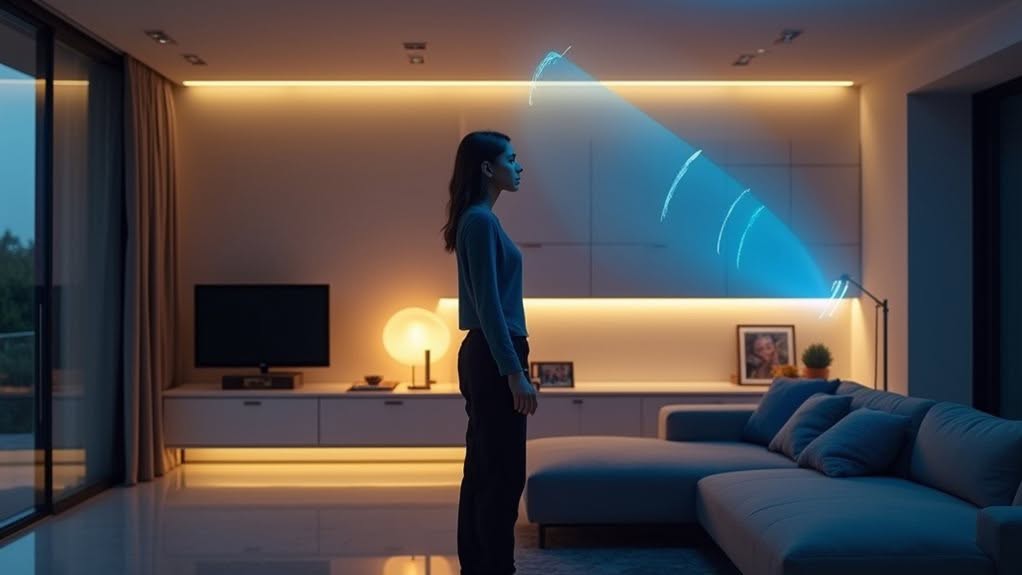
While voice-controlled lighting has already transformed how we interact with our homes, emerging innovations promise to make these systems even more intuitive and responsive. The Matter protocol will soon guarantee your devices work together seamlessly, regardless of brand or ecosystem.
AI-driven automation represents another notable advancement, as systems learn your preferences and adjust lighting automatically. You’ll notice your lights adapting to your daily routines without explicit commands.
Human-centric design focuses on aligning lighting with your circadian rhythms, supporting both your physical and emotional wellbeing.
- Improved voice recognition will distinguish between family members, applying personalized settings for each person.
- Adaptive color temperature will automatically shift from energizing morning light to relaxing evening ambiance.
- Gesture controls will complement voice commands, offering alternative ways to manage your lighting environment.
Frequently Asked Questions
How Much Do Voice-Activated Lighting Systems Cost to Install?
You’ll pay $300-$1,500 for DIY voice-activated lighting, or $800-$12,500+ for professional installation. Costs depend on your home size, component quality, and whether you’re installing basic bulbs or whole-home systems.
Can Voice-Controlled Lights Work During Internet Outages?
Yes, you can still use voice-controlled lights during internet outages if they use Bluetooth, Zigbee with a local hub, or have dual-connectivity features. However, most Wi-Fi-only smart bulbs won’t respond to voice commands offline.
Do Voice-Activated Lights Require Special Bulbs or Fixtures?
You’ll need smart bulbs or smart switches, not special fixtures. Your existing lamps and fixtures work fine with either Wi-Fi/Zigbee smart bulbs or with traditional bulbs controlled by smart switches.
How Accurate Are Voice Commands in Noisy Environments?
Voice commands can struggle in noisy environments, achieving 85-90% accuracy. You’ll experience better results with noise filtering techniques like LMS or ICA, and few-shot learning models that maintain around 94.5% accuracy despite background noise.
Can Multiple Users Set Different Voice Preferences for the Same Lights?
Yes, you can set different voice preferences for shared lights when you create individual voice profiles. You’ll need to use distinct commands or name lights differently to avoid conflicts between users’ preferences.
Final Thoughts
You’re witnessing a remarkable transformation in how we control our homes. Voice-activated lighting isn’t just convenient—it’s reshaping energy consumption, improving accessibility, and integrating seamlessly with existing smart systems. While privacy concerns remain valid, the technology continues to become more affordable and sophisticated. As innovation accelerates, expect your voice-controlled lighting experience to become more intuitive, personalized, and crucial to your daily routine.