To integrate smart home lighting and climate control, select devices that use compatible protocols like Wi-Fi, Zigbee, or Matter. Position your smart hub centrally and secure your network with WPA3 encryption. Create automated scenes that coordinate lights with your thermostat for energy savings of 10-15%. Implement occupancy sensors to adjust both systems when rooms are empty, and set up voice control for hands-free management. Strategic zoning and daylight harvesting further improve efficiency while creating comfortable living environments.
Choosing Compatible Smart Devices and Protocols
When integrating smart lighting into your home, selecting devices with compatible protocols forms the foundation of a seamlessly functioning system.
Your existing ecosystem—whether Apple HomeKit, Google Home, or Amazon Alexa—should guide your device selection.
Wi-Fi-enabled devices offer direct internet control without requiring a hub and work with most voice assistants. They’re ideal for homes with strong Wi-Fi coverage.
For more reliable networks, consider Zigbee or Z-Wave devices, which create robust mesh networks but typically require a compatible hub.
These protocols excel in larger homes where signal strength might otherwise be an issue.
Bluetooth devices, while often less expensive, generally offer limited range and fewer integration options.
The emerging Matter standard promises to improve cross-compatibility, making future expansions easier.
The Home Controls Wi-Fi Smart Home Kit supports multiple platforms including Amazon Alexa, Google Assistant, Apple HomeKit, and SmartThings for comprehensive integration options.
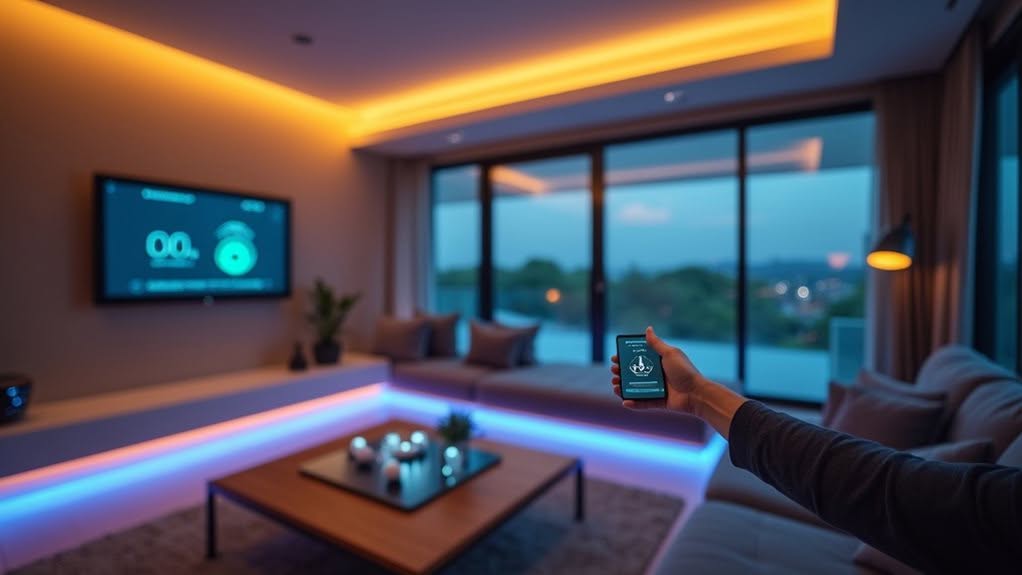
Smart climate control devices can be integrated with lighting systems for seamless experiences that enhance both comfort and energy efficiency in your smart home.
Smart home automation can transform your living space with centralized control of multiple household systems.
Setting Up Your Smart Home Hub and Network
After selecting compatible smart lighting devices, your next step involves establishing a reliable control center through proper hub setup and network configuration.
Position your smart home hub centrally in your home to guarantee optimal wireless coverage and reduce dead zones. Connect the power adapter to an outlet and, if available, use an Ethernet cable for a direct connection to your LAN. Consider using a dedicated smart hub for centralized management of all your connected devices.
Secure your Wi-Fi network with WPA2 or WPA3 encryption to protect device communications. For larger homes, consider adding Wi-Fi extenders or mesh systems to eliminate weak spots. Make sure to verify that your router has ports 11111, 9443, 443, and 39500 open for proper hub communication.
Download the manufacturer’s app to configure your hub, confirming it connects to the same network as your devices. Select hubs supporting multiple protocols like Zigbee, Z-Wave, or Thread for better reliability than Wi-Fi alone.
Maintain regular firmware updates and monitor network performance to keep your smart lighting system functioning seamlessly.
Syncing Lighting and Climate for Energy Efficiency
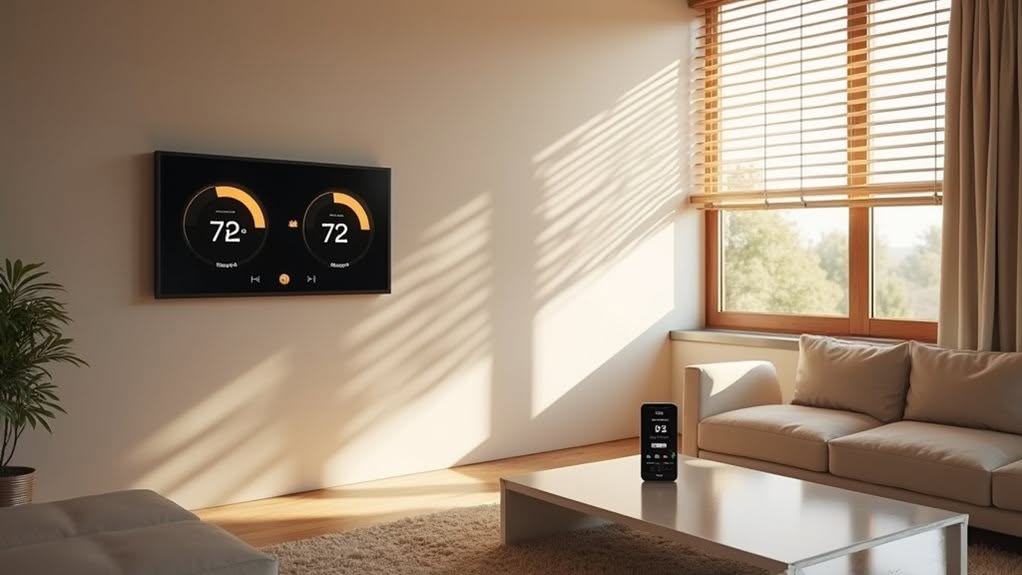
Syncing your smart lighting with climate control systems can dramatically reduce your home’s energy consumption while maintaining ideal comfort levels.
You’ll benefit from occupancy-based power management, which automatically adjusts lighting and temperature settings when rooms are empty, potentially cutting energy use by up to 50%.
Implementing smart thermostats that work alongside your lighting can achieve 10-15% savings on heating and cooling costs.
Daylight harvesting systems complement these savings by measuring natural light levels and dimming artificial lighting accordingly, creating a seamless balance between natural and electric light throughout the day.
Smart LED bulbs integrated with your system consume 90% less energy than traditional incandescent lighting while providing the same illumination quality.
Subheading Discussion Points
By integrating your smart lighting with climate control systems, you’ll create a powerful combination that greatly reduces energy consumption throughout your home. This synergy works through multiple coordinated approaches.
Smart window shades can automatically close during intense sunlight, reducing heat gain and lowering your cooling demands. When natural light is abundant, your artificial lighting system can dim accordingly, minimizing electricity usage for illumination. These systems can maintain optimal comfort while automatically adjusting based on occupancy and time of day.
Your thermostat can adjust cooling or heating setpoints based on solar gain data received from lighting sensors, improving overall HVAC efficiency. Professional integration of these systems into your smart home ecosystem offers seamless control of both temperature and lighting from a single interface. These integrated sensors continuously monitor ambient conditions, facilitating real-time adjustments to both systems simultaneously.
For maximum efficiency, consider zoning your home so lights and climate controls work together room by room, preventing energy waste in unoccupied areas. This targeted approach guarantees you’re only using energy where and when it’s needed.
Occupancy-Based Power Management
Occupancy-based power management represents the next evolution in smart home efficiency, building on the climate integration concepts we just explored. This approach uses sensors to detect when rooms are occupied, then automatically adjusts both lighting and HVAC systems accordingly.
You’ll achieve considerable energy savings by implementing this technology. Smart sensors can reduce operational energy by 22% in commercial settings, with residential applications showing 15-30% annual energy reductions. Your lighting consumption alone could drop by 20-60%. This technology maintains comfort while reducing energy use, as research shows proper implementation ensures indoor air quality remains within healthy ranges. Building management systems can be configured to optimize energy consumption during periods of low occupancy, similar to what’s being done in commercial settings.
The system works by keeping your home in a “resting” state when rooms are empty, then instantly adapting when occupancy is detected. For best results, install IoT-enabled sensors (motion, thermal, CO2) that communicate through compatible protocols like Wi-Fi, Zigbee, or Matter with your centralized control system.
Daylight Harvesting Systems
Natural daylight represents an often underutilized resource that can transform your home’s energy profile while improving comfort.
By installing photosensors that continuously monitor ambient light levels, your smart home can automatically adjust artificial lighting to maintain ideal illumination.
Modern daylight harvesting systems use dimmable LEDs that adjust seamlessly as natural light changes throughout the day.
You’ll need strategically placed sensors to guarantee balanced lighting across different areas of your rooms.
The real efficiency comes when you integrate these lighting controls with your HVAC system.
Your smart thermostat can use light sensor data to anticipate solar heat gain and adjust cooling or heating accordingly.
This coordination prevents overheating while maintaining comfortable light levels.
You can expect to reduce your lighting energy consumption by 20-60%, while also decreasing cooling loads and extending the life of your LED fixtures.
Programming Automated Scenes and Routines
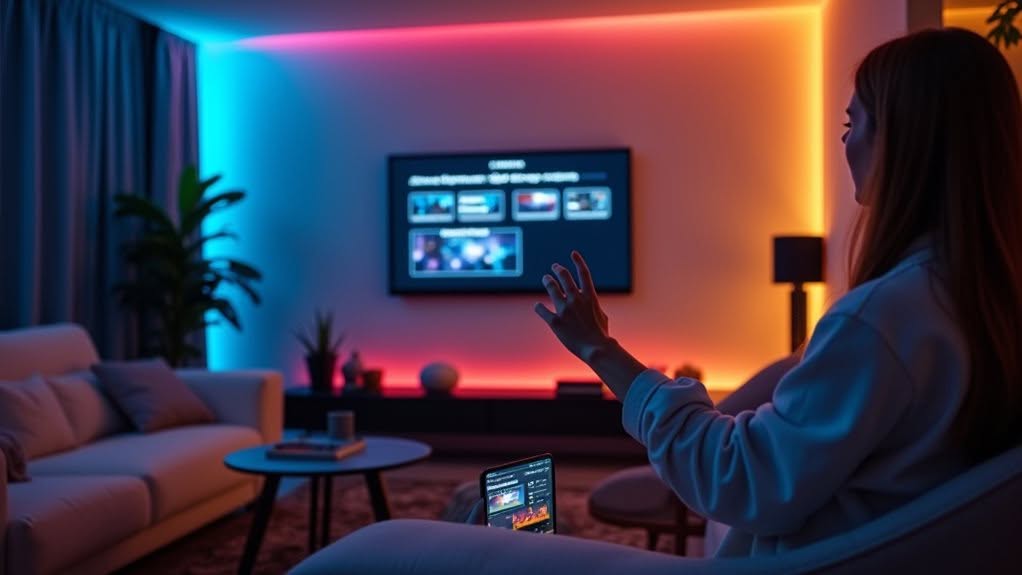
You can transform your daily routines with automated smart lighting scenes that include morning wake-up sequences that gradually brighten your bedroom as you awaken.
Setting up energy-saving vacation modes guarantees your home maintains security lighting while minimizing unnecessary power usage when you’re away.
Programming seasonal comfort settings allows your lighting to adjust automatically to changing daylight hours, coordinating with your climate control for peak comfort throughout the year.
Morning Wake-Up Sequences
While traditional alarm clocks startle you awake, smart home lighting systems offer a gentler alternative through programmable morning wake-up sequences. These sequences simulate a natural sunrise by gradually increasing brightness and shifting from warm to cool tones, supporting your circadian rhythms.
You can create a thorough routine by combining lighting with other smart devices. Program your thermostat to reach an ideal temperature before you rise, while your smart speaker begins playing energizing music at wake-up time.
For maximum effectiveness, use mobile apps like Routinery or iOS Shortcuts to build personalized routines with timed changes. Consider setting up conditional triggers based on your calendar events or sleep data for adaptive wake-ups.
Research shows these multi-sensory approaches reduce sleep inertia and morning stress compared to jarring alarms, improving overall alertness and comfort.
Energy-Saving Vacation Modes
When traveling away from home, smart lighting systems offer substantial energy savings through dedicated vacation modes that combine security benefits with efficiency.
These modes can be programmed through dedicated apps or dashboards with options for remote adjustments if your plans change.
Vacation lighting scenes use randomization algorithms to simulate occupancy without predictable patterns, deterring potential intruders while minimizing energy use.
According to ENERGY STAR requirements, proper “safety mode” lighting should consume less than 0.03kWh daily during vacations.
For maximum effectiveness, integrate your lighting with thermostat setbacks, which can shift by 9°F for heating and 5°F for cooling compared to normal occupied periods.
Smart plugs can further reduce “phantom” loads from idle electronics.
Always test your vacation routines before departing to verify proper device interoperability and confirm your desired energy and security outcomes.
Seasonal Comfort Settings
Seasonal comfort settings represent the intersection of smart lighting, HVAC systems, and automated controls working together to create ideal indoor environments year-round.
You can program customized scenes that combine warmer lighting tones with raised temperatures for winter evenings, or cooler hues with lower temperatures during summer afternoons. These scenes automatically trigger based on time, occupancy, or environmental conditions like sunset.
Integrating sensors improves this experience by enabling room-by-room temperature control based on actual usage patterns. Motion, temperature, and humidity sensors maintain best comfort levels without manual intervention.
Motorized window treatments complement these systems by adjusting automatically for sunlight exposure, reducing heat gain in summer and heat loss in winter.
This coordinated approach guarantees your home remains comfortable through seasonal changes while minimizing energy consumption.
Voice Control Integration for Seamless Management
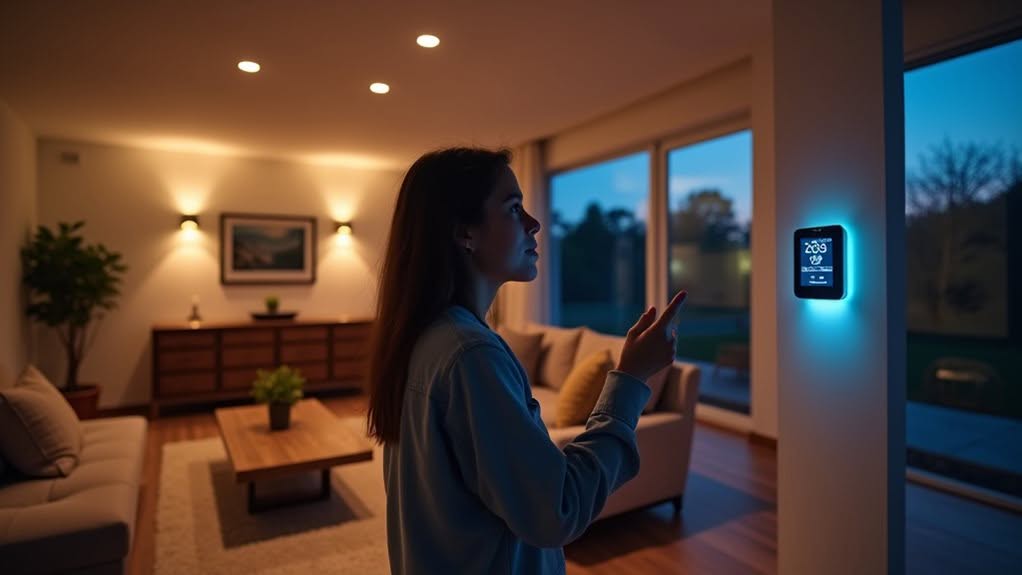
As smart homes continue to evolve, voice control has emerged as a cornerstone of intuitive home management. By integrating platforms like Alexa, Google Assistant, or Siri with your lighting and climate systems, you’ll gain hands-free control throughout your home.
Start by verifying compatibility between your devices and preferred voice assistant. Most platforms support device discovery and grouping, allowing you to control multiple fixtures with a single command.
Personalize your experience by creating custom routines and scenes. A simple “Goodnight” command can dim lights and lower your thermostat simultaneously.
For maximum flexibility, consider using voice control alongside traditional interfaces. While voice commands work well in quiet environments, having backup control methods guarantees reliability when noise levels increase or for guests unfamiliar with your system’s commands.
Leveraging Sensors for Occupancy-Based Adjustments
Intelligent sensors form the backbone of truly responsive smart lighting systems, automatically adjusting illumination based on human presence and movement patterns.
These devices can be strategically placed in areas without natural light to maximize energy efficiency while guaranteeing comfort and convenience.
When implementing occupancy-based lighting control, consider these key strategies:
- Position sensors with wide field of view capabilities in corners of rooms to eliminate blind spots and prevent false triggers.
- Integrate wireless sensors with your smart home system to control multiple devices simultaneously without additional wiring.
- Create custom scenarios that coordinate lighting with climate control adjustments based on occupancy data.
Remember that proper sensor placement is essential for system effectiveness.
Battery-powered options provide flexibility in installation locations, while regular maintenance secures peak performance.
User education about sensor functionality will help maximize the benefits of your automated system.
Advanced Zoning Strategies for Climate and Lighting
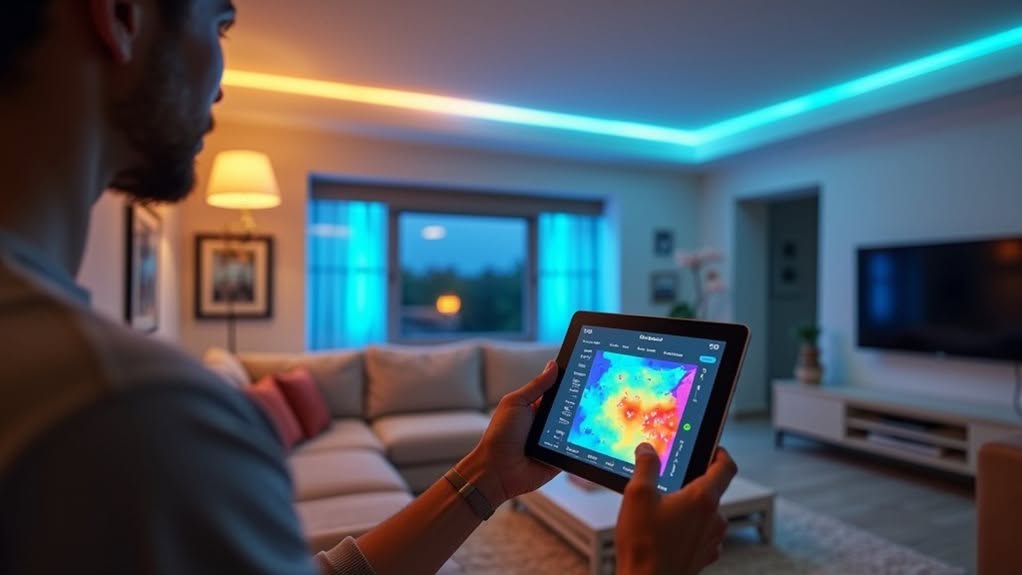
Strategic zoning represents the cornerstone of an integrated smart home environment, allowing you to create customized climate and lighting areas that respond to your specific needs.
By dividing your home into functional zones, you’ll reduce energy waste by up to 50% while maintaining peak comfort. Create lighting zones based on room function—task lighting for kitchens, ambient lighting for living areas, and softer illumination for bedrooms.
Climate zones should mirror your lifestyle patterns, addressing temperature variations between floors and sun-facing rooms. Consider setting up complex schedules that adjust automatically based on time of day, season, or occupancy.
For maximum efficiency, coordinate your HVAC and lighting zones to work together. This integration prevents short cycling, extends system lifespan, and maintains indoor humidity within the recommended 30-60% range.
Enhancing Wellness With Environmental Controls
While strategic zoning optimizes your home’s functionality, the right environmental controls can transform your living space into a wellness sanctuary.
Smart technology offers considerable health benefits that go beyond convenience.
Your smart home can actively improve your well-being in these key ways:
- Reduce stress levels through automated routine tasks, security monitoring, and personalized lighting that creates calming environments.
- Improve sleep quality with sunset-simulating lights, temperature regulation, and integrated sound machines that block disturbances.
- Support physical health by monitoring air quality, detecting harmful pollutants, and automatically activating purification systems when needed.
These wellness-focused controls create environments that respond to your needs.
Smart mattresses adjust firmness for better support, while air quality monitors protect respiratory health by eliminating pollutants that are often more concentrated indoors than outside.
Frequently Asked Questions
Can Smart Lighting and Climate Systems Work During Internet Outages?
Yes, many smart systems retain basic local functionality during internet outages. You’ll still have manual control, and devices with edge computing can run preset routines, though you’ll lose remote access and cloud-dependent features.
How Do I Troubleshoot When Devices Stop Responding to Automation Commands?
First check if one device or multiple devices are affected. Power cycle unresponsive devices, update firmware, and review automation rules for conflicts. If problems persist, verify your Wi-Fi signal strength and reset your smart home hub.
Are Professional Installers Necessary or Can DIY Installation Work Effectively?
DIY can work effectively for basic setups if you’re tech-savvy. However, professional installers offer seamless integration, proper wiring, and optimized performance for complex systems. Your choice depends on your technical skills and project scope.
How Vulnerable Are Integrated Systems to Hacking or Security Breaches?
Integrated systems are highly vulnerable to hacking. Your entire network can be compromised through a single weak device. You’ll need strong passwords, regular updates, network segmentation, and encryption to protect your connected home.
Will Older Homes Require Electrical Upgrades Before Installing Smart Systems?
Yes, you’ll likely need electrical upgrades for your older home. Insufficient panels (60-100 amps), outdated wiring, and limited circuits can’t safely support multiple smart devices that require 200-amp service and dedicated connections.
Final Thoughts
You’ve now learned how to create a fully integrated smart home environment that maximizes both comfort and energy usage. By connecting your lighting and climate systems through compatible protocols and thoughtful automation, you’ll enjoy a more efficient home that responds to your needs. Remember that regular updates and occasional system adjustments will guarantee your smart home continues to perform at its best as technology evolves and your preferences change.