
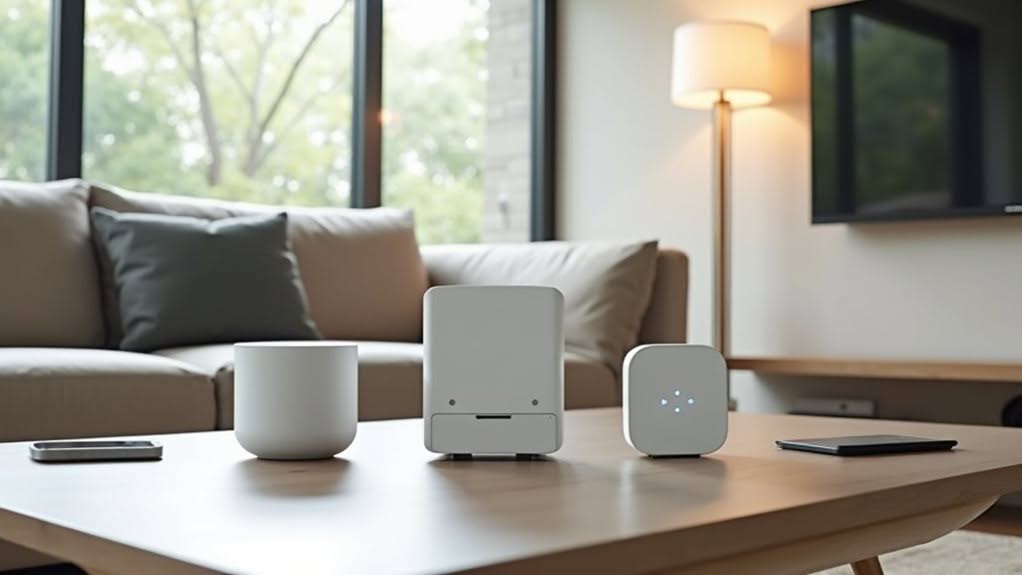
For beginners venturing into home automation, three standout hubs offer user-friendly experiences. The Aqara Hub M2 provides reliable connectivity for up to 128 Zigbee devices with local processing capabilities. Amazon’s Echo Hub combines a touchscreen interface with multi-standard support, controlling over 140,000 compatible devices. Apple’s HomePod Mini delivers seamless integration for iOS users at an accessible $99 price point. Each option balances simplicity with powerful features that will transform how you interact with your living space.
Aqara Hub Series: Smart Home Control Made Simple
The versatile Aqara Hub M2 stands at the center of an extensive smart home ecosystem, offering seamless integration with major platforms including Apple HomeKit, Google Assistant, and Amazon Alexa.
It supports up to 128 Aqara Zigbee 3.0 devices simultaneously, making it ideal for both small apartments and larger homes.
You’ll appreciate the wired Ethernet option that provides more stable connectivity than Wi-Fi alone. The included micro USB cable powers the hub with 5-volt support for reliable operation.
The hub’s 360° infrared controller transforms your traditional appliances into smart devices, letting you control TVs and air conditioners through voice commands or automations.
For improved reliability, the M2 processes automations locally, guaranteeing your smart home functions even during internet outages.
The Zigbee protocol utilized by the M2 provides energy efficiency for connected devices, extending battery life significantly compared to Wi-Fi alternatives.
The built-in speaker delivers customizable alerts and notifications, while robust encryption and two-factor authentication keep your smart home secure.
As a central control system, the Aqara Hub M2 enables complete automation of your home’s lighting, security, and climate devices from a single interface.
Amazon Echo: Budget-Friendly Voice Command Hub
While Aqara focuses on sophisticated Zigbee integration, Amazon’s Echo Hub takes a different approach by combining voice control and touchscreen management at a wallet-friendly price point.
The Echo Hub features an 8-inch touchscreen display and supports multiple connectivity standards including Wi-Fi, Zigbee, Matter, Thread, and Bluetooth.
You’ll appreciate its central dashboard for controlling over 140,000 compatible devices from various brands.
At $180, this hub offers notable value compared to pricier models like Echo Show 15 or Echo Studio.
The customizable widgets let you focus on frequently-used devices, while the multiview feature displays up to four camera feeds simultaneously.
The slim design makes it perfect for wall mounting, with integrated cable management that maintains a clean aesthetic in your home.
For beginners, setup is straightforward: power on, connect to Wi-Fi, and log into your Amazon account.
Your smart home devices automatically appear on the interface, ready for voice or touch control.
The hub comes with a complete installation kit including wall adapter, plugs, screws, and a helpful template to simplify the mounting process.
Apple Homepod Mini: Seamless Integration for Ios Users
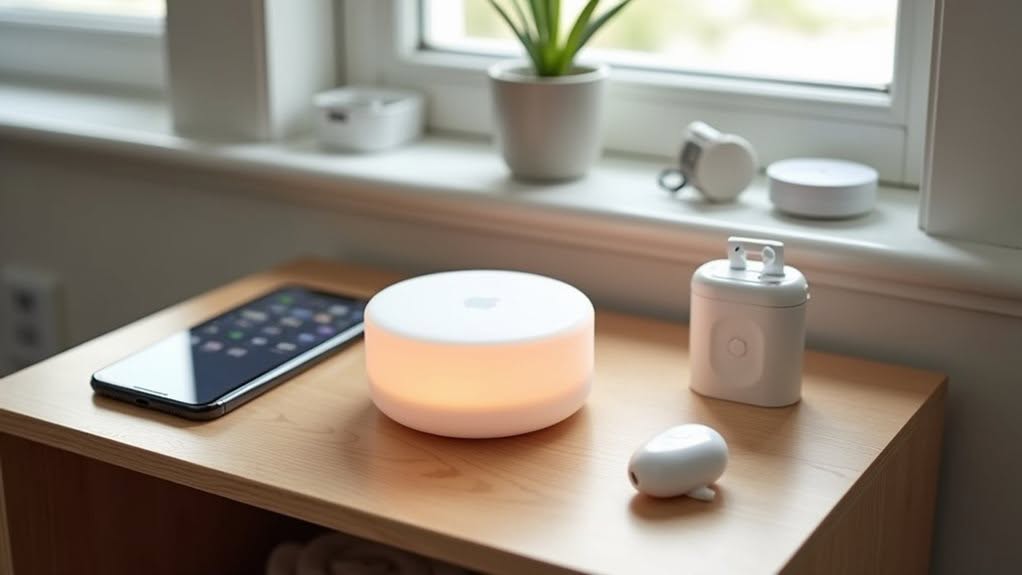
For Apple devotees seeking an affordable entry point to smart home management, the HomePod mini offers unparalleled ecosystem integration at just $99.
This compact 0.76-pound speaker comes in five attractive colors with a mesh fabric exterior designed for both aesthetics and acoustic performance.
The HomePod mini delivers impressive 360-degree sound through its custom waveguide and computational audio powered by Apple’s S5 chip.
You’ll appreciate how it automatically optimizes audio in real-time for your space.
Where the HomePod mini truly excels is in its iOS ecosystem integration.
The device syncs effortlessly with your Apple Home app, supports personalized voice recognition for up to six family members, and enables intercom messaging between devices. The HomePod mini includes advanced accessibility features like Touch Accommodations for users with specific needs.
Its four-microphone array guarantees your “Hey Siri” commands are heard clearly from across the room. The HomePod mini is significantly smaller than its predecessor, standing at just 3.3 inches in height.
Frequently Asked Questions
Can I Mix Devices From Different Brands With One Hub?
Yes, you can mix devices from different brands with one hub if it supports the necessary protocols like Zigbee, Z-Wave, or Matter. Multi-protocol hubs like Hubitat or SmartThings offer the broadest compatibility.
Do I Need Technical Skills to Set up Automation Routines?
You don’t need advanced technical skills for basic automation routines. Most beginner-friendly hubs offer intuitive interfaces where you’ll simply select triggers and actions through user-friendly apps without any programming knowledge required.
What Happens to My Smart Home if My Internet Goes Down?
Your smart home’s functionality depends on your hub type. Cloud-dependent devices will stop working remotely, while locally-processed systems will continue running automations. Basic functions like manual light switches will still work regardless.
How Do Hubs Handle Privacy and Data Security Concerns?
Hubs secure your data through encryption, local processing, and authentication features. You’ll find privacy-focused options that limit cloud dependency, offer transparent policies, and give you control over what’s collected and shared.
Can I Control My Hub and Devices When Away From Home?
Yes, you can control your hub and devices remotely through smartphone apps. With internet connectivity and cloud integration, you’ll manage everything from anywhere, receive real-time alerts, and even use voice commands while away from home.
Final Thoughts
You’ll find that smart home hubs like the Aqara Hub Series, Amazon Echo, and Apple HomePod Mini offer straightforward entry points into home automation. Each option provides distinct advantages based on your existing devices, budget, and technical comfort level.
Consider which features matter most to you—voice control, device compatibility, or ecosystem integration—before making your choice. Starting with any of these beginner-friendly hubs will help you build a connected home system that you can expand over time.


