

Home Assistant stands as the ultimate smart home hub in 2025 because you’ll maintain complete control over your data with its privacy-first, local processing approach. You won’t compromise on capabilities, as it delivers advanced voice AI, intuitive automations, and extensive energy management without cloud dependencies. Your smart home remains functional even offline, while supporting universal device compatibility through Matter standards and open-source flexibility. The platform’s AI-enhanced security features protect your home without exposing sensitive information to external servers.
Privacy-First Architecture: The Foundation of Modern Smart Homes
While many smart home systems prioritize connectivity over security, Home Assistant takes a fundamentally different approach by putting privacy at the center of its architecture.
This open-source platform runs entirely on local devices, minimizing data sent to external servers. You can review and modify the code yourself, guaranteeing complete transparency in how your information is handled.
When needed, you can completely isolate Home Assistant from the internet, preventing any unauthorized data transmission. This local control extends to device integration, allowing you to connect a wide range of smart home components without relying on cloud services.
You maintain full ownership of your data and can disable cloud integrations at any time. Home Assistant’s latest update allows users to enable or disable AI features based on personal privacy preferences. The platform can be integrated with smart security systems to create a comprehensive home protection solution. With its integration capabilities with the Raspberry Pi 5, Home Assistant provides advanced AI functionality without cloud reliance, enhancing both privacy and real-time responsiveness. This privacy-first approach reduces your attack surface and minimizes vulnerabilities associated with cloud-based systems.
Voice AI Evolution: Beyond Simple Commands to Genuine Conversations
Home Assistant’s voice capabilities have evolved dramatically beyond simple commands into genuine conversational experiences.
You can now interact naturally with your smart home through integration with advanced LLMs like OpenAI, Gemini, Claude, or locally hosted options like Ollama.
Simple requests are handled efficiently by Assist, while complex queries are seamlessly routed to your configured AI for intent-based processing.
This enables context-aware interactions where your assistant can ask follow-up questions and engage in multi-turn dialogues.
You can create multiple AI agents with different personalities and configurations, tailoring voice interactions to your specific needs.
The system supports local processing for privacy-conscious users, with capabilities to run fully offline on devices like Raspberry Pi 4.
New features like streaming text-to-speech and multiple wake word support make interactions more natural and responsive.
The revamped Text-to-Speech system has significantly improved response speed through streaming technology for more fluid conversations.
The latest update delivers word by word streaming of LLM responses, making voice interactions feel more engaging and human-like.
Automation Redefined: Intuitive Controls for the 2025 Lifestyle
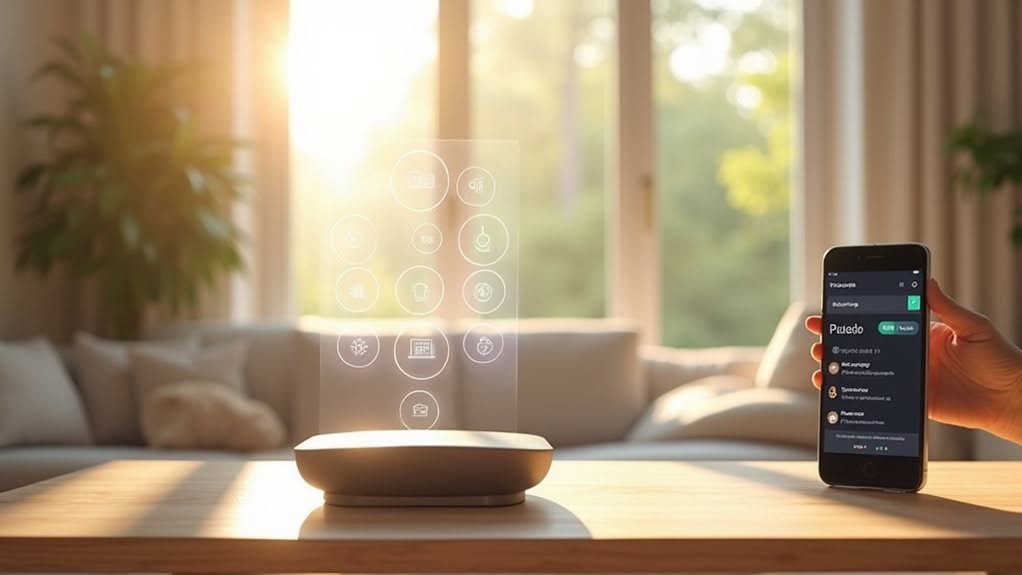
As smart homes evolve toward true intelligence, Home Assistant’s automation capabilities have undergone a complete transformation to match modern lifestyle needs.
You’ll find AI now autofills and suggests automation options during setup, markedly reducing complexity while supporting multiple language models like OpenAI and Claude.
The redesigned automation editor features undo/redo capabilities, a resizable sidebar, and copy/paste functionality for automation blocks.
Home Assistant’s contextual understanding of devices improves automation relevance through the new Device Database. This catalog of compatible devices enables collective intelligence and better recognition of your smart home ecosystem. The upcoming revamp focuses on making triggers and conditions more intuitive yet powerful for all users.
The latest update introduces the exciting ability to generate images through LLMs that can be displayed on dashboards for enhanced visual feedback.
Predictive analytics now power your dashboards, forecasting conditions and automating responses without your input.
Energy monitoring sensors and weather forecast integration further enable your home to proactively respond to changing conditions.
Security Without Compromise: AI-Enhanced Home Protection
You’ll rest easy knowing your home is protected by Home Assistant’s AI-enhanced security system, which processes all threat detection locally on your hub rather than in the cloud.
The system analyzes live footage through cameras and sensors, identifying unusual patterns and triggering automated responses like lights, alarms, or lockdowns when potential threats are detected. Real-time interpretations provide instant actionable insights to ensure comprehensive protection of your property. With the new OpenRouter integration, you can harness over 400 AI models to create sophisticated security analyses customized to your specific needs.
Your security setup becomes more intelligent over time as machine learning recognizes your household patterns, reducing false alarms while maintaining vigilance against genuine threats without compromising your privacy.
Security Without Compromise: AI-Enhanced Home Protection
When security meets artificial intelligence, your home protection capabilities expand dramatically while keeping privacy intact.
Home Assistant’s AI models analyze live feeds to instantly detect anomalies like unauthorized entry without sending data outside your network.
You’ll experience fewer false alarms as image recognition distinguishes between residents and strangers. AI Tasks automate real-time responses, such as locking doors when threats are detected. The new AI Task feature even lets you generate cartoon images of visitors at your doorbell for friendly notifications.
The system respects your privacy by processing AI features locally on your Home Assistant hardware. You maintain full control over which AI features are enabled and where they operate.
Multi-modal interfaces allow security management through voice commands with improved authentication. The system can even predict potential security risks by analyzing patterns from multiple sensors and historical data. Recent updates introduce a comprehensive home dashboard view that centralizes all security metrics alongside climate and lighting controls for better situational awareness.
Local Intelligence, Global Protection
Home Assistant’s approach to security combines powerful local intelligence with global protection capabilities, giving you extensive safeguards without sacrificing privacy.
The 2025.8 update enables local analysis of camera footage without relying on cloud services, guaranteeing your data stays within your home. You can customize text or data outputs for personalized security notifications that don’t compromise your information.
ESPHome voice assistants now support multiple wake words while keeping processing local, reducing external vulnerabilities.
The rebuilt Home Dashboard improves situational awareness with context-based suggestions, supporting proactive security management.
When needed, OpenRouter integration provides access to over 400 cloud-based LLM models, letting you balance local processing with advanced AI capabilities.
This flexibility assures you maintain control over your data while leveraging cutting-edge security features.
Predictive Threat Neutralization
Beyond local processing, the Predictive Threat Neutralization framework represents the next frontier in smart home security. This system combines real-time monitoring with advanced pattern recognition to identify potential threats before they materialize.
Your smart home continuously analyzes device behavior, network traffic, and user interactions, flagging anomalies that deviate from established baselines. The system’s sensor fusion capability merges data from cameras, motion sensors, and smart locks to reduce false positives while providing thorough protection.
When threats emerge, autonomous response systems spring into action. Compromised devices are automatically isolated from your network, preventing attackers from gaining deeper access. Dynamic access controls adjust permissions in real time based on threat levels.
You’ll receive instant notifications about suspicious activities, allowing for quick intervention with markedly reduced response times compared to traditional security systems.
Energy Optimization: Smart Consumption for a Sustainable Future
With Home Assistant’s advanced energy monitoring capabilities, you’ll gain instant visibility into your home’s electricity, gas, and water consumption through precise real-time metrics.
The integrated Energy Dashboard combines data from Matter-compatible energy meters, smart plugs, and specialized sensors to help you identify wasteful usage patterns and high-consumption appliances.
You can then leverage EMHASS automation to schedule energy-intensive tasks during off-peak hours or peak solar production, automatically controlling everything from EV charging to hot water systems for maximum efficiency and cost savings.
Real-Time Usage Insights
As modern homes become increasingly connected, real-time usage insights serve as the cornerstone of effective energy management within the Home Assistant ecosystem.
With the 2025.9 update, you’ll gain unprecedented visibility into your energy consumption, tracking usage down to 0.001 kWh with compatible devices like the Tapo Smart Plug P110M.
The thorough Energy Dashboard consolidates electricity, gas, and water monitoring in one unified interface.
You can now analyze six detailed parameters including Apparent Current and RMS Voltage, helping you identify energy-intensive appliances with precision.
Time-of-use pricing integration lets you optimize consumption during lower-rate periods.
Local-only monitoring through clamp meters, pulse meters, and P1 smart meters guarantees your data remains private while providing actionable insights that help reduce standby power waste and unnecessary consumption.
Automated Energy Saving
Home Assistant’s revolutionary approach to automated energy saving transforms how you manage power consumption throughout your entire home.
The system integrates with Matter energy-meter clusters to collect precise data, measuring consumption down to 0.001 kWh with compatible devices like the Tapo Smart Plug P110M.
The EMHASS integration creates optimization plans that consider solar production, usage patterns, and cost variables. This allows you to automate EV chargers, batteries, and pool pumps to minimize grid reliance based on your priorities.
You can choose between self-consumption or cost minimization objectives, adapting the system to your specific needs.
Even without full smart equipment, you’ll benefit from optimizing controllable loads.
The platform’s weekday-specific triggers enable customized routines that align with your household’s actual energy usage patterns throughout the week.
Universal Compatibility: Breaking Down Ecosystem Barriers
While many smart home platforms lock users into their specific ecosystems, Home Assistant stands out by deliberately breaking down these barriers. Its open-source foundation allows for extensive device compatibility across manufacturers and technologies.
Home Assistant supports Matter, a standard designed to improve interoperability between different smart home platforms. You’ll find integration options for major voice assistants like Alexa and Google Assistant, bridging gaps between competing systems.
The “Works with Home Assistant” certification helps you identify reliable devices, while community contributions continuously expand compatibility. Popular options include Aquara and Sonoff devices, which integrate seamlessly without additional configuration.
Whether you’re using Zigbee, Bluetooth, or proprietary protocols, Home Assistant’s multi-standard support guarantees your devices work together regardless of their original ecosystem.
This universal approach gives you unprecedented freedom in building your smart home.
Local Intelligence: Freedom From Cloud Dependency
Unlike cloud-dependent smart home systems, Home Assistant prioritizes local intelligence that keeps your data and processing on your own hardware. This approach fundamentally changes how your smart home operates, guaranteeing functionality even when your internet connection fails.
The 2025 updates include native AI and voice control capabilities that run entirely on your local devices. Your commands are processed immediately without leaving your home network, offering cloud-like responsiveness with superior privacy protection.
Home Assistant stores all device states, automations, and AI model outputs locally. This local storage strategy, combined with the new Device Database, eliminates reliance on external servers for everyday operations.
The security benefits are substantial—by reducing data transmission to cloud providers, you dramatically decrease potential attack vectors while maintaining complete control over your smart home environment.
Frequently Asked Questions
Can Home Assistant Run Effectively on Older Hardware?
Yes, you can run Home Assistant effectively on older hardware with at least 2GB RAM like Raspberry Pi 3B, Odroid-N2, or repurposed laptops, though you’ll face limitations with extensive add-ons or integrations.
How Steep Is the Learning Curve for Complete Beginners?
You’ll face a steep learning curve initially, but don’t worry – start with simple projects and use community resources. With patience and practice, you’ll gradually master Home Assistant’s powerful capabilities.
What Happens to Automations During Internet Outages?
Your local automations keep running during internet outages. Time-based triggers work, and devices using local protocols (Zigbee, Z-Wave, ESPHome) stay functional. Only cloud-dependent integrations and remote access stop working.
How Does Home Assistant Handle Multi-User Household Preferences?
Home Assistant gives each household member their own profile with personalized device settings, automations, and notifications. You’ll enjoy customized preferences for lighting, temperature, media, and voice recognition—all managed with individual access permissions.
Are There Subscription Costs for Any Core Features?
No, all core Home Assistant features are completely free. You’ll only pay if you choose Nabu Casa ($6.50/month), which adds convenience for remote access and voice assistant integrations.
Final Thoughts
By choosing Home Assistant as your smart home hub in 2025, you’re investing in a future where technology serves your needs without compromising your privacy. The platform’s commitment to local processing, universal compatibility, and intuitive controls puts you in charge of your digital environment. With improved security features and energy optimization capabilities, Home Assistant transforms your house into a truly intelligent home that anticipates your needs while respecting your boundaries.


