
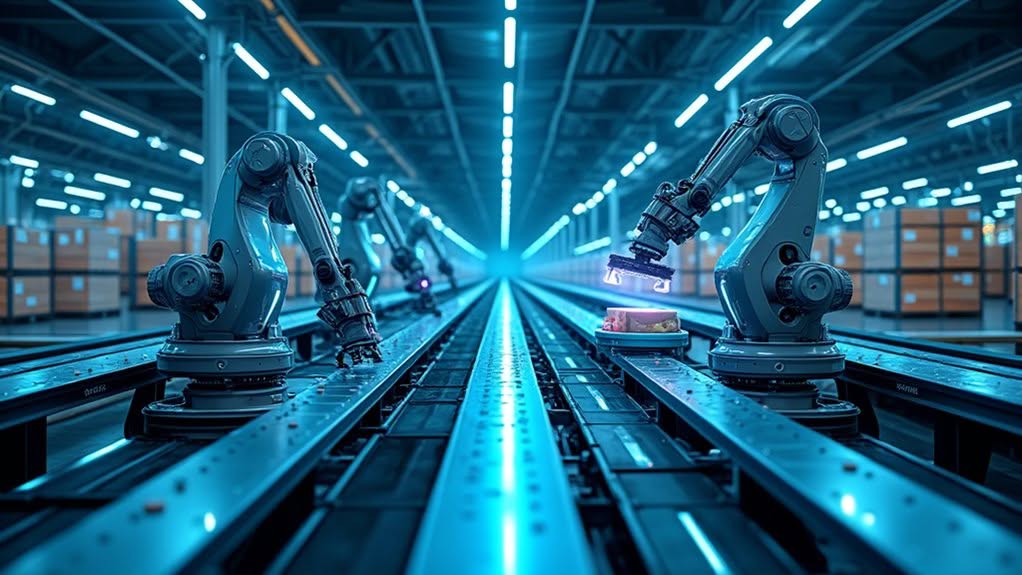
The automation revolution is transforming industries with noteworthy market growth projected to reach $590.9 billion by 2035. You’ll find AI integration, IoT connectivity, and robotics leading technological advancements across key sectors. Assembly line automation currently dominates, while warehouse automation will approach $30 billion by 2025. North America leads in market share, though Asia Pacific shows the fastest growth rate. Industries like automotive, food and beverage, and pharmaceuticals are embracing automation to boost efficiency and meet regulatory standards. The detailed breakdown reveals compelling investment opportunities ahead.

As global industries rush to adopt automation technologies, the market is experiencing unprecedented growth that’s reshaping manufacturing, logistics, and countless other sectors. Projections indicate the global industrial automation market will surge from $228.9 billion in 2024 to a staggering $590.9 billion by 2035, representing a 9% compound annual growth rate.
The automation revolution is here—transforming industries and rocketing market values toward $590.9 billion by 2035.
You’ll find that this expansion is primarily driven by the increasing demand for operational efficiency across industries. Companies are investing heavily in automation solutions to streamline processes, reduce costs, and improve productivity in competitive markets. The increasing necessity for high-quality products that meet regulatory standards is further accelerating this market growth.
Technological advancements are accelerating this transformation. AI integration, IoT connectivity, and robotics are becoming standard features in modern automation systems, offering unprecedented control and optimization capabilities for your operations. The integration of collaborative robots (cobots) is particularly transforming workplaces by enabling safer human-machine interactions in shared spaces.
Assembly line automation currently holds the largest market share, especially in automotive and electronics manufacturing. Material handling automation follows closely behind, with robotic arms, automated guided vehicles, and conveyor systems gaining rapid adoption across warehousing and distribution centers.
Regional disparities in adoption are notable. While North America currently leads in market share due to advanced technology integration and substantial government investment, the Asia Pacific region is projected to grow at the highest rate through 2035. This region already accounts for over 39% of global industrial automation revenue as of 2024.
The automotive sector continues to lead in automation adoption, implementing sophisticated systems for manufacturing and assembly processes. Food and beverage, pharmaceutical, and electronics industries are also rapidly increasing their automation investments to guarantee quality, consistency, and regulatory compliance.
Looking ahead to 2025, you’ll see the warehouse automation market reach approximately $29.91 billion, while building automation systems are projected to hit $101.74 billion. The process automation market, though smaller at $1 billion, demonstrates considerable growth potential.
As these technologies become more accessible and cost-effective, even smaller operations can leverage automation to compete in increasingly efficiency-driven markets.


