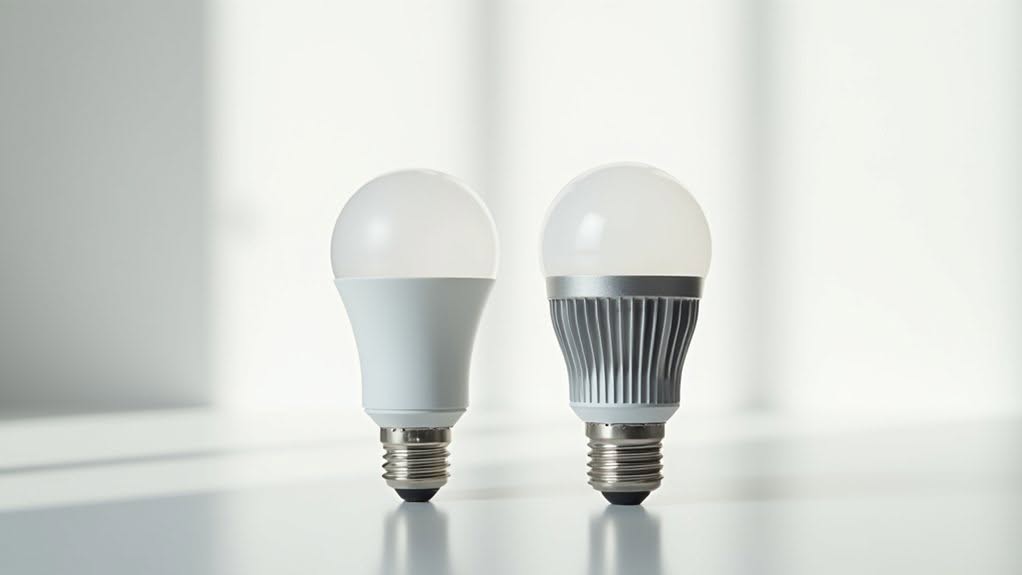
IKEA TRÅDFRI offers better value than Philips Hue for most homeowners, costing 60% less while delivering fundamental smart lighting features. You’ll pay $15 for TRÅDFRI white bulbs versus $30 for Hue equivalents, with an 18-bulb whole-home setup costing $250 compared to Hue’s $800+. Both systems provide reliable dimming, scheduling, and voice control, though Hue offers premium features like 16 million colors and superior app responsiveness. A detailed comparison reveals which system matches your specific needs and budget.
IKEA TRÅDFRI vs Philips Hue: Price Breakdown
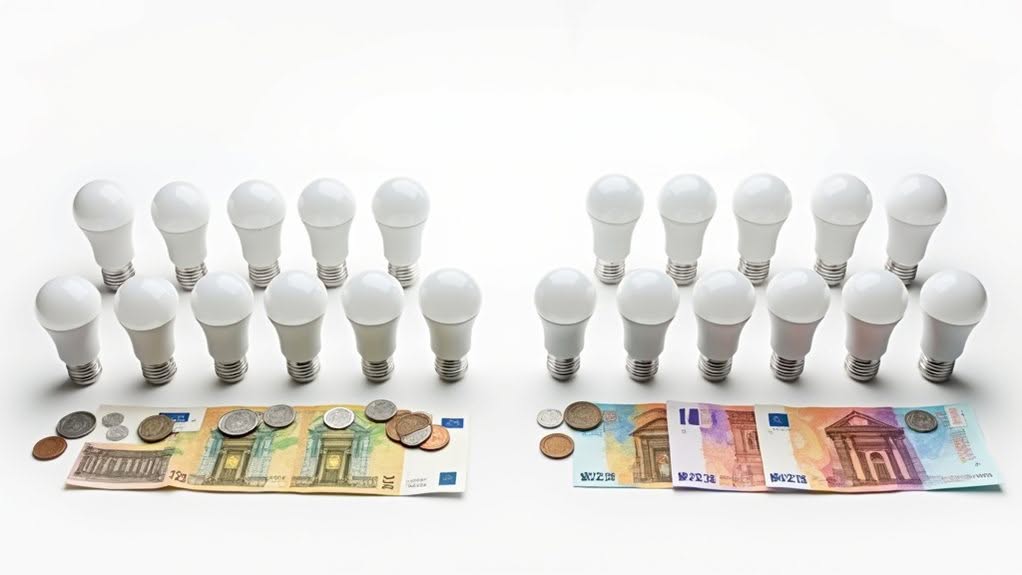
The most notable difference between IKEA TRÅDFRI and Philips Hue lies in their pricing structures, where IKEA consistently offers bulbs and accessories at roughly half the cost of Philips equivalents.
IKEA’s basic white dimmable bulbs cost $15, while Philips Hue white bulbs start at $30.
Color smart bulbs show similar patterns, with IKEA ranging from $25 to $50 compared to Philips Hue’s $45-$50 for standard color options.
Accessories reinforce this price gap markedly.
IKEA’s TRÅDFRI smart plug costs $20, while Philips Hue’s equivalent reaches $64.95.
Whole-home setups demonstrate the most dramatic differences.
You’ll spend approximately $250 for an 18-bulb IKEA system with sensors and remotes, while Philips Hue’s flagship whole-home setup exceeds $800. A complete IKEA starter kit typically costs under $50, making it significantly more accessible for budget-conscious consumers. Philips Hue’s premium technology and extensive ecosystem breadth justify its higher price point for users seeking advanced features.
Features That Actually Matter in Smart Lighting
When comparing smart lighting systems, you’ll need to distinguish between basic functions and premium features that justify higher costs. Core functionality includes reliable dimming, scheduling capabilities, and smartphone app control that works consistently across your home’s Wi-Fi network.
Advanced automation features like motion sensor integration, voice assistant compatibility, and complex lighting scenes separate budget options from professional-grade systems. Systems with daylight harvesting capabilities automatically adjust artificial lighting based on natural light levels, reducing energy consumption throughout the day.
Smart lighting systems utilize various wireless communication protocols including Wi-Fi, Bluetooth, Zigbee, and Z-Wave to connect devices across your home network for seamless control and automation.
Core Functionality Essentials
How do these smart lighting systems perform where it matters most for everyday use? Both IKEA TRÅDFRI and Philips Hue deliver fundamental smart lighting functions, but their capabilities differ markedly in practical applications.
IKEA TRÅDFRI provides straightforward control with basic diming, limited color options, and simple grouping features. You’ll get reliable on/off functionality and three white temperature settings through their app or physical remotes. The system offers an offline gateway that enhances security by operating without internet access.
Philips Hue offers extensive control with 16 million colors, tunable white temperatures, and advanced scene customization. Their app enables room-based grouping, photo-based scene creation, and detailed brightness adjustments. A single Hue bridge can support up to 50 connected devices, providing substantial scalability for larger homes. For dedicated entertainment spaces, both systems can create immersive theater lighting experiences that enhance your home viewing environment.
- Basic dimming and on/off control work reliably on both systems
- Voice assistant integration requires hub connection for either brand
- Remote access needs internet connectivity through respective hubs
- App responsiveness varies, with Philips offering more responsive performance
- Motion sensor automation functions effectively with both platforms
Advanced Automation Needs
Beyond basic lighting control, sophisticated automation separates truly smart systems from simple remote-controlled bulbs.
Philips Hue excels in complex scene creation, allowing you to combine lights with thermostats and blinds through single-button activation.
The system supports up to 50 devices per bridge, enabling complete whole-home automation.
IKEA Trådfri offers core automation features like Away from Home timers and multi-light scene control through physical buttons.
However, it lacks Hue’s deeper integration capabilities with third-party devices like Lutron blinds and Netatmo thermostats.
Hue’s app provides extensive customization options, including photo-based scene creation and usage pattern routines. The system also offers remote access through web platforms and Apple Watch applications.
Trådfri focuses on fundamental functions without advanced tweaking capabilities. The system maintains reliable performance weeks after installation with straightforward app-based setup and pairing instructions.
For users requiring sophisticated multi-device coordination, Hue delivers superior automation depth despite higher costs.
Which Smart Lighting System Fits Your Home?
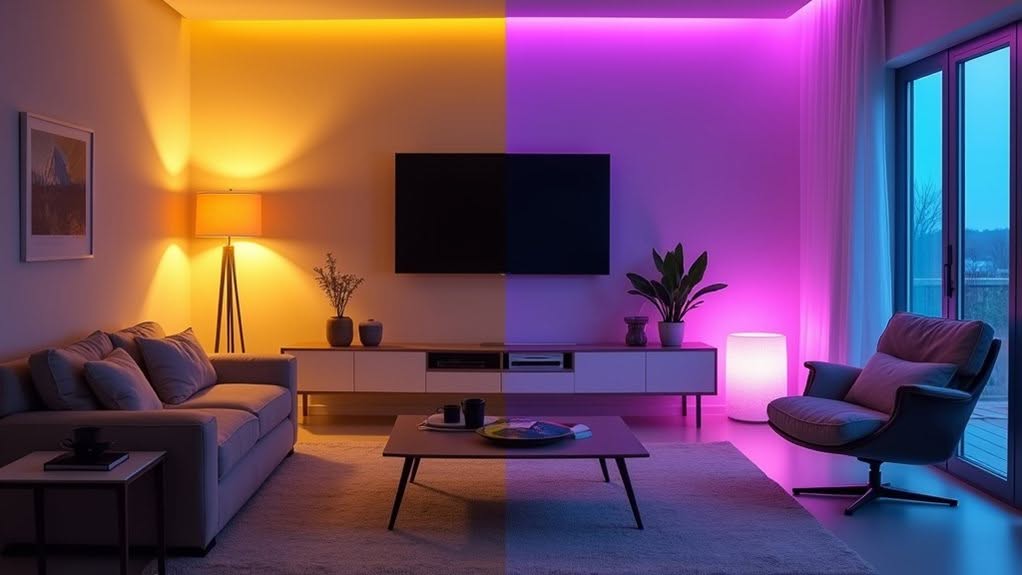
Which smart lighting system aligns with your specific home requirements? Your decision depends on balancing features, budget, and long-term expansion plans.
IKEA Trådfri suits budget-conscious households seeking basic automation with superior brightness output. The system produces 980-1000 lumens compared to Hue’s 806-800 lumens, and costs considerably less for whole-home installations.
Philips Hue targets users prioritizing versatility and seamless integration. The extensive product lineup includes specialized fixtures like lightstrips and decorative bulbs that Trådfri can’t match. However, Hue excels in low-level dimming scenarios, offering significantly finer brightness control at minimal settings compared to Trådfri’s more limited range.
Consider these key factors when choosing:
- Budget: Trådfri costs nearly half of equivalent Hue setups
- Brightness needs: Trådfri delivers 20% more maximum output
- Product variety: Hue offers considerably more specialized lighting options
- Setup complexity: Hue provides simpler bulb addition without distance requirements
- Future compatibility: Both support Matter for universal smart home integration
For budget-conscious buyers, the Hue Essential series launched in September 2025 bridges the gap between premium flagship models and IKEA’s affordable options.
IKEA TRÅDFRI vs Philips Hue App and Control Experience
Where these smart lighting systems diverge most dramatically is in their app interfaces and control capabilities. Philips Hue delivers a polished, intuitive interface with advanced features like complex lighting scenes, entertainment sync, and conditional automations.
The Hue app syncs lights with movies and music, creates scenes from saved photos, and offers geofencing rules for automatic location-based control. You’ll experience seamless performance with no reported delays, plus broad compatibility with Apple Home, Alexa, and Google voice control.
IKEA TRÅDFRI focuses on simplicity, handling basic functions like on/off, diming, and color changes through an appealingly straightforward design. However, you’ll encounter slower connection delays and limited remote access options.
TRÅDFRI restricts control to its own app without the gateway, while Hue supports third-party apps and multiple platform integrations for extensive smart home control.
Smart Home Integration: Hue vs TRÅDFRI Compatibility
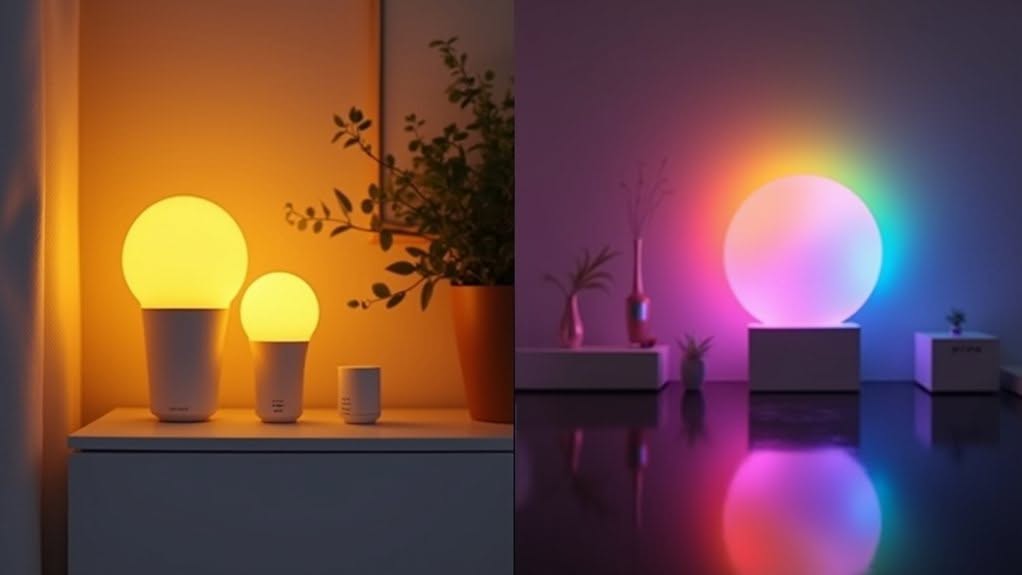
How well these smart lighting systems connect with your existing smart home setup depends largely on their hub requirements and protocol support.
Both systems use Zigbee protocol and connect with major voice assistants including Apple HomeKit, Google Assistant, and Amazon Alexa. However, their integration capabilities differ markedly in depth and reliability.
- IKEA TRÅDFRI requires DIRIGERA or TRÅDFRI gateway for full smart home features
- Philips Hue mandates Hue Bridge for complete functionality and remote access
- Newer Hue bulbs support Bluetooth for up to 10 lights without bridge
- IKEA’s newer products use Matter over Thread, eliminating hub requirements
- Hue’s “Friends of Hue” program enables wider third-party app compatibility
Philips Hue offers deeper third-party integration with platforms like Lutron blinds and Netatmo thermostats.
TRÅDFRI faces more challenges pairing with non-IKEA platforms but benefits from native Matter support.
Build Quality and Performance Testing Results
The materials and construction methods used in these smart lighting systems reveal considerable differences in their intended market positioning and longevity expectations. Philips Hue products utilize heavy-duty materials and best-in-class LEDs engineered for long-term, stable performance.
In contrast, IKEA TRÅDFRI products employ cost-effective materials suitable for daily control but without the same longevity expectations.
You’ll notice Hue bulbs demonstrate substantially more substantial build quality feel compared to TRÅDFRI counterparts. TRÅDFRI construction prioritizes affordability and accessibility over premium durability standards.
Regarding brightness output, TRÅDFRI bulbs produce 980 lumens while Philips Hue White Ambiance bulbs output 800 lumens at standard settings. However, both brands offer identical 2-year warranty coverage on products.
IKEA TRÅDFRI vs Philips Hue for Different Budgets
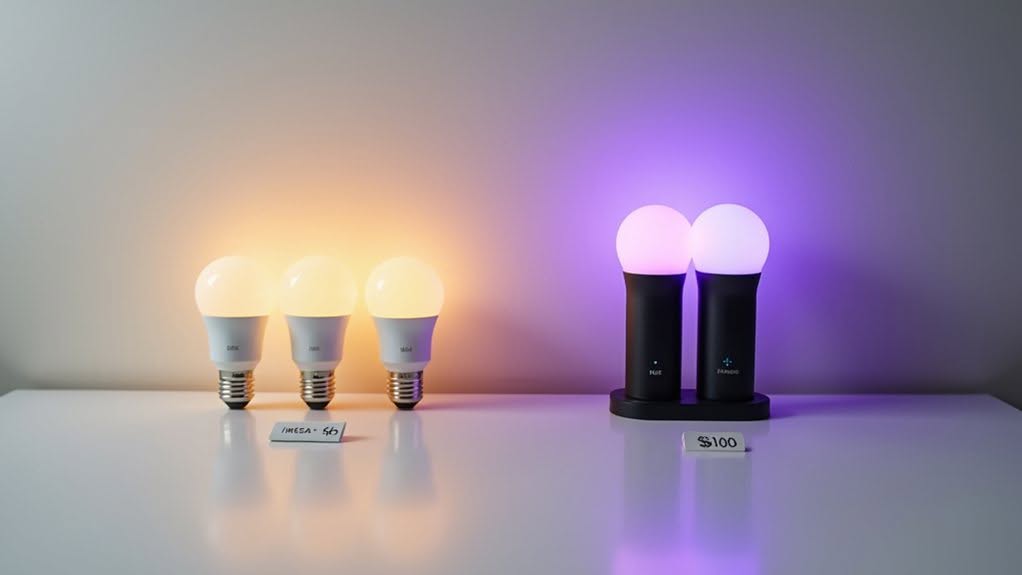
Budget constraints greatly influence which smart lighting system delivers better value for your specific needs. IKEA TRÅDFRI consistently costs 60% less than Philips Hue equivalents, with filament bulbs priced at $9.99 versus $24.99.
Your budget determines the most suitable approach:
- Low Budget ($250): IKEA TRÅDFRI provides whole-home coverage with 18 bulbs, motion sensors, and remotes
- Medium Budget ($400): Mix IKEA basics with Hue fundamental upgrades, controllable via Matter integration
- High Budget ($800+): Philips Hue flagship line offers premium features but costs 2-3 times more
- Starter Systems: IKEA gateway setups remain accessible while Hue bridge kits range $100-$200
- Expansion Strategy: TRÅDFRI bulbs pair with Hue gateways for cost savings without sacrificing core functionality
IKEA fulfills most lighting needs affordably, while Hue provides improved customization at premium prices.
Best Value Smart Lighting System for Most People
You need to balance your budget constraints against fundamental smart lighting features when choosing between IKEA TRÅDFRI and Philips Hue systems.
Your decision should prioritize the specific functionality you’ll actually use, rather than paying for premium features that remain unused in daily operation.
Consider how your initial investment will perform over several years, including potential expansion costs and compatibility with future smart home additions.
Budget-Conscious Buyer Priorities
Most homeowners seeking smart lighting functionality will find IKEA’s TRÅDFRI system delivers the best overall value proposition in today’s market. Budget-conscious buyers can achieve extensive smart lighting coverage without the premium price tag associated with flagship alternatives.
Your priorities as a cost-focused consumer align perfectly with TRÅDFRI’s strengths:
- Immediate affordability – Basic dimmable bulbs start at $15 versus $30+ competitors
- Scalable investment – Purchase components gradually without upfront system costs
- Whole-home accessibility – Complete 18-bulb setup achievable under $250
- Future-proof compatibility – Matter support prevents expensive replacements when upgrading
- Essential functionality – Voice assistant integration and reliable performance included
TRÅDFRI’s 250-lumen output and decent build quality satisfy standard residential lighting needs.
You’ll sacrifice some color accuracy and premium features, but gain substantial cost savings without compromising core smart lighting benefits.
Essential Feature Requirements
Which features truly matter when selecting a smart lighting system that delivers genuine value for everyday use? Voice control through Amazon Alexa or Google Assistant represents the most practical daily feature, allowing hands-free brightness and color adjustments.
Smartphone app control provides fundamental remote access, enabling you to adjust lights from anywhere in your home. Scheduling functionality automates daily routines, turning lights on and off without manual intervention.
Dimming capability reduces energy consumption markedly while creating appropriate lighting for different activities. Motion sensor compatibility adds convenience by automatically activating lights when you enter rooms.
Reliable connectivity proves vital for consistent performance. Zigbee mesh networks offer superior range and stability compared to Bluetooth’s limited single-room coverage.
These core features deliver practical benefits that justify smart lighting investments.
Long-Term Investment Considerations
Smart lighting systems require careful evaluation beyond initial purchase prices when determining true long-term value. Your investment decision should consider durability, maintenance costs, and system scalability over several years.
IKEA TRÅDFRI offers impressive longevity with 25,000-hour rated lifespans compared to Philips Hue‘s 15,000 hours. However, build quality differences become apparent in complex installations, where Philips Hue’s heavy-duty materials provide more stable performance.
Consider these long-term factors:
- Gateway reliability affects ongoing maintenance and replacement costs
- System expansion costs multiply when building whole-home setups
- Warranty coverage remains identical at two years for both brands
- Connectivity stability impacts daily usability and troubleshooting time
- Cross-platform compatibility guarantees future smart home integration flexibility
Philips Hue’s higher upfront investment often delivers better value through reduced maintenance needs and superior ecosystem stability.
Frequently Asked Questions
Can I Mix IKEA TRÅDFRI and Philips Hue Bulbs in the Same Setup?
Yes, you can mix IKEA TRÅDFRI and Philips Hue bulbs using a Hue Bridge. You’ll need TRÅDFRI software version 1.2.x or later, and both brands work together via Zigbee protocol for seamless control.
How Long Do the Batteries Last in Ikea’s Wireless Remotes?
IKEA’s wireless remote batteries typically last about two years with regular daily use. You’ll see a red LED flash when they’re running low and need replacement, which takes just minutes to complete.
Do Both Systems Work During Internet Outages or Power Failures?
Both systems work during internet outages using physical remotes. However, during power failures, only battery-powered remotes function while mains-powered lights won’t work. You’ll lose app control and voice commands without internet.
Can I Upgrade From IKEA TRÅDFRI to Philips Hue Gradually Over Time?
Yes, you can gradually upgrade by adding your existing TRÅDFRI bulbs directly to a Philips Hue Bridge, then mixing in new Hue lights over time, creating a combined system without replacing everything at once.
Which System Uses Less Electricity and Has Lower Operating Costs?
IKEA TRÅDFRI has lower operating costs due to cheaper hardware, but you’ll pay more for electricity since the bulbs consume 50% more energy than Philips Hue’s A+ rated alternatives.
Final Thoughts
You’ll find better value with IKEA TRÅDFRI if you’re starting small or need basic lighting control. The system costs 40% less than Hue while offering solid performance and fundamental features. However, you should choose Philips Hue if you want advanced color options, premium build quality, and extensive smart home integration. TRÅDFRI works best for budget-conscious users, while Hue delivers superior functionality for those willing to invest more.