
Z-Wave and Zigbee each offer distinct advantages for your smart home. Z-Wave provides better reliability through walls, less interference (using sub-GHz frequencies), and stronger security with its S2 framework. Zigbee excels with faster data rates (250 kbps), supports larger networks (65,000+ devices), and typically costs less. Your ideal choice depends on your specific needs—whether you prioritize range and stability (Z-Wave) or speed and scalability (Zigbee). The differences in performance become apparent when considering your home’s layout and device requirements.
The Fundamental Difference Between Z-Wave and Zigbee
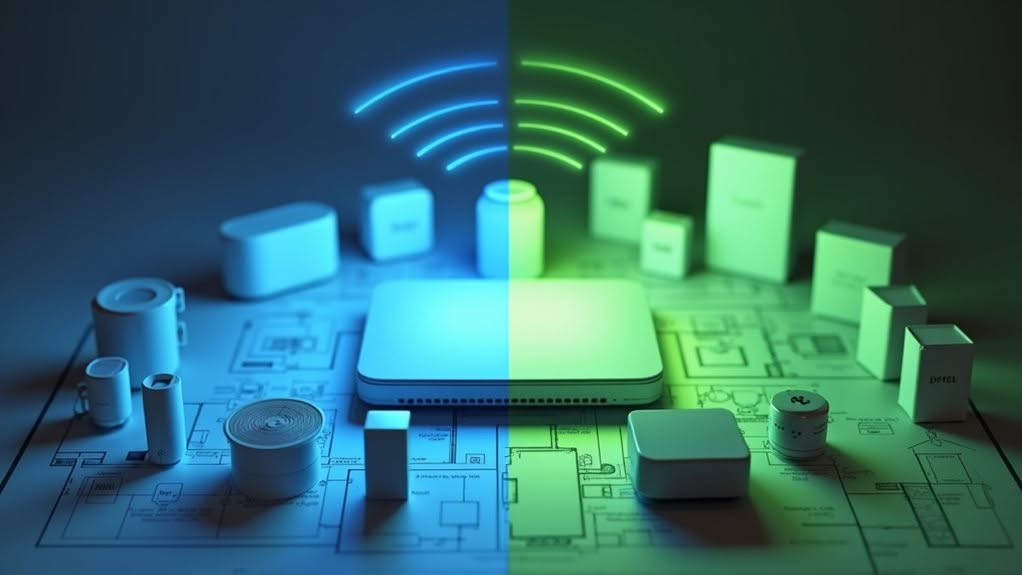
When comparing Z-Wave and Zigbee smart home protocols, their fundamental differences begin with the frequencies they operate on.
Zigbee primarily uses the 2.4 GHz band worldwide, which overlaps with Wi-Fi and other common devices, increasing potential interference.
Z-Wave, by contrast, utilizes sub-GHz frequencies: 868.42 MHz in Europe and 908.42 MHz in the US. This helps Z-Wave avoid the congested 2.4 GHz spectrum, though it requires region-specific devices.
The protocols also differ in their development approach.
Zigbee follows an open-standard model with multiple chip manufacturers, while Z-Wave was originally proprietary and remains more tightly controlled by Silicon Labs.
These differences extend to network capacity as well.
Zigbee networks can support over 65,000 devices, while Z-Wave networks are limited to 232 devices. This significant difference in capacity makes Zigbee potentially better suited for large-scale deployments in commercial or industrial settings.
Z-Wave offers superior range capabilities with transmission distances of 30-65 meters compared to Zigbee’s more limited 10-20 meter range.
Range Comparison: Which Protocol Goes the Distance?
How far can your smart home devices communicate? When comparing Z-Wave and Zigbee range capabilities, Z-Wave typically offers better direct communication, reaching 30-100 meters versus Zigbee’s 10-100 meters.
Z-Wave Plus can extend up to 150 meters in ideal conditions, making it advantageous for larger homes. However, walls and other obstacles considerably reduce these ranges for both protocols.
Z-Wave Plus offers superior range for spacious homes, though real-world performance depends heavily on physical barriers within your space.
Both systems use mesh networking to extend coverage, though they differ in implementation. Zigbee supports up to 30 hops between devices, while Z-Wave is limited to 4 hops. The routing algorithms employed by Zigbee help optimize communication paths throughout the network.
For best range with either protocol, strategically place mains-powered devices throughout your home to serve as network routers. Z-Wave operates in sub-GHz bands which generally provide better wall penetration compared to Zigbee’s 2.4GHz frequency.
Battery-powered devices generally have shorter ranges due to power conservation requirements.
Signal Reliability Through Walls and Interference
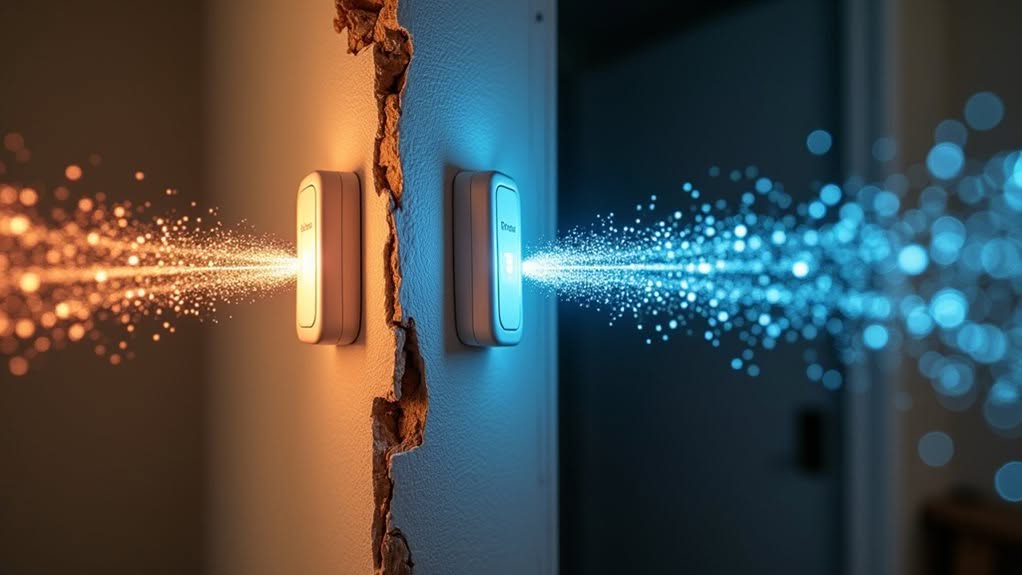
While both Z-Wave and Zigbee create reliable smart home networks, they differ greatly in their ability to transmit signals through physical obstacles.
Z-Wave’s lower frequency (908.42 MHz in the U.S., 868.42 MHz in Europe) gives it a distinct advantage when penetrating walls and floors compared to Zigbee’s 2.4 GHz signals. This makes Z-Wave more consistent across different home constructions, including older houses with thicker walls.
Interference presents another critical difference between these protocols. Zigbee shares its 2.4 GHz frequency band with Wi-Fi, Bluetooth, and microwave ovens, making it more susceptible to everyday interference.
Z-Wave operates on less congested frequency bands, resulting in fewer disruptions. Z-Wave’s impressive self-healing mesh network automatically reroutes signals when devices fail, further enhancing its reliability in complex home environments. This technology is particularly beneficial in Z-Wave home security systems which require consistent connectivity to maintain protection.
Both protocols use mesh networking to strengthen reliability, but Z-Wave’s standardized routing and strict certification process typically deliver more stable connections, especially in environments with many potential signal obstructions. Despite Zigbee’s higher data transmission speed of 250 kbps, Z-Wave’s superior wall penetration makes it preferable for larger homes.
Speed vs. Efficiency: Transmission Rate Tradeoffs
When comparing these smart home protocols, you’ll notice that Zigbee offers faster data transmission at 250 kbps, while Z-Wave tops out at 100 kbps.
This speed difference affects how quickly your devices respond to commands, with Zigbee providing near-instant responses for time-sensitive applications like motion sensors.
Your battery-powered devices may last longer with Zigbee, which generally consumes less power despite its higher data rate, making it slightly more energy-efficient for most smart home setups. The mesh network capability of Zigbee allows it to support over 65,000 connected devices, significantly more than Z-Wave’s 232 device limit. However, Z-Wave devices typically maintain more stable connections, with Zigbee devices having a tendency to drop off the network more frequently.
Data Rate Comparison
Two critical factors separate Z-Wave and Zigbee when examining their data transmission capabilities. The maximum data rates reveal a notable gap: Zigbee tops out at 250 kbps while Z-Wave ranges from 9.6 kbps to 100 kbps.
This speed difference stems from their operating frequencies. Zigbee’s 2.4 GHz band enables faster data transfer but faces more interference from common household devices.
Z-Wave’s sub-GHz frequencies (908/915 MHz in US, 868 MHz in EU) deliver slower speeds but better reliability.
For practical applications, Zigbee’s higher data rate translates to faster responsiveness with lighting controls and other real-time devices. Users experience shorter response times with Zigbee systems compared to Z-Wave alternatives.
Z-Wave’s moderate speed is sufficient for most home automation tasks while offering more consistent performance.
The protocols also differ in network capacity, with Zigbee supporting over 65,000 devices compared to Z-Wave’s 232 device limit. Zigbee exhibits strong anti-interference capabilities despite potential challenges in dense environments where multiple wireless technologies operate simultaneously.
Battery Implications
The transmission speeds of these protocols directly impact their power consumption and battery performance. Zigbee’s design prioritizes power efficiency over raw speed, resulting in considerably longer battery life for sensors and other devices.
When choosing between these protocols, consider these battery-related factors:
- Zigbee devices typically offer superior battery performance, with many sensors operating for years on a single battery due to their optimized low-power design.
- Z-Wave Plus has improved efficiency compared to earlier versions, with some devices lasting up to 5 years, though still generally consuming more power than Zigbee.
- Larger networks affect power consumption differently—Zigbee handles expansive installations efficiently, while Z-Wave’s four-hop limitation helps maintain consistent power usage in smaller setups.
For battery-powered applications like door sensors or motion detectors, Zigbee’s power efficiency often makes it the preferred choice.
Device Ecosystem and Market Availability
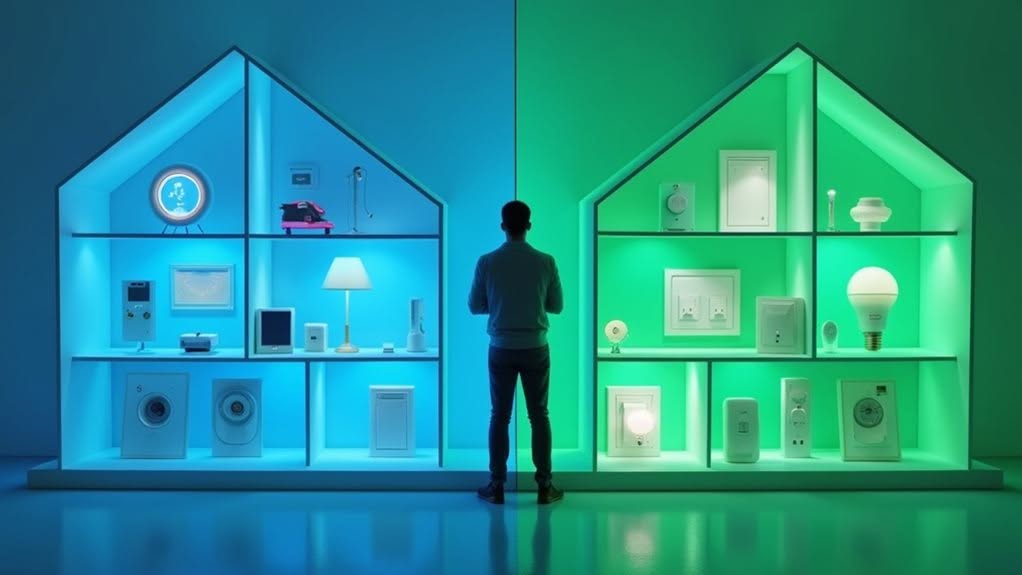
Although both Z-Wave and Zigbee have established considerable market presence, their ecosystems differ substantially in size, growth trajectory, and regional dominance.
Zigbee’s ecosystem includes over 4,000 certified products and is projected to reach $8 billion by 2033, growing at a 6.01% CAGR. Its open-source protocol has facilitated wider adoption across diverse applications including lighting, security, and industrial automation.
Z-Wave, with approximately 2,100 certified products, is experiencing faster growth with a projected 13.5% CAGR from 2025-2032, potentially reaching $30.75 billion by 2032.
Regional preferences are evident, with Z-Wave dominant in North America and holding 25% market share in Europe, while Zigbee shows stronger penetration in developing markets, particularly throughout the Asia-Pacific region.
Battery Life Performance in Real-World Applications
Beyond ecosystem considerations, battery life remains a crucial factor for consumers selecting smart home devices for practical, everyday use. When comparing the two protocols, Zigbee typically offers longer battery life for sensors and small devices due to its optimized power consumption patterns.
In real-world applications, several factors influence battery performance:
- Device type matters – Motion detectors using Zigbee often last longer than Z-Wave counterparts.
- Z-Wave advancements – Z-Wave Plus and Z-Wave LR technology now enable up to 5 and 10 years of battery life respectively.
- Environmental conditions – Physical barriers and network size affect signal strength and battery consumption in both protocols.
Z-Wave Plus has markedly improved power efficiency, making Ecolink sensors achieve up to 5-year battery life, closing the gap with Zigbee’s traditionally superior efficiency.
Security Features and Vulnerability Assessment
When comparing Z-Wave and Zigbee security features, encryption standards form the foundation of both protocols’ defenses against potential threats. Both utilize AES-128 encryption, but their implementation differs considerably.
Z-Wave employs the S2 security framework with mandatory security implementation for all certified devices. Its public/private key infrastructure offers strong protection against man-in-the-middle attacks during device inclusion.
Z-Wave’s S2 framework mandates security across all certified devices, utilizing public/private keys to effectively thwart man-in-the-middle attacks during device pairing.
Zigbee has evolved with its 3.0 version addressing previous vulnerabilities, particularly the problematic default global key used in earlier versions. However, its open standard nature can lead to inconsistent security implementations across manufacturers.
Z-Wave’s certification process guarantees uniform security standards, while Zigbee’s fragmented certification may result in varying security postures.
Both protocols have addressed previous vulnerabilities through updated specifications, but Z-Wave’s mandatory security approach provides more reliable protection across devices.
Setup Complexity and User Experience
When setting up your smart home system, you’ll notice notable differences in how Z-Wave and Zigbee hubs are configured.
Z-Wave typically offers a more straightforward initial setup process with fewer compatibility issues, while Zigbee might require additional steps to guarantee devices from different manufacturers work together properly.
If network problems arise, Z-Wave’s lower frequency band (868/908 MHz) experiences less interference than Zigbee’s 2.4 GHz frequency, potentially reducing the time you’ll spend troubleshooting connection issues.
Initial Hub Configuration
The initial setup process for smart home hubs represents a critical first step in your home automation expedition, with Z-Wave and Zigbee offering distinctly different experiences.
Z-Wave hubs typically require more sophisticated hardware but provide reliable connections in complex building environments due to their sub-GHz frequency operation.
When configuring your first hub, consider these key differences:
- Z-Wave hubs offer more stable initial device pairing in crowded wireless environments but may require manual inclusion steps and firmware updates.
- Zigbee devices generally set up faster with quicker data transmission speeds (250 kbps vs. Z-Wave’s 100 kbps).
- Hub software greatly impacts user experience, with expensive Z-Wave hubs providing richer interfaces but steeper learning curves.
Remember that Z-Wave devices must match your region’s frequency settings, while Zigbee’s standardized 2.4 GHz frequency simplifies global compatibility.
Troubleshooting Network Issues
Troubleshooting network issues presents distinct challenges for Z-Wave and Zigbee systems, with each protocol offering different approaches to resolving connectivity problems.
Z-Wave’s simpler architecture makes identifying and fixing issues more straightforward, especially in typical home setups with fewer than 232 devices. When troubleshooting, you’ll find Z-Wave’s lower frequency band creates more stable connections through walls and reduces Wi-Fi interference.
Zigbee networks, while capable of supporting up to 65,000 devices, often require more complex troubleshooting due to their distributed architecture. You’ll likely encounter more interference issues since Zigbee operates in the crowded 2.4GHz spectrum alongside Wi-Fi and Bluetooth.
When Z-Wave devices are unpaired and re-paired, your automation rules typically break and need reconstruction. Zigbee maintains these rules thanks to hard-coded device IDs, saving you configuration time during troubleshooting procedures.
Cost Analysis: Hardware and Long-Term Maintenance
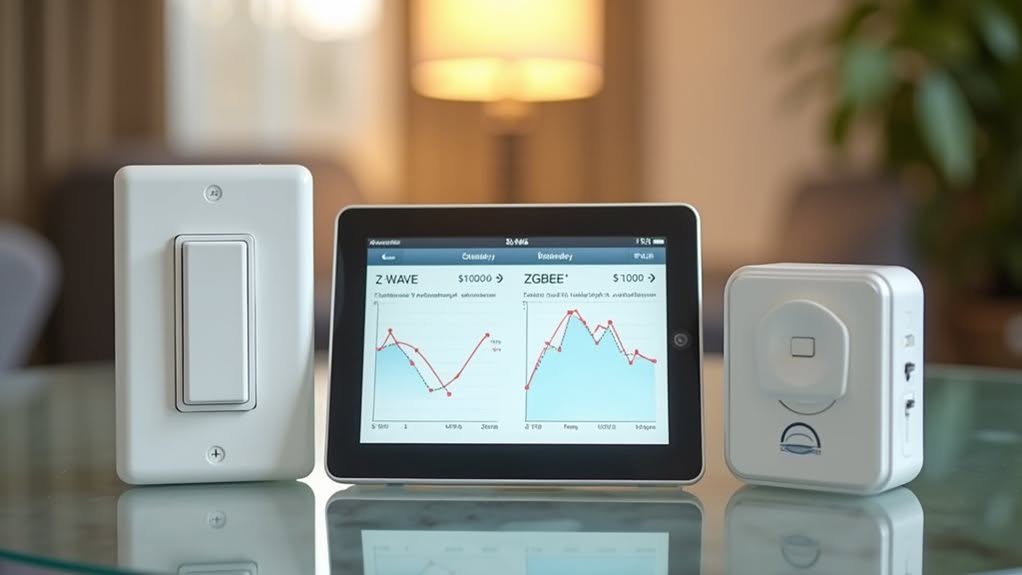
Choosing between Z-Wave and Zigbee involves considerable cost considerations that extend beyond initial purchase price. Z-Wave devices typically cost 3-4 times more than comparable Zigbee products, with European manufacturing and single-source chips contributing to higher pricing.
When evaluating long-term value, consider these factors:
- Z-Wave devices demonstrate exceptional longevity, often functioning reliably for over a decade with minimal maintenance requirements.
- Zigbee offers substantially lower upfront costs, making it ideal for larger networks or budget-conscious implementations.
- Battery life tends to be superior in Z-Wave devices, reducing replacement frequency and associated maintenance.
For powered applications, Zigbee’s affordability and speed make it attractive, while Z-Wave’s reliability and efficiency excel in battery-operated scenarios.
Your specific needs and network size will ultimately determine which protocol delivers the best value.
Future-Proofing Your Smart Home Network
As you plan for a future-proof smart home, understanding how Z-Wave and Zigbee technologies will evolve becomes crucial to making sustainable investment decisions.
Zigbee’s larger ecosystem of 4,000+ certified devices and capacity for 65,000 network nodes gives you more expansion options compared to Z-Wave’s 2,100 certified products and 232-device limit. This difference matters as your smart home grows over time.
The upcoming Matter protocol integration will likely benefit both technologies, though Zigbee’s open-source nature may accelerate its adaptation.
Additionally, Zigbee’s global 2.4 GHz frequency standard guarantees your devices will work internationally, while Z-Wave’s regional frequency restrictions could limit cross-border compatibility.
Consider that major platforms like Amazon and Google more commonly support Zigbee natively, potentially streamlining future ecosystem integration with your existing devices.
Frequently Asked Questions
Can Z-Wave and Zigbee Networks Operate Together in the Same House?
Yes, you can run Z-Wave and Zigbee networks simultaneously in your home without interference because they operate on different frequencies. Multi-protocol hubs like SmartThings can manage both, allowing you to create integrated smart home automations.
How Do Power Outages Affect Z-Wave Versus Zigbee Networks?
During power outages, your Z-Wave network may perform better as it often uses hardwired repeaters that stay powered. Your Zigbee network might struggle more if it relies primarily on battery-powered devices without line-powered repeaters.
Which Protocol Works Better With Voice Assistants Like Alexa?
Zigbee works better with Alexa, especially if you’re using Echo devices with built-in hubs. You’ll find more compatible devices (over 4,000) and easier integration with Amazon’s ecosystem than with Z-Wave.
Can I Migrate Devices Between Z-Wave and Zigbee Networks?
No, you can’t migrate devices between Z-Wave and Zigbee networks. They use incompatible protocols and frequencies. You’ll need to physically reset each device and re-pair it to a hub supporting your desired protocol.
Do Weather Conditions Impact Z-Wave or Zigbee Signal Performance?
Yes, weather conditions impact both protocols. Rain, fog, and snow can attenuate your Z-Wave and Zigbee signals. Harsh environments affect outdoor range, but mesh networking helps mitigate these effects by creating alternative communication paths.
Final Thoughts
You’ve now seen both Z-Wave and Zigbee‘s strengths and weaknesses. Neither protocol is universally better—your choice depends on your specific needs. Z-Wave offers better compatibility and reliability, while Zigbee provides faster speeds and more device options. Consider your home’s size, wall construction, and which smart devices you’ll use most. Whichever system you choose, you’ll need a compatible hub to create your smart home foundation.