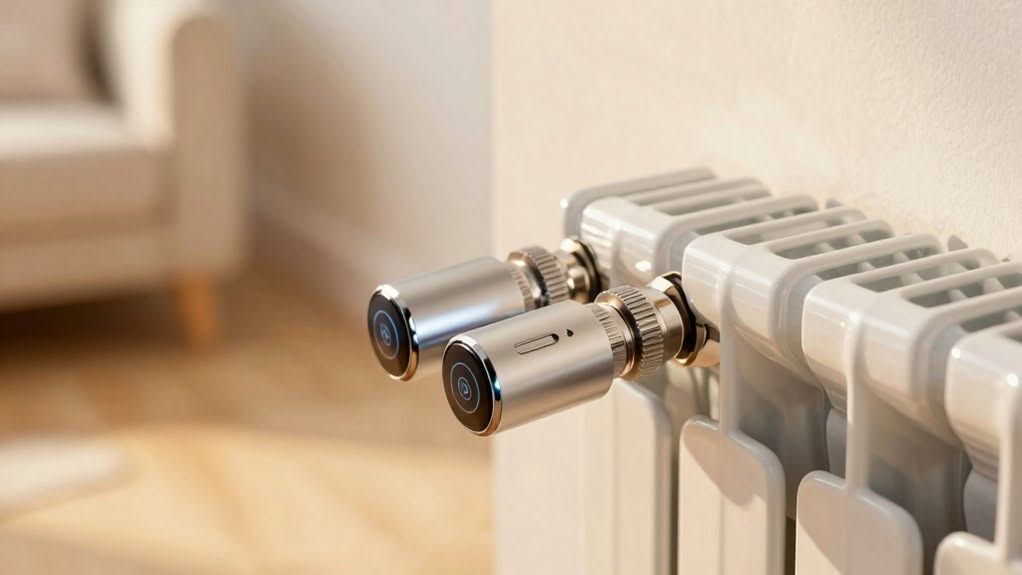
You can cut heating costs with smart radiator valves that adapt to your schedule. These devices offer 7‑day programs, occupancy sensing, and remote app control, so rooms aren’t heated when no one’s there. They pair with Alexa or Google Assistant and install in minutes. Look for energy-saving modes, window detection, and auto-scheduling to maximize efficiency without sacrificing comfort. Ready to choose a model that fits your home’s rhythm? Let’s compare options.
| Nachukan Smart Radiator Valve with WiFi Thermostat |
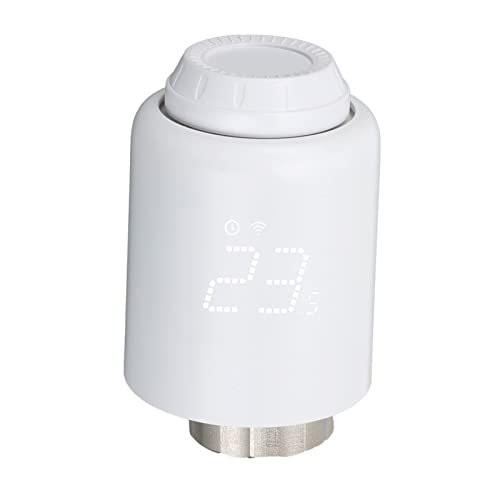
| All-in-One Smart | App control: App-enabled (WiFi control) | Scheduling / Programmable: Programmable timing function | Temperature range lower bound: 5°C (minimum) | VIEW LATEST PRICE | Read Our Analysis |
| Smart Zigbee Thermostat for Radiator Valve (Black) |

| Zigbee Budget Pick | App control: Tuya/Smart Life App control | Scheduling / Programmable: Weekly scheduling (5+2, 6+1, or 7-day programs) | Temperature range lower bound: 5°C (minimum) | VIEW LATEST PRICE | Read Our Analysis |
| Shelly Blu TRV and Gateway Gen3 Thermostatic Valve |

| Premium Ecosystem Control | App control: Shelly Smart Control App | Scheduling / Programmable: Smart scheduling | Temperature range lower bound: 5°C (minimum) [not explicitly stated, but implied by typical TRV ranges in similar specs] | VIEW LATEST PRICE | Read Our Analysis |
| Smart Thermostatic Radiator Valve with 7-Day Programmable App |
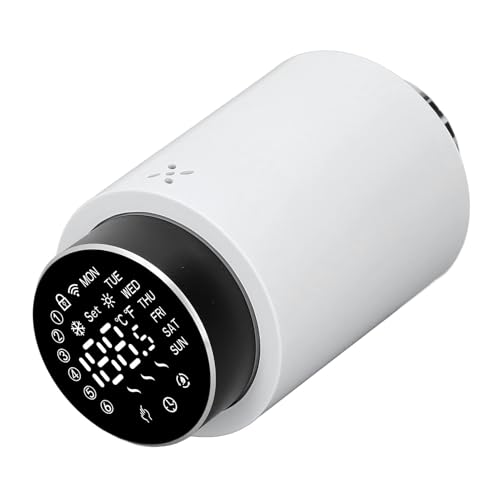
| 7-Day Programmable | App control: Tuya/Smart Life App control | Scheduling / Programmable: 7-day programmable schedule | Temperature range lower bound: 5°C (minimum) | VIEW LATEST PRICE | Read Our Analysis |
| Smart Zigbee Thermostat Radiator Valve with App Control |
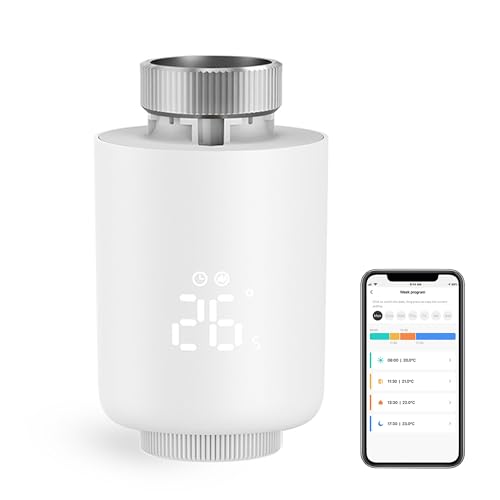
| Voice-Enabled Zigbee | App control: Tuya Smart/Smart Life App control | Scheduling / Programmable: Programmable schedule (weekly) | Temperature range lower bound: 5°C (minimum) | VIEW LATEST PRICE | Read Our Analysis |
More Details on Our Top Picks
Nachukan Smart Radiator Valve with WiFi Thermostat
If you’re after a smart radiator upgrade that combines hands-on control with remote convenience, the Nachukan Smart Radiator Valve with WiFi Thermostat is a strong fit. You’ll manage schedules using the app or the simple rotating knob, and the backlit display keeps temperature reads clear even at night. It operates on 5°C to 35°C, so you can fine‑tune comfort without overheating. Installation is tool-free, and mounting is compact on a surface. Regular decalcification is automatic on Mondays, with a CR alert, helping you maintain performance. It supports Wi‑Fi connectivity and dual control for flexible heating that fits busy lives.
- App control:App-enabled (WiFi control)
- Scheduling / Programmable:Programmable timing function
- Temperature range lower bound:5°C (minimum)
- Mounting type:Surface mount
- Display / Readout:Digital display with backlight
- Power / Battery powered:3 x AA batteries (battery-powered)
- Additional Feature:Routine decalcification alert
- Additional Feature:IP20 protection
- Additional Feature:6 x Connector included
Smart Zigbee Thermostat for Radiator Valve (Black)
This Smart Zigbee Thermostat for Radiator Valve (Black) shines for anyone seeking seamless integration into a Zigbee-powered smart home while optimizing radiator control with precise scheduling. It uses Zigbee connectivity and Tuya Smart Life app control, compatible with Alexa and Google Home for voice commands. You’ll monitor temp from 5–45°C, with a 0–70°C display, in a sleek ABS body and IP20 protection. Powered by 2 AA batteries, it fits standard radiators and supports automatic, manual, energy-saving, and vacation modes, plus 6 time periods for 7-day programs. Battery life alerts keep you in control. Rugged build meets practicality and value.
- App control:Tuya/Smart Life App control
- Scheduling / Programmable:Weekly scheduling (5+2, 6+1, or 7-day programs)
- Temperature range lower bound:5°C (minimum)
- Mounting type:Surface mount
- Display / Readout:LCD with backlight
- Power / Battery powered:2 x AA batteries (included)
- Additional Feature:Tuya Zigbee hub required
- Additional Feature:2 AA batteries included
- Additional Feature:Alexa & Google Home compatible
Shelly Blu TRV and Gateway Gen3 Thermostatic Valve
Get precise comfort with Shelly Blu TRV and Gateway Gen3, a smart radiator valve system that shines if you want tight temperature control in a compact, ecosystem-friendly package. Bluetooth-operated Shelly Blu TRV pairs with a gateway for Wi-Fi, letting you manage heat from the Shelly app or your smart home. It locks in your target to ±0.1°C and offers Boost Mode for rapid warming. You can add Shelly BLU H&T or door/window sensors to improve occupancy-based control. Smart schedules align with your routine, trim energy when you’re away, and warm before you return. A 3-year warranty backs it fully.
- App control:Shelly Smart Control App
- Scheduling / Programmable:Smart scheduling
- Temperature range lower bound:5°C (minimum) [not explicitly stated, but implied by typical TRV ranges in similar specs]
- Mounting type:(not explicitly stated; typical valve form is wall/valve-mounted) [information not clearly labeled]
- Display / Readout:(not explicitly described as having a display)
- Power / Battery powered:Battery-powered (Shelly Blu TRV uses batteries)
- Additional Feature:Boost Mode
- Additional Feature:External sensor support
- Additional Feature:Gateway required for Wi-Fi
Smart Thermostatic Radiator Valve with 7-Day Programmable App
Designed for homeowners who want precise, hands-off control over their heating, the Smart Thermostatic Radiator Valve with a 7-Day Programmable App makes automation central to comfort.
You set year-round comfort with a 7-day programmable schedule that adapts to your lifestyle and seasonal needs.
It tunes temperatures from 5℃ to 45℃, helping you save over 15% on energy while keeping rooms comfortable.
Installation is quick and compatible with standard valves, plus a child lock and a quiet motor under 25 dB.
Control comes via Tuya or Smart Life apps, with voice commands and a clear LED display for real-time tweaks.
- App control:Tuya/Smart Life App control
- Scheduling / Programmable:7-day programmable schedule
- Temperature range lower bound:5°C (minimum)
- Mounting type:Compatible with standard radiator valves (installation around existing valve)
- Display / Readout:LED display for real-time temperature
- Power / Battery powered:Battery-powered (implied via app-based control; explicit power source not stated)
- Additional Feature:7-day programmable schedule
- Additional Feature:Child lock
- Additional Feature:Silent operation
Smart Zigbee Thermostat Radiator Valve with App Control
If you’re already using Zigbee in your smart home, this Thermostat Radiator Valve from SENCKIT is a natural fit, offering reliable app control and compatibility with Alexa and Google Assistant. You’ll appreciate its simple setup, battery power, and real-time adjustments through the Tuya Smart / Smart Life app. With a 5°C to 45°C set range, it keeps you comfortable while preserving energy. The device supports manual, automatic, and vacation modes, plus features like anti-freeze and window detection. Pair it with Alexa or Google Assistant for hands-free temperature control and smarter scheduling. Its compact white design suits most radiators without clutter in homes.
- App control:Tuya Smart/Smart Life App control
- Scheduling / Programmable:Programmable schedule (weekly)
- Temperature range lower bound:5°C (minimum)
- Mounting type:Surface mount
- Display / Readout:LCD with backlight
- Power / Battery powered:2 x AA batteries (included)
- Additional Feature:Anti-freezing
- Additional Feature:Window opening detection
- Additional Feature:Low battery warning
Factors to Consider When Choosing Smart Radiator Valves
When you’re choosing a smart radiator valve, consider how it connects and what protocols it supports, since compatibility with your hub or ecosystem matters for setup and reliability. Next, look at scheduling capabilities, battery life, and the display or interface, so you can manage temps, energy use, and routines without constant fiddling. Also weigh compatibility with existing devices and ecosystems, because a broader ecosystem can simplify control, updates, and future-proofing.
Connectivity And Protocols
How you choose between Wi‑Fi and Zigbee shapes more than just setup but daily use, influencing control flexibility, power needs, and future scalability. Wi-Fi valves let you control them directly from your app over the home network and enable remote access, provided your coverage is solid. Zigbee valves, by contrast, rely on a hub and benefit from mesh networking, which improves range and stability across multiple devices while typically sipping power. A Zigbee setup shines in larger homes or apartments with many valves, because the network expands without choking your wifi. In practice, consider how you plan to scale: Zigbee can handle many devices on a single hub, whereas Wi‑Fi can strain bandwidth if you add numerous connected valves. Voice assistant compatibility often depends on the protocol and app, so check integrations. Choose the approach that matches your household size and tech habits for more seamless daily use.
Scheduling Capabilities
Scheduling capabilities are where smart radiator valves prove their true value, building on how you already wired your setup. You’ll access five decisions of the week, choosing 5+2, 6+1, or a full 7-day configuration to fit your routine. Many models let you create up to six time blocks per day, so you can fine-tune morning, afternoon, and overnight temperatures without guesswork. This feature lets you automate heating around occupancy, so rooms stay warm when someone’s there and save energy when you’re out. Advanced options include vacation, anti-freeze, and window-detection modes that temporarily override programs for safety and efficiency. In practice, programmable schedules sustain comfort while trimming energy use—often by over 15% annually. Start simple, then expand as you learn your patterns at your pace.
Power And Battery
Do you want a valve that keeps your home comfortable without frequent battery changes? Most smart radiator valves run on batteries—typically 2 to 3 AA—lasting anywhere from six months to over a year, depending on usage and how often they talk to your hub. If you choose Zigbee, you’ll usually see longer life than Wi‑Fi polling, thanks to lower power consumption. Low battery warnings arrive via app alerts or a small indicator on the device to help you replace them before you notice a drop in performance. Valve actuation uses more power, so frequent temperature tweaks can shorten longevity. Some models include adaptive polling or sleep modes to stretch life between replacements. This can save you money while keeping comfort steady, and predictable performance.
Display And Interface
A backlit digital display makes it easy to read temperature settings and system status even in dim rooms, which can save you from fumbling for controls late at night. Beyond visibility, the readout helps you confirm exact values at a glance, so you don’t guess whether the valve is at 22°C or a different point. Most displays show 0°C to 70°C for temperature readouts, while the setpoint typically spans 5°C to 45°C, letting you dial in comfort precisely. Some models use an LCD screen with mode indicators for anti-freeze, vacation, or low battery, which keeps you aware of system status. An intuitive control interface usually combines a rotating knob with button controls for quick manual tweaks and seamless app synchronization. Keep in mind the protection grade IP20, which means protection from objects larger than 12mm but not moisture, so install indoors accordingly. This clarity supports reliable scheduling and energy savings in everyday use.
Compatibility And Ecosystem
How well does a smart radiator valve fit your existing ecosystem, and is it worth the hassle of integration? You want a valve that speaks your language, so check that it uses a connectivity protocol supported by your smart home hub. Make sure it’s compatible with your preferred voice assistants, like Alexa or Google Assistant, for effortless voice control. Some models need a separate gateway or bridge, especially with Zigbee, so factor that into setup time and placement. Confirm the mobile app works with your OS (iOS or Android) and supports multi-device synchronization. Finally, assess whether it offers local automation options or integrates with broader platforms for advanced scenes and scheduling, giving you reliable, scalable control. This keeps your system cohesive without overcomplicating daily use.
Installation Simplicity
If you’re choosing a smart radiator valve, installation simplicity should top your checklist, because many models snap directly onto standard M30 x 1.5mm connections without draining the system. These valves are compact and lightweight—typically under 250 grams—so you can handle and mount them without extra support. Many models include multiple connector adapters, guaranteeing compatibility with a wide range of radiator valve types you’ll encounter in homes. You’ll usually finish installation in minutes, thanks to clear step-by-step instructions in the manual. Surface-mount designs remove the need for complex modifications, enabling quick placement and precise alignment on existing valves. Overall, you get a practical, user-friendly setup that gets you up and running fast. It’s a reliable starting point for other smart home integrations too over time.
Energy Saving Potential
When you choose smart radiator valves, energy saving potential becomes a key factor alongside how easy they are to install. They can cut energy use by more than 15% by optimizing heating schedules and preventing overheating in empty rooms. With programmable weekly schedules and multiple time periods per day, you’ll control when and where heat flows, avoiding waste. Features like automatic anti-freeze mode and window opening detection stop heating when it’s not needed, boosting efficiency. Accurate regulation within ±0.1°C means you stay comfortable without excess energy use. Remote access lets you adjust settings in real time via your phone, so you correct misjudgments instantly and prevent lingering waste. These capabilities complement good insulation and mindful occupancy habits, delivering dependable long-term savings for your home.
Final Thoughts
You’ll save on heating costs by choosing a smart radiator valve that matches your schedule and occupancy. Start with a model offering 7 day programming, app control, and compatibility with your setup. Consider energy-saving modes and auto-scheduling to minimize waste. Install easily, link to Alexa or Google Assistant, and set sensible temperature ranges. Monitor usage over a few weeks, adjust, and you’ll notice a comfort level and smarter bills without sacrificing convenience and lasting savings.