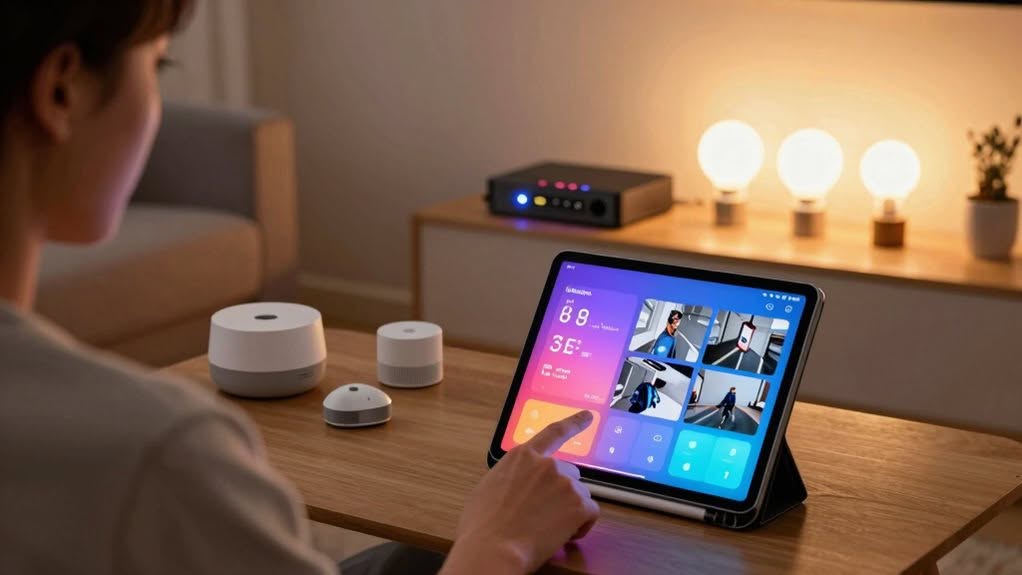
Home Assistant is gaining popularity over cloud-based smart home systems due to its local-first approach. You’ll experience faster response times (0.5-1 second vs. 2-15 seconds for cloud solutions), improved privacy with local data processing, and continued functionality during internet outages. The system processes voice commands locally without sending your data to big tech companies and has a thriving community of 2 million users. These benefits explain why many smart home enthusiasts are making the switch.
The Dangers of Cloud Dependency in Smart Home Systems
While cloud-based smart home systems offer convenience and accessibility, they introduce serious security vulnerabilities that many users overlook.
Cyberattacks on smart homes increased by 124% in 2024, with cloud-dependent devices creating a single point of failure that hackers can exploit to compromise multiple devices simultaneously.
Your smart home’s functionality depends entirely on internet connectivity, leaving you vulnerable during outages.
When companies like Insteon shut down their cloud services, users found their devices suddenly useless. These cloud service shutdowns represent a growing concern for smart home enthusiasts who invest in these systems.
Cloud platforms also restrict your control, imposing standards on data encryption and updates without your consent.
Companies can force changes or end support at any time.
Privacy concerns are equally troubling.
Large providers collect up to 28 sensitive data points, including health information, photos, and audio recordings.
For greater peace of mind, consider investing in smart security systems that offer comprehensive protection for your home environment.
What many consumers don’t realize is that quality cloud-based systems actually maintain local functionality through home-based hubs even when internet connection is lost.
Local Control: The Foundation of Home Assistant’s Philosophy
In stark contrast to cloud-dependent systems and their risks, Home Assistant builds its entire foundation on local control. The platform’s core philosophy, established in 2016, emphasizes that reliable home automation must run at home, not in the cloud.
Home automation systems must work for all household members, ensuring that multiple users can interact with the system regardless of their technical expertise. Home Assistant processes all automations, device states, and integrations locally on your machine, minimizing external dependencies. This architecture guarantees your smart home continues working even during internet outages. This approach delivers nearly instantaneous response times when controlling devices, eliminating the frustrating lag experienced with cloud solutions.
The platform prioritizes local-first protocols like Zigbee, Z-Wave, Matter, and MQTT. These technologies allow devices to communicate directly with your Home Assistant server without routing through manufacturer clouds.
The “Works with Home Assistant” program further reinforces local control by requiring manufacturers to support open standards. This approach protects you from investing in products that might become unusable if vendor cloud services are discontinued.
Voice Control Without Big Tech Listening
While major tech companies like Amazon and Google record your voice commands on remote servers, Home Assistant processes your speech locally, keeping your conversations private within your home’s network.
You’ll find privacy-focused options like OpenAI’s Whisper for speech-to-text that works entirely on your hardware without sending data outside your walls.
This local processing not just protects your privacy but also reduces response time, as commands don’t need to travel to distant data centers before your lights turn on or your thermostat adjusts.
Home Assistant’s integration with Almond and Ada offers a comprehensive voice assistant solution that prioritizes user privacy even when leveraging some cloud-based functionalities.
Unlike traditional smart assistants that are constantly listening for wake words like “Alexa” or “Hey Google,” Home Assistant can be configured to only activate when you choose.
Privacy Beyond Cloud Walls
Smart homes typically expose your personal data to major tech corporations, yet Home Assistant fundamentally changes this paradigm. It processes and stores all device data locally on your network by default, preventing information from traveling beyond your home.
When you turn on lights or adjust your thermostat with Home Assistant, those commands never leave your premises. This “Open Home” vision stands in stark contrast to cloud-dependent alternatives.
For remote access, you can use secure methods like WireGuard VPN or NGINX reverse proxy with SSL, eliminating reliance on third-party cloud services. For beginners concerned about setup complexity, Nabu Casa provides secure remote access with minimal configuration required. These solutions encrypt your data and authenticate access without cloud intermediaries.
Even when using voice assistants, Home Assistant can proxy commands without directly exposing your data to major tech companies, giving you greater control over your privacy. Home Assistant’s approach provides an escape from vendor lock-in by supporting over 2,500 integrations with various devices from different manufacturers.
DIY Voice Independence
Privacy concerns extend beyond data storage to voice interactions, an area where Home Assistant offers remarkable freedom from big tech surveillance.
You can implement fully offline speech recognition using solutions like Speech-to-Phrase or Whisper, processing voice commands locally without cloud connections. The Speech-to-Phrase engine delivers sub-second transcription even on modest hardware like Raspberry Pi 4.
Home Assistant Voice hardware improves this independence with dual microphones and local wake word detection. Your voice data never leaves your network, unlike commercial alternatives that constantly listen and transmit. This approach aligns with Home Assistant’s commitment to creating open, local, private voice assistants that respect user autonomy.
For responses, local text-to-speech engines such as Piper convert text into natural-sounding voice feedback without cloud servers. Piper generates 1.6 seconds of voice in just one second when using medium quality models. This creates a complete voice control pipeline that respects your privacy.
Physical mute switches provide additional peace of mind, guaranteeing hardware-level prevention of unwanted audio capture.
Local Latency Wins
When you interact with voice assistants, the delay between your command and the system’s response—known as latency—significantly impacts your experience. Delays exceeding 200ms make conversations feel robotic and disjointed rather than natural.
Home Assistant’s local voice processing eliminates network travel time, delivering responses faster than cloud-dependent systems that average 800ms latency. This difference is immediately noticeable in daily use.
Local processing also avoids unpredictable latency spikes caused by internet congestion or server loads. Your commands execute consistently, regardless of network conditions.
The advantages extend beyond speed. You’ll experience more reliable performance during high-traffic periods and maintain privacy since your voice data stays within your home.
For smart home control, these split-second improvements transform the user experience from frustrating to seamless.
Performance Comparison: Local vs. Cloud Response Times
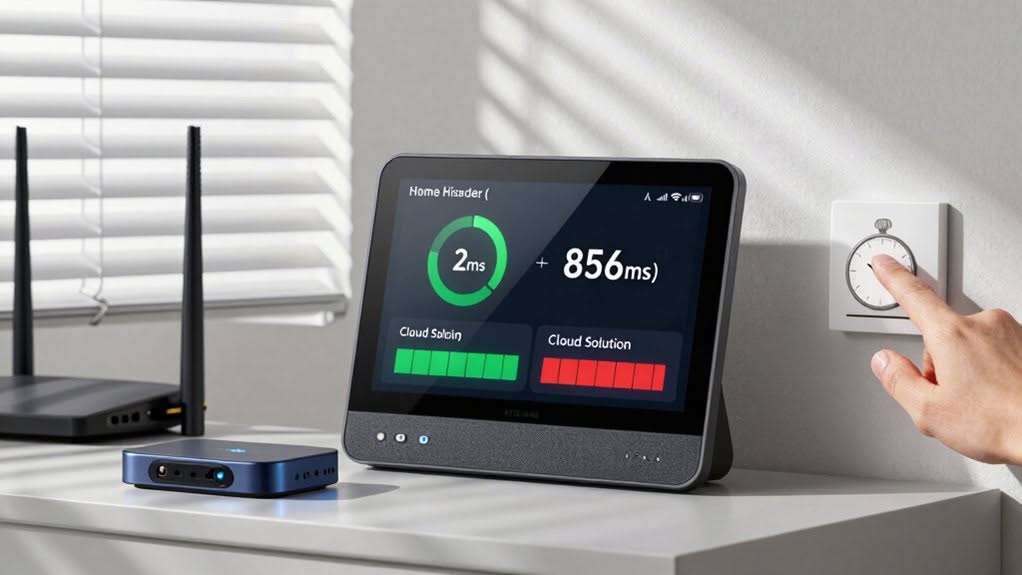
When comparing Home Assistant’s local voice processing to cloud solutions, response time testing reveals a notable difference in real-world performance.
Local voice commands average 3.89 seconds on tested hardware, which is 25% faster than cloud LLM responses at 5.21 seconds, though both lag behind commercial assistants like Amazon Echo.
You’ll maintain control over your smart home during internet outages with local processing, while cloud solutions become completely unavailable when your connection drops.
Real-World Response Testing
Understanding how your smart home system performs in daily use requires looking beyond theoretical specifications to actual response times.
Tests show local voice AI in Home Assistant responds about 25% faster than cloud solutions, averaging 3.89 seconds versus 5.21 seconds for cloud-based alternatives. However, both options may feel slower than dedicated smart speakers.
Streaming technology greatly improves perceived performance. Cloud streaming begins speaking at 0.51 seconds while local streaming starts at around 0.56 seconds, effectively eliminating noticeable delays despite differences in raw processing speed.
Hardware choices profoundly impact response times. Running local AI on powerful devices like the Nvidia Jetson Nano can provide near-instant responses by eliminating network latency entirely.
For simple commands like turning lights on, both solutions execute quickly, but cloud AI generally handles complex requests with better accuracy.
Internet Outage Resilience
Because internet connectivity can be unpredictable, the resilience of your smart home system during outages becomes a critical factor to contemplate.
Local systems like Home Assistant operate entirely on your home network, maintaining functionality when the internet goes down. Your automations continue running, and device control remains available regardless of external connectivity.
In contrast, cloud-based solutions require constant internet connections, resulting in complete functionality loss during outages. When your internet fails, so do your smart devices and automations.
Local AI running on dedicated hardware like the Nvidia Jetson Nano processes commands without network dependency, guaranteeing seamless service during internet downtime.
This local-first approach provides peace of mind that critical home functions won’t suddenly stop working when your internet connection becomes unstable.
Device Control Latency
Response time plays a crucial role in determining the overall quality of your smart home experience.
Local Home Assistant setups typically deliver sub-second latency (0.5-1 second), which users often can’t distinguish from physical switch responses. This consistent performance creates a seamless interaction with your devices.
In contrast, cloud-based solutions frequently experience 2-15 second delays, depending on your internet speed, server load, and transmission distances. These factors introduce unpredictable variability into your smart home’s responsiveness.
For time-sensitive applications like motion-activated lighting, even milliseconds matter. The multiple network hops required by cloud solutions (device → cloud → controller → device) greatly impact performance.
Hardware capability and network configuration also influence local control latency, but these factors remain within your control rather than depending on external cloud services.
Privacy Advantages of Keeping Your Data at Home
While cloud-based smart home systems transmit your personal information to distant servers, Home Assistant offers a fundamentally different approach by keeping your data entirely within your home.
When you self-host on devices like Raspberry Pi, you maintain physical control over your data storage hardware. Your sensor readings, automation patterns, and device controls never leave your network without your permission.
Local processing means sensitive video and audio data isn’t sent to external companies for analysis. Motion detection and other AI functions happen on your own hardware, preventing corporations from collecting behavioral insights.
This local-first design greatly reduces your vulnerability to data breaches, unauthorized surveillance, and targeted advertising.
You can also implement additional protections like VPNs, two-factor authentication, and ad blocking to further improve your privacy.
Community-Driven Innovation in Local Smart Home Technology
Unlike proprietary smart home ecosystems, Home Assistant thrives on the collective intelligence of its rapidly growing community.
With over 2 million active installations in 2024, this open source platform has become a powerhouse of innovation driven by users themselves.
The community’s impact is evident through:
- Home Assistant ranks as the second most active project on GitHub, with developers worldwide contributing code, integrations, and translations
- Users average 24 automations and 74 integrations per installation, demonstrating sophisticated usage patterns that guide development
- Community-created projects like Music Assistant have been adopted as official Foundation projects, formalizing grassroots innovation
- Annual surveys with 8,600+ respondents directly shape the product roadmap based on real user needs
This collaborative approach guarantees Home Assistant evolves according to users’ actual needs rather than corporate priorities.
Frequently Asked Questions
Can Home Assistant Integrate With Existing Cloud-Dependent Devices?
Yes, you can integrate cloud-dependent devices with Home Assistant through native cloud integrations, local bridges, and protocols like MQTT, Z-Wave, Zigbee, and Matter. This creates a hybrid setup maintaining local control where possible.
How Difficult Is Setting up Local Voice Assistants Compared to Alexa?
You’ll find local voice assistants require more technical knowledge than Alexa. They demand networking configuration, custom command programming, and troubleshooting skills, while lacking Alexa’s plug-and-play simplicity and natural language understanding capabilities.
What Hardware Is Required to Run Home Assistant Effectively?
You’ll need a 1 GHz+ processor, 2-4GB RAM minimum, and 16GB+ SSD storage. For beginners, a Raspberry Pi 4 (4GB) works well, while Intel NUCs offer better performance for complex setups.
Can Home Assistant Handle Complex Multi-Room Audio Synchronization Locally?
Yes, you can manage complex multi-room audio synchronization locally with Home Assistant using Snapcast or Music Assistant 2.0, which provide time-synchronized playback across multiple speakers while keeping everything on your local network.
How Does Home Assistant Handle Power Outages Versus Cloud Solutions?
Home Assistant with a UPS keeps running during outages while cloud solutions go offline completely. You’ll maintain local control of devices and can receive power loss notifications when properly configured with NUT integration.
Final Thoughts
You’ve seen how Home Assistant’s local-first approach offers considerable advantages over cloud-dependent alternatives. By keeping your smart home data on your own hardware, you gain better privacy, faster response times, and freedom from subscription fees or service outages.
As big tech companies continue to shift their business models, your investment in local-first technology represents a future-proof choice that puts you in control of your smart home.


