
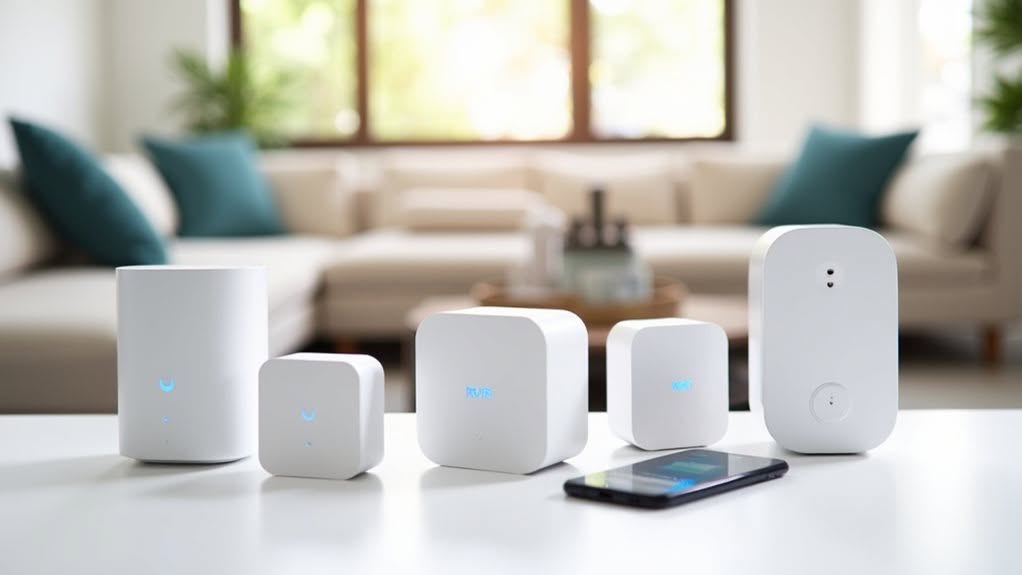
For Home Assistant integration, you’ll find strong IR blaster options with the budget-friendly XIAO Smart IR Mate ($10.99) featuring ESPHome firmware, the Matter-compatible Switchbot Hub 2 with temperature sensors, the Linknlink Eremote HA with MQTT support, and versatile Broadlink RM4 models. Each device offers different connectivity protocols, range capabilities, and price points to control your non-smart appliances. The following comparison helps you determine which solution best matches your specific smart home needs.
XIAO Smart IR Mate: Budget-Friendly ESPHome Solution
The XIAO Smart IR Mate represents a compact powerhouse for transforming traditional IR-controlled devices into smart home components.
Built on the ESP32-C3 SoC with RISC-V architecture, this disc-shaped device measures just 65mm in diameter and 19mm in height.
Pre-flashed with ESPHome firmware, it integrates seamlessly with Home Assistant without requiring cloud services.
The device features three high-power IR LEDs that provide 360° coverage for controlling TVs, air conditioners, and other appliances.
You’ll appreciate the intuitive touch sensor for manual control and the haptic feedback that confirms successful commands.
The Smart IR Mate can learn up to ten infrared signals directly onboard, storing them in its 4MB flash memory.
At just $10.99, this open-source solution offers impressive value for adding legacy devices to your smart home ecosystem.
Powered via USB Type-C connection, the device supports both Wi-Fi 2.4GHz and Bluetooth Low Energy for flexible connectivity options.
The Smart IR Mate operates in two distinct modes: Universal Remote mode and Smart Air Controller mode.
Switchbot Hub 2: Matter Compatibility With Advanced Features


Bridging the gap between legacy devices and modern smart home ecosystems, SwitchBot Hub 2 stands out as a versatile IR blaster with full Matter protocol compatibility.
You’ll appreciate how it transforms older Bluetooth SwitchBot devices into Matter-compatible accessories without replacing hardware.
The Hub 2 combines crucial features for Home Assistant integration:
- Functions as both an IR blaster for controlling traditional appliances and a Matter bridge for modern smart home platforms
- Includes built-in temperature and humidity sensors (±0.2°C, ±2% RH accuracy) that expose data to Home Assistant
- Operates via 2.4GHz Wi-Fi and Bluetooth connectivity with convenient USB-C power
The compact size (3.1×2.8×0.9 in) allows discreet placement near your devices, while the LED display provides real-time environmental readings without requiring your smartphone. Its elegant white matte finish offers an aesthetically pleasing appearance that blends seamlessly with most home decor styles. Note that currently only Curtain Bot and Tilt devices offer complete Matter support, with more devices expected to gain compatibility through future firmware updates.
Linknlink Eremote HA: Seamless Home Assistant Integration

Three standout features make the LinknLink eRemote HA IR Blaster a compelling choice for Home Assistant enthusiasts.
Its native MQTT support eliminates the need for third-party integrations, allowing direct connection to your Home Assistant setup with minimal configuration.
You’ll appreciate the device’s extensive compatibility, supporting over 500,000 models across 2,000+ brands.
This coverage guarantees you can control virtually any IR-based appliance in your home, from TVs to air conditioners.
The eRemote HA operates on a 2.4GHz Wi-Fi network and offers impressive range with its 38kHz IR signal that reaches up to 15 meters. The device features a convenient USB type-C port for power and a reset button for troubleshooting.
The device is similar to other smart hubs that offer long-range RF control capabilities for various home devices.
Setup requires the LinknLink app initially, but afterward, you won’t need your smartphone for daily operation.
For automation fans, the device supports scheduling, routines, and voice control through Alexa and Google Home.
Broadlink IR Blaster: Versatile Control for Multiple Devices


When it comes to versatile IR control, Broadlink offers compelling options that rival the LinknLink eRemote HA.
The RM4 Mini and RM4 Pro models provide thorough solutions for your smart home integration needs, with the Pro version adding RF capabilities for controlling curtains and light switches.
Both Broadlink models integrate seamlessly with Home Assistant, enabling sophisticated automation possibilities. The RM4 Pro’s infrared frequency of 38kHz ensures reliable signal transmission when controlling your devices.
You’ll appreciate their extensive device database, which covers most popular entertainment equipment. The database contains over 50,000 devices that can be controlled through the Broadlink system.
- RM4 Mini operates at 38 kHz frequency with an 8-meter range for IR control only
- RM4 Pro supports both IR and RF (433MHz) controlled devices for expanded functionality
- Both models work with voice assistants like Google Assistant and Alexa for hands-free operation
The Broadlink ecosystem offers intuitive app control and straightforward setup, making it an excellent choice for Home Assistant enthusiasts.
Comparing Cost-Effectiveness Across Smart IR Options
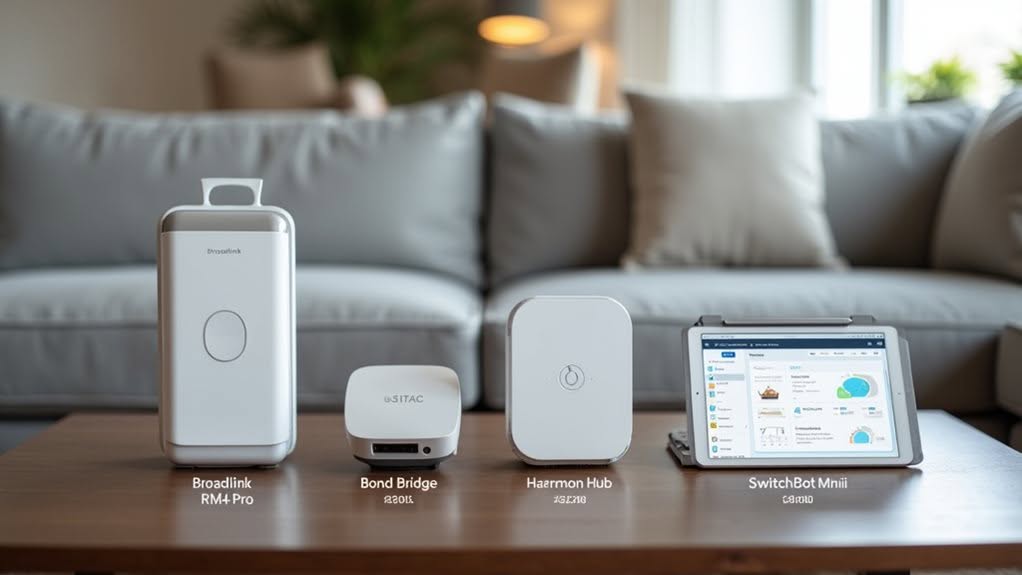
Although features and compatibility often dominate smart home discussions, cost-effectiveness remains a crucial factor when selecting the right IR blaster for your Home Assistant setup.
SwitchBot offers options at different price points, with the Hub 2 providing additional sensors for $100+, while the more affordable Hub Mini focuses solely on IR control functionality.
Zigbee alternatives like the MOES UFO-R11 cost under $60 but require an existing Zigbee hub, making them more economical for those already invested in the ecosystem. The recently introduced battery-powered Zigbee IR controller offers impressive value at €14.95 to €16.40 on AliExpress.
Budget-conscious users might consider the LinknLink eRemote HA at around $40, which offers basic functionality with Alexa and Google Home integration. IR blasters require direct line of sight to effectively control your devices, so placement is crucial when considering any budget option.
For the most cost-effective solution, DIY enthusiasts can build ESPHome-compatible IR blasters using ESP8266 modules for as little as $5-15 per device.
Frequently Asked Questions
How Far Can These IR Blasters Transmit Signals Effectively?
Most IR blasters transmit effectively within 3-8 meters indoors under ideal line-of-sight conditions. You’ll get best results without obstructions, though premium models can reach up to 23-26 feet in favorable environments.
Can These IR Blasters Learn Commands From Original Remotes?
Yes, many IR blasters can learn commands from your original remotes. LinknLink eRemote and eHub models specifically excel at this, allowing you to capture and store custom IR commands for Home Assistant automation.
Do Any IR Blasters Work Without Internet Connectivity?
Yes, several IR blasters work without internet. Zigbee options like MOES UFO-R11, ESPHome-based devices, and Broadlink units (after setup) all function locally through your Home Assistant without requiring cloud connectivity.
Can Multiple IR Blasters Be Used in Different Rooms Simultaneously?
Yes, you can use multiple IR blasters in different rooms simultaneously. Each blaster needs a unique identifier in Home Assistant. Wi-Fi, Zigbee, or ESP-based options all support this multi-room setup with proper configuration.
Are Firmware Updates Available for These IR Blasters?
Yes, most IR blasters support firmware updates. ESPHome devices offer easy over-the-air updates, while Tuya devices typically update through their app. Broadlink devices use proprietary updates, and DIY options allow complete customization of your firmware.
Final Thoughts
You’ve now explored five excellent IR blaster options for your Home Assistant setup. Each device offers unique advantages, from the budget-friendly XIAO Smart IR Mate to the Matter-compatible Switchbot Hub 2. When choosing the right solution, consider your specific needs for device compatibility, connection methods, and price point. With these smart IR blasters, you’ll gain convenient control over your non-smart appliances while expanding your home automation capabilities.


