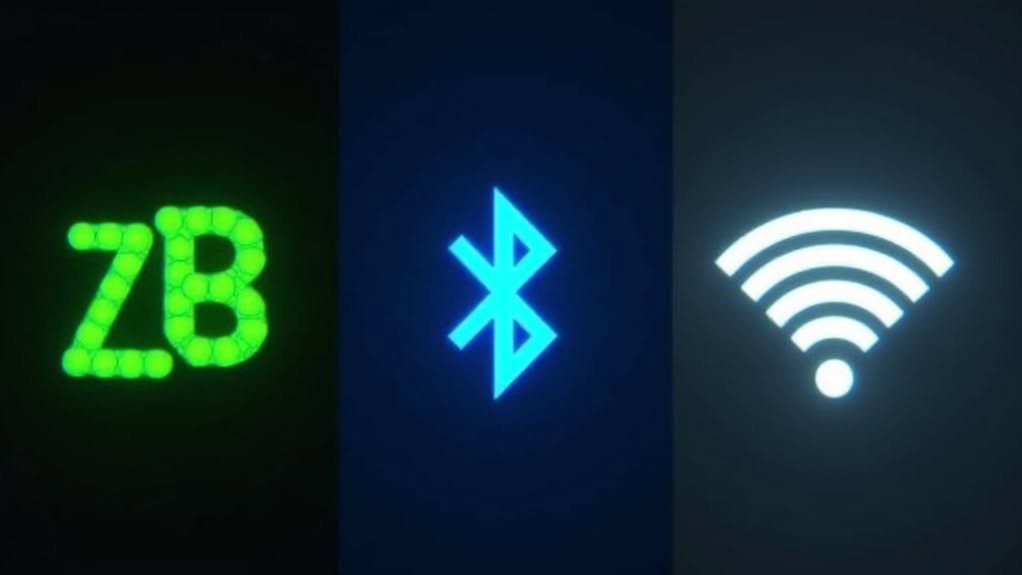
Zigbee is neither Bluetooth nor Wi-Fi, but a separate wireless communication protocol. Built on the IEEE 802.15.4 standard, it’s specifically designed for low-power, low-data-rate networks. While Bluetooth excels at simple device connections and Wi-Fi offers high-speed data transfer, Zigbee prioritizes energy efficiency and mesh networking capabilities. It operates at 250 kbps with ranges of 10-100 meters indoors and creates self-healing networks that can support thousands of devices. The following sections explore these key differences in detail.
What Zigbee Actually Is: A Distinct Wireless Protocol
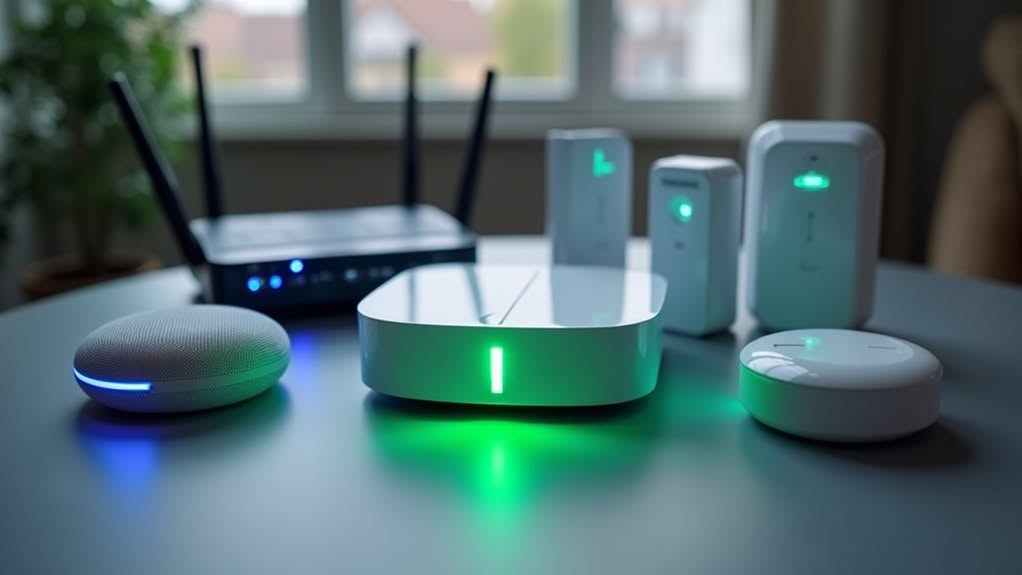
While often confused with Bluetooth or Wi-Fi, Zigbee stands as its own unique wireless communication protocol with distinctly different characteristics.
It’s built on the IEEE 802.15.4 standard, specifically designed for low-power, low-data-rate wireless networks.
Unlike Bluetooth or Wi-Fi, Zigbee operates primarily across three frequency bands—868 MHz (Europe), 915 MHz (US/Australia), and 2.4 GHz (worldwide). Its maximum data rate reaches only 250 kbps, considerably lower than Wi-Fi or Bluetooth.
What makes Zigbee special is its mesh networking capability, where devices can relay data for other devices, extending range and reliability. Zigbee can theoretically support up to 65,000 devices in a single network, though practical implementations typically handle around 240 devices.
The protocol supports three device types: coordinators (network managers), routers (data relayers), and end devices (sensors/actuators).
Zigbee’s architecture prioritizes power efficiency, allowing battery-powered devices to operate for years without replacement. Unlike Wi-Fi which connects directly to routers, Zigbee creates a mesh-like structure that enables numerous small devices to work together effectively.
Comparing Zigbee, Bluetooth, and Wi-Fi Technologies
When you compare these wireless technologies, you’ll find fundamental differences in how each protocol balances range capability against power consumption.
Zigbee prioritizes energy efficiency and mesh networking to extend range, while Bluetooth focuses on simple device-to-device connections with moderate power usage.
Wi-Fi, in contrast, delivers superior data throughput and coverage but demands considerably more power, making each technology suited to different applications based on these core design tradeoffs. Security implementation also varies significantly, with Zigbee offering 128-bit AES encryption to protect sensitive industrial data. The network topology options differ greatly among these protocols, with Zigbee supporting versatile mesh networking capabilities that allow for extended coverage and reliability in complex environments.
Protocol Design Differences
Although Zigbee, Bluetooth, and Wi-Fi are all wireless communication technologies, they differ fundamentally in their protocol design and intended purposes.
Zigbee operates on IEEE 802.15.4 standard, prioritizing low power consumption and extended battery life for IoT and smart home applications. It supports mesh networking with up to 65,000 nodes, making it ideal for complex sensor systems. Zigbee utilizes Direct Sequence Spread Spectrum for its transmission method, which differs from Bluetooth’s approach. Zigbee offers a significantly lower data transfer rate of 250 kbps compared to its alternatives.
Bluetooth, based on IEEE 802.15.1, focuses on short-range device-to-device communication at higher data rates (~1 Mbps). It typically uses a star topology with limited node capacity, usually maxing at 8 connected devices.
Wi-Fi follows IEEE 802.11 standards, delivering much higher data rates (hundreds of Mbps) for bandwidth-intensive applications. It employs point-to-hub topology through central access points, optimized for continuous high-throughput connectivity rather than power efficiency.
Range Vs Power Tradeoffs
The protocol designs of Zigbee, Bluetooth, and Wi-Fi reveal essential differences, but their range and power consumption characteristics further distinguish their practical applications.
Zigbee offers an impressive indoor range of 10-100 meters (up to 300 meters outdoors) while consuming minimal power. Its mesh network topology minimizes failures with multiple transmission paths. Its mesh networking capability extends this range by relaying signals through multiple nodes.
Bluetooth provides shorter ranges around 10 meters with moderate power requirements. Bluetooth 5 offers improved flexibility with four data rates available to balance range and speed needs. Its wall penetration is limited compared to Zigbee, making it better suited for personal device connections.
Wi-Fi delivers the longest potential range (50-100 meters) and highest data rates (up to 9.6 Gbps), but at the cost of considerably higher power consumption. For comprehensive protection, many smart home systems integrate multiple wireless protocols to leverage their respective strengths.
You’ll find Zigbee excels in battery-powered applications where devices need to operate for years without charging, making it ideal for home automation sensors.
Network Structure and Coverage: How Zigbee Differs
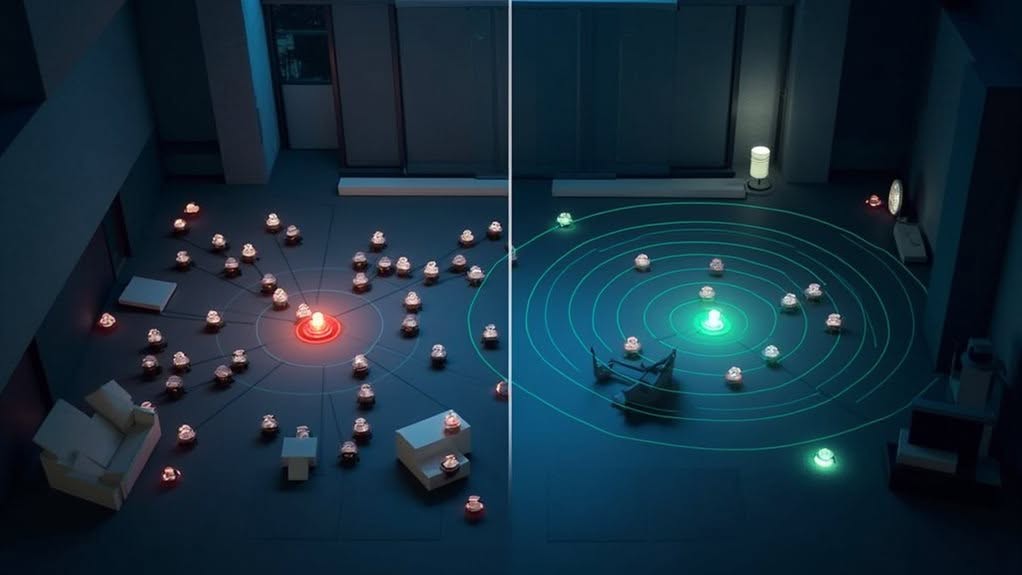
Zigbee’s mesh network structure fundamentally differs from Bluetooth and Wi-Fi’s typical star topology, allowing devices to communicate through multiple paths rather than connecting directly to a central hub.
You’ll find this mesh architecture enables Zigbee networks to “self-heal” by automatically rerouting data when a node fails, creating more reliable connections across your space.
While Wi-Fi might offer faster speeds, Zigbee’s mesh design extends coverage by letting signals hop through multiple devices, effectively expanding your network’s range beyond what a single device could achieve. This extended coverage is made possible through the strategic deployment of Zigbee Router devices that facilitate data transmission throughout the network. The network supports various topologies including star, mesh, or tree configurations, giving users flexibility in designing their IoT infrastructure.
Mesh vs. Star Networks
When examining network structures, Zigbee implements fundamentally different approaches than both Wi-Fi and Bluetooth through its support of star, tree, and mesh topologies.
In star networks, all devices communicate through a single coordinator node. This centralized approach offers simplicity and easier troubleshooting but creates vulnerability—if the coordinator fails, the entire network goes down.
Mesh networks, however, create multiple communication paths between devices. Routers remain always-on to relay messages, while end devices conserve power by sleeping when inactive. This structure enables self-healing capabilities, automatically rerouting if nodes fail.
The differences affect your coverage considerably. Star networks limit range to the coordinator’s reach, while mesh networks extend coverage through multi-hop transmission.
For large spaces or buildings with obstacles, mesh networks provide superior resilience and range without requiring additional range extenders.
Range Extension Capabilities
Unlike Wi-Fi and Bluetooth, Zigbee excels at extending network range through its unique mesh architecture, allowing signals to travel far beyond the limitations of direct device-to-device communication.
While standard Zigbee devices have a line-of-sight range of 10-100 meters indoors, the network’s true power comes from its router functionality.
These routers act as signal repeaters, creating multi-hop pathways for data transmission across your entire home or facility.
- For ideal coverage, place Zigbee routers every 10-15 feet (3-4.5 meters) in challenging indoor environments
- Each router extends the network by relaying messages between devices that can’t directly communicate
- Unlike Wi-Fi’s star topology, Zigbee’s mesh design automatically finds the most efficient path for data transmission
Power Consumption and Battery Life Advantages
One of the most remarkable benefits of Zigbee technology lies in its exceptionally low power consumption profile. With transmit currents around 33-45mA and deep sleep currents under 3µA, Zigbee modules are designed for efficiency.
This power efficiency is achieved through strategic duty cycling, where end devices spend most of their time in sleep mode, activating only when necessary. The hardware and software stacks are specifically customized to minimize energy usage.
When compared to alternatives, Zigbee stands out. Wi-Fi devices typically consume over 100mA during transmission, while Bluetooth generally requires more power for connection maintenance.
Zigbee’s approach prioritizes low average power across the network. For you, this translates to considerably extended battery life—often years on small batteries—making Zigbee ideal for sensors and controls that don’t need constant connectivity.
Speed Vs Efficiency: Data Transfer Rate Differences
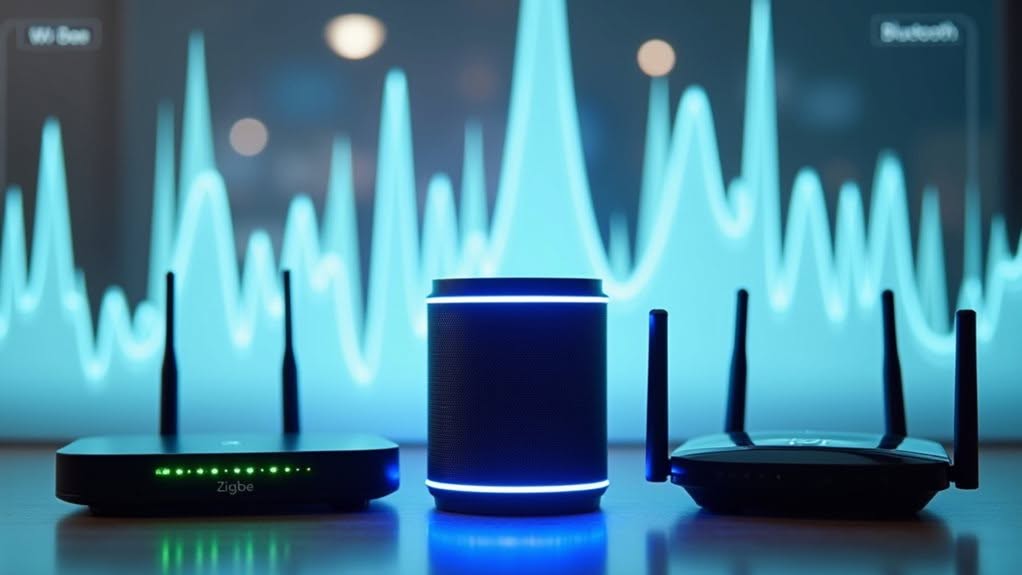
The fundamental difference between Zigbee and its wireless counterparts lies in their data transfer capabilities. Zigbee operates at just 250 kbps with a maximum packet size of 127 bytes, making it suitable only for low-data applications like sensor readings and simple commands.
When you compare the protocols directly:
- Zigbee (250 kbps) prioritizes energy efficiency and reliability over speed, with latency around 70-80 milliseconds.
- Bluetooth offers moderate speeds (1-3 Mbps for Classic, 125 kbps to 2 Mbps for BLE) with point-to-point optimization.
- Wi-Fi delivers considerably higher throughput (hundreds of Mbps to multi-Gbps) but requires more power and processing capability.
Zigbee’s mesh networking extends range through multi-hop transmission but increases latency. This trade-off supports months or years of battery life while restricting throughput to control and sensor data applications.
Choosing the Right Protocol for Your Smart Home Needs
Selecting the right wireless protocol for your smart home involves understanding how each technology addresses your specific needs and constraints.
For battery-powered devices like door sensors or motion detectors, Zigbee’s energy efficiency makes it the superior choice, as devices can operate for years without charging.
If you’re planning a large home with many connected devices, Zigbee’s mesh networking capability provides reliable coverage without additional infrastructure.
Wi-Fi remains the best option for bandwidth-intensive applications such as security cameras or streaming speakers. These devices typically have constant power sources, negating Wi-Fi’s higher energy consumption.
Consider which devices you’ll connect most frequently.
If you’re primarily interested in controlling lights, locks, thermostats, and sensors, Zigbee’s interoperability across manufacturers offers greater flexibility than either Bluetooth or Wi-Fi alone.
Frequently Asked Questions
Can Zigbee Devices Communicate With Bluetooth or Wi-Fi Devices Directly?
No, your Zigbee devices can’t communicate directly with Bluetooth or Wi-Fi devices. They’ll need a bridge or hub to translate between these different protocols. Future Matter-compatible devices may improve this interoperability.
Does Zigbee Require a Separate Hub for Smart Home Integration?
Yes, you’ll generally need a dedicated Zigbee hub for smart home integration. This hub acts as the central coordinator that manages your devices, enables automations, and connects your Zigbee network to other systems.
How Secure Is Zigbee Compared to Wi-Fi for Sensitive Applications?
While Zigbee offers robust 128-bit AES encryption, Wi-Fi’s WPA3 provides more advanced security features. For sensitive applications, both need regular audits, but Wi-Fi’s widespread adoption has led to more mature security infrastructure.
Can Zigbee Penetrate Walls and Obstacles Better Than Bluetooth?
Yes, Zigbee penetrates walls better than Bluetooth. You’ll get superior obstacle penetration thanks to Zigbee’s mesh networking and its ability to operate on lower frequencies, which helps signals traverse through walls more effectively.
Are There Compatibility Issues Between Different Brands of Zigbee Devices?
Yes, you’ll encounter compatibility issues between different Zigbee brands due to proprietary implementations, despite standardization. Always check compatibility before purchasing, as some devices may require specific hubs or software to work together properly.
Final Thoughts
Zigbee isn’t Bluetooth or Wi-Fi, but a separate wireless protocol with its own distinct advantages. You’ll find it excels in smart home applications due to its low power consumption, reliable mesh networking, and compatibility with numerous devices. When choosing between these technologies, consider your specific needs for range, battery life, and data transfer rates. Each protocol serves different purposes, with Zigbee positioning itself as an efficient option for connected home systems.