
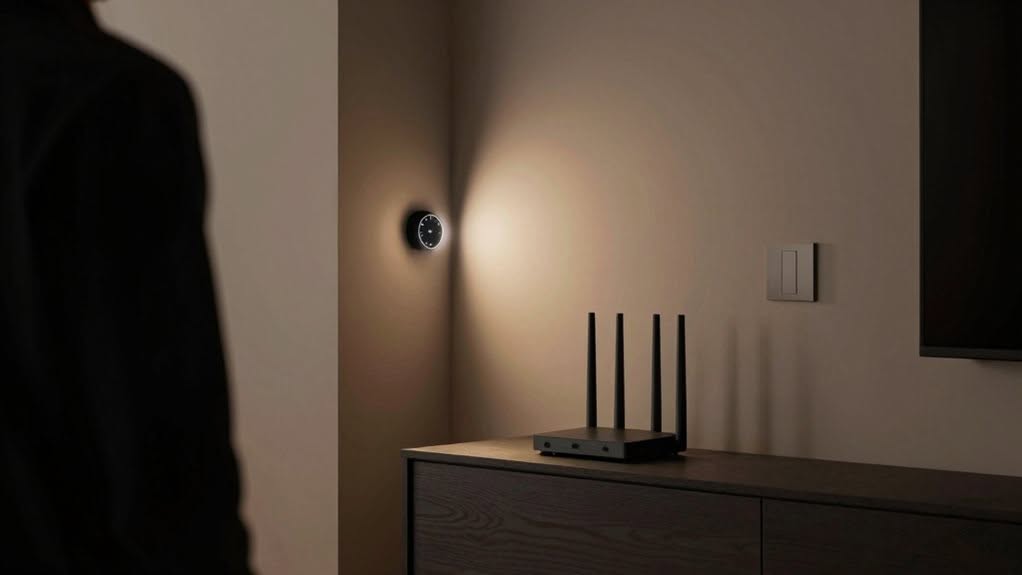
Mmwave technology represents a notable leap beyond traditional motion sensors for home automation. Operating at 30-300 GHz frequencies, these sensors detect both movement and stillness by capturing micro-motions like breathing. When integrated with Thread networks, they enable reliable, low-power presence detection that works across multiple rooms without privacy concerns. Combined with Matter protocol support, mmwave sensors create truly responsive environments that eliminate the need for manual light switches. Discover how this technology creates homes that respond intuitively to your presence.
Understanding the Science Behind Mmwave Sensing Technology
Millimeter wave (mmWave) sensing technology represents one of the most advanced approaches to presence detection available today. This radar-based system operates at frequencies between 30-300 GHz, typically using the 60-77 GHz range for sensing applications.
When you install an mmWave sensor, it emits electromagnetic waves that bounce off objects and return to the device. The system measures the time delay of these reflections to determine distance, while frequency shifts (Doppler effect) reveal motion and velocity. These sensors consist of a signal generator and specialized antennas for both transmitting and receiving signals.
Unlike cameras or infrared sensors, mmWave technology works in darkness and can detect presence through materials like fabric and plastic. The system isn’t affected by environmental conditions such as rain, dust, or strong sunlight. The superior resolution of mmWave technology allows it to detect even the smallest movements and environmental changes with remarkable precision.
Signal processing techniques like Fast Fourier Transform and beamforming improve accuracy by filtering noise and enhancing spatial resolution, allowing for precise detection of human presence.
Why Traditional Motion Sensors Are Being Left Behind
While mmWave technology represents the cutting edge of presence detection, traditional motion sensors are rapidly becoming obsolete due to their considerable limitations.
These conventional sensors struggle with false alarms triggered by pets, wind, or passing vehicles, undermining your trust in the system and wasting energy through unnecessary activations. Traditional motion sensors also lack the customizable settings necessary to adapt to diverse environmental conditions and specific user needs.
Over time, frequent false positives lead to desensitization and increased frustration.
Coverage presents another important challenge. Traditional sensors can’t effectively monitor larger or irregular spaces without multiple units, often leaving blind spots where intruders can hide undetected.
Weather conditions further compromise their reliability.
Security vulnerabilities are equally concerning. Skilled intruders can recognize sensor patterns, jam signals, or simply maneuver around detection zones.
Without integration capabilities for modern smart home ecosystems, these standalone devices lack the thorough protection and privacy controls that today’s homeowners expect.
Installation often requires professional assistance due to technical electrical configurations and strategic placement requirements for optimal performance.
Modern security systems provide significant advantages over these outdated technologies with enhanced detection capabilities and fewer false alarms.
Technical Capabilities That Make Mmwave Revolutionary
Unlike traditional motion detection systems that can only register broad movements, mmWave technology introduces a revolutionary suite of capabilities that transform how we detect human presence.
Operating between 24 GHz and 300 GHz, these sensors detect both motion and stillness, identifying people who are sitting, sleeping, or otherwise stationary. You’ll find they can track multiple people simultaneously within ranges up to 25 meters.
What’s truly impressive is mmWave’s ability to detect micro-movements like breathing, maintaining presence status even when you’re nearly motionless.
These compact sensors, roughly 24 mm by 28 mm, penetrate non-metallic materials and work in darkness or through obstructions. With a power requirement of just 3.6~5V, these sensors can be easily integrated into various smart home applications.
They’re resistant to interference from light changes and temperature fluctuations, outperforming traditional sensors in nearly all environmental conditions. Modern mmWave sensors also allow for the creation of virtual zones for precise control over specific areas in your home.
The Seamless Integration of Mmwave With Thread Networks
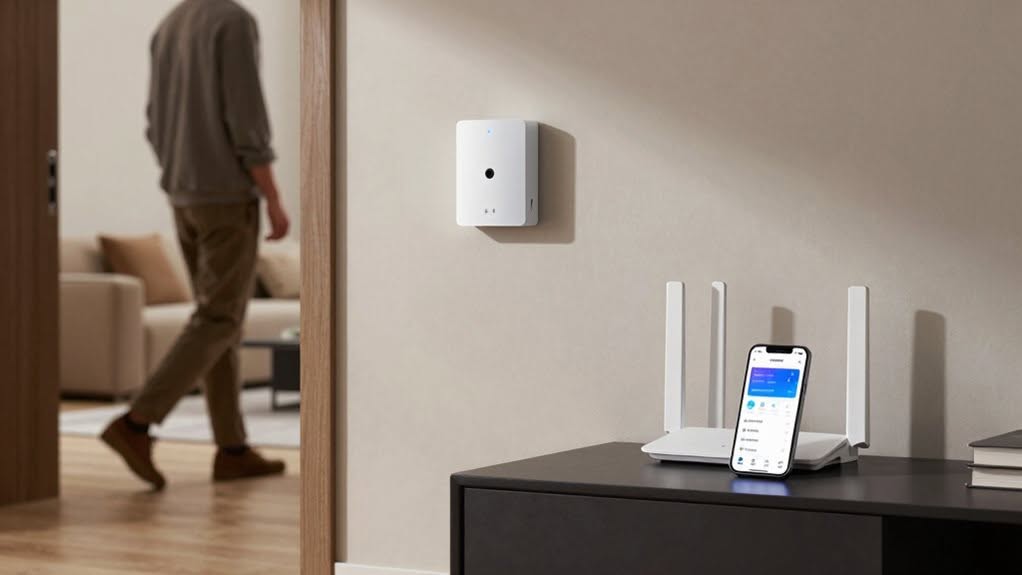
The integration of mmWave technology with Thread networks represents a notable improvement in smart home infrastructure.
Thread’s low-power mesh networking protocol provides the perfect foundation for mmWave sensors, allowing self-healing networks that maintain continuous coverage.
When you install mmWave sensors on a Thread network, you’ll benefit from multi-room presence detection with IPv6 connectivity that integrates seamlessly with your existing IP networks.
The Matter protocol running over Thread further improves this setup by guaranteeing cross-platform interoperability across different smart home ecosystems.
Thread’s capabilities also support hybrid sensor strategies, where mmWave can work alongside PIR sensors for event-triggered scanning.
This approach balances detection accuracy with energy efficiency while enabling coordinated sensor fusion through Thread’s real-time communication capabilities.
The intelligent algorithms within these systems continuously optimize scanning strategies to maximize battery life without compromising the reliability of presence detection.
With support from major tech companies including Apple, Google, Amazon, and Samsung, Thread and Matter create a unified smart home environment where mmWave sensors can operate consistently across all platforms.
Smart Home Applications: Beyond Basic Automation
Smart homes equipped with mmWave and Thread technology offer considerably more sophisticated capabilities than conventional automation systems that rely on simple triggers.
Your home becomes truly responsive when devices activate only during actual occupancy, eliminating wasted energy from running air purifiers, fans, and heaters in empty rooms.
Unlike motion-dependent systems that shut off during periods of stillness, mmWave sensors detect subtle biological signals like breathing, guaranteeing lights remain on even when you’re sitting quietly. This technology divides rooms into 20-30 separate zones for localized lighting adjustments. Studies show these smart systems can reduce energy waste by 30% according to the U.S. Department of Energy.
Beyond convenience, these systems support wellness applications by monitoring breathing patterns and enabling sleep tracking without wearables.
For elderly care, they provide fall detection and nighttime movement monitoring without privacy-invasive cameras, allowing for quick response to potential emergencies. The affordable mmWave modules are starting at $10, making this advanced technology accessible for both developers and DIY home automation enthusiasts.
Privacy and Security Advantages in a Camera-Free World
When choosing mmWave presence detection for your smart home, you’ll benefit from built-in data anonymity that doesn’t capture identifiable images or videos of household members.
Unlike camera-based systems, mmWave sensors detect presence without visual surveillance, preserving your family’s privacy while maintaining security functionality.
Many mmWave devices process data locally rather than in the cloud, adding another layer of protection by keeping your occupancy information secure within your home network.
Data Anonymity by Design
Unlike camera-based monitoring systems that capture recognizable images of individuals, mmWave and Thread-based presence detection offers inherent data anonymity by design.
These technologies collect only crucial movement and proximity data, rather than storing personally identifiable information.
Data anonymization techniques further improve privacy protection:
- Pseudonymization replaces personal identifiers with coded values, preventing direct identification while maintaining system functionality.
- Edge computing processes data locally, minimizing transmission of sensitive information to cloud servers.
- Differential privacy adds mathematical noise to collected data, making it impossible to extract individual patterns while preserving statistical usefulness.
This privacy-by-design approach helps your smart home comply with regulations like GDPR without sacrificing performance.
The systems maintain utility through customized anonymization algorithms that balance security needs with detection accuracy.
No Visual Surveillance
Because traditional security systems rely heavily on cameras, they create considerable privacy concerns for homeowners and businesses alike.
mmWave and Thread-based presence detection technologies offer a compelling alternative by detecting occupancy without capturing any visual information.
Unlike cameras that collect identifiable personal data, these non-visual sensors only detect presence or movement patterns. You’ll appreciate that no images or video recordings exist that could be compromised through security breaches.
These systems process data locally on the device, minimizing exposure to potential cloud vulnerabilities. They’re also effective in all lighting conditions and consume less power than camera-based alternatives.
The psychological comfort of not being visually monitored is substantial. You can maintain security without the discomfort many people feel when under camera surveillance, especially in private spaces like bedrooms or bathrooms.
Local Processing Protection
Local processing represents one of the most powerful privacy safeguards in smart home security systems today. When your data stays within your home network rather than traveling to external servers, you maintain complete control over sensitive information like motion events and sensor readings.
This approach creates a considerable more private and secure environment by:
- Eliminating cloud transmission that could expose your data to breaches or third-party collection
- Maintaining full functionality during internet outages, guaranteeing security systems remain operational
- Reducing attack surface for remote cyber intrusions that typically target cloud-connected devices
Your smart home remains responsive without cloud latency, making security responses faster and more reliable.
This local edge computing model guarantees that sensitive identification data never leaves your premises, giving you true data sovereignty regardless of external policy changes.
The Evolution of Home Control: Living Without Switches
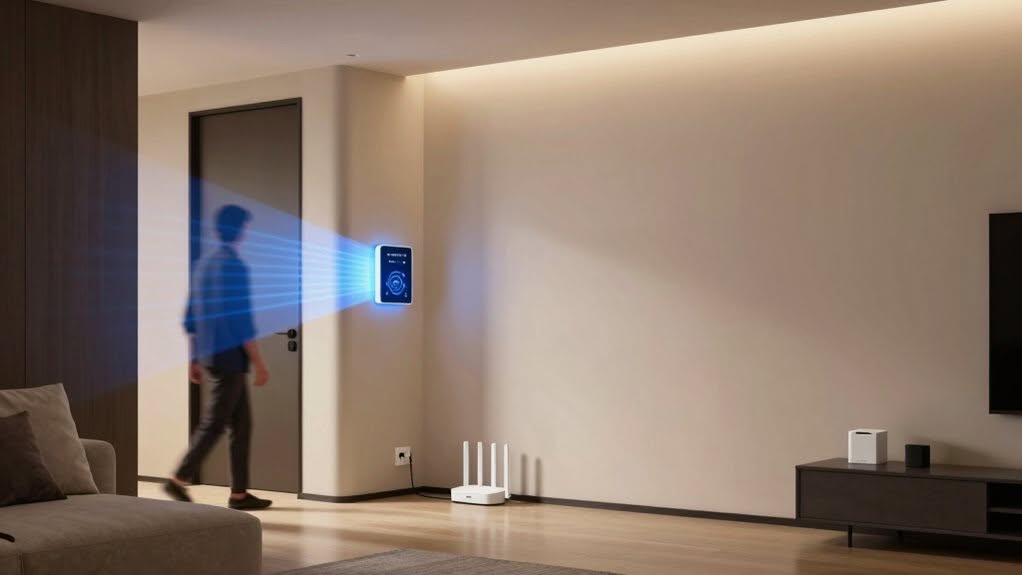
Traditional manual light switches may soon become as obsolete as landline phones in modern homes equipped with mmWave presence detection technology.
You’ll find your spaces responding to your presence automatically, with lights illuminating as you enter rooms and adjusting based on your location within defined zones.
This evolution toward buttonless living extends beyond lighting to create truly responsive environments where gesture controls and ambient intelligence replace physical switches, eliminating the frustration of fumbling for controls in the dark.
Subheading Discussion Points
As smart home technology advances rapidly, the concept of living without traditional wall switches has transformed from science fiction into practical reality. Millimeter-wave radar sensors now detect subtle human movements, including breathing, enabling truly automatic control systems.
The benefits of this switchless evolution include:
- Energy efficiency improves dramatically as systems operate only when needed, reducing your home’s carbon footprint.
- Privacy concerns are addressed through non-camera detection methods that use radio waves rather than capturing images.
- Customizable detection zones allow for precise control customized to your specific room layouts and usage patterns.
Thread and Matter protocols improve these capabilities by providing reliable, low-latency connections between devices.
With sensors that can differentiate between actual occupants and false triggers, your home responds intelligently to your presence without requiring conscious interaction or physical touch.
Gesture Controls Replace Buttons
Moving beyond pure presence detection, modern smart homes now utilize sophisticated gesture recognition to eliminate physical switches altogether.
These systems achieve up to 98.8% precision and 97.7% recall for numerical commands, making them reliable for everyday use.
You can control lights, TVs, and music systems with simple hand movements from up to 3.5 meters away from sensors.
The technology combines AI algorithms with depth-sensing cameras and infrared sensors to understand your intentions accurately.
The market reflects growing acceptance, with global gesture recognition expected to reach $165.49 billion by 2034.
This technology is particularly beneficial for elderly and disabled users who may struggle with traditional controls.
AI-powered systems, comprising about 45% of gesture recognition by 2025, will continue improving response times while reducing false positives.
Voice-Free Ambient Intelligence
Voice commands, once considered revolutionary for smart homes, now represent merely a stepping stone toward true ambient intelligence. The future of smart homes relies on systems that anticipate your needs without explicit instructions.
True ambient intelligence integrates multiple technologies to create a seamless, voice-free experience:
- mmWave radar sensors detect your presence and movement with high accuracy while maintaining privacy.
- Thread protocol enables reliable, secure mesh networking that connects devices without cloud dependency.
- AI algorithms learn your patterns and preferences, automatically adjusting environments based on context.
These technologies work together to eliminate the need for manual controls entirely. Your home recognizes you, understands your routines, and adapts to your moods without commands.
This shift from reactive to predictive control represents the next evolution in home automation—one where technology fades invisibly into the background.
Future-Proofing Your Smart Home With Presence Detection
When designing a smart home system that’ll stand the test of time, presence detection technology should be at the core of your planning.
Choose mmWave sensors for true presence detection that works regardless of movement. Unlike PIR sensors, mmWave can detect micro-movements like breathing, making it reliable for static presence situations.
Thread connectivity offers notable advantages over Wi-Fi or Bluetooth for presence sensors. Its self-healing mesh network extends coverage throughout your home while reducing Wi-Fi congestion.
Consider zone-based sensors that can divide rooms into specific areas. The Aqara FP2 and Apollo MTR-1 track multiple people with individual coordinates, enabling sophisticated automations based on precise locations.
For maximum flexibility, select Matter-compatible devices that work across ecosystems. This interoperability guarantees your presence detection system remains valuable regardless of which platforms you use.
Frequently Asked Questions
What Is the Average Cost of Implementing Mmwave Sensors Throughout a Home?
You’ll spend $2,000-$6,000 for a whole-home mmWave setup, including hardware ($10-100 per sensor) and installation costs. Prices vary based on your home’s size, sensor quality, and professional installation requirements.
How Much Power Do Mmwave Sensors Consume Compared to Traditional Motion Sensors?
You’ll find mmWave sensors consume considerably more power than traditional motion sensors – typically 1-2W compared to just tens of milliwatts for PIR sensors, making battery operation more challenging for mmWave technology.
Can Mmwave Sensors Distinguish Between Different Household Members or Just Detect Presence?
mmWave sensors can’t identify who you are specifically. They’ll detect your presence and can count multiple people in different zones, but won’t distinguish between you, your spouse, or your children individually.
What Happens During Power Outages With Mmwave and Thread-Based Lighting Systems?
During power outages, your hardwired mmWave sensors stop working while battery-powered ones continue. Thread networks partially function with battery devices. Lights turn off and won’t respond to presence detection until power’s restored.
How Long Does a Typical Mmwave Presence Detection Sensor Last Before Replacement?
Battery-powered mmWave sensors typically last 3 years on AA batteries, while wired versions can exceed 10 years. You’ll replace them less often than PIR sensors, especially if you’ve installed them in low-traffic areas.
Final Thoughts
You’re witnessing the beginning of a transformative era in home automation. Mmwave sensors and Thread networks will soon make light switches obsolete, replacing them with intuitive presence detection that responds to your movements and needs. This technology offers improved privacy without cameras, greater energy efficiency, and more natural interaction with your living space. By embracing these advancements now, you’ll create a home that anticipates your needs before you reach for a switch.


