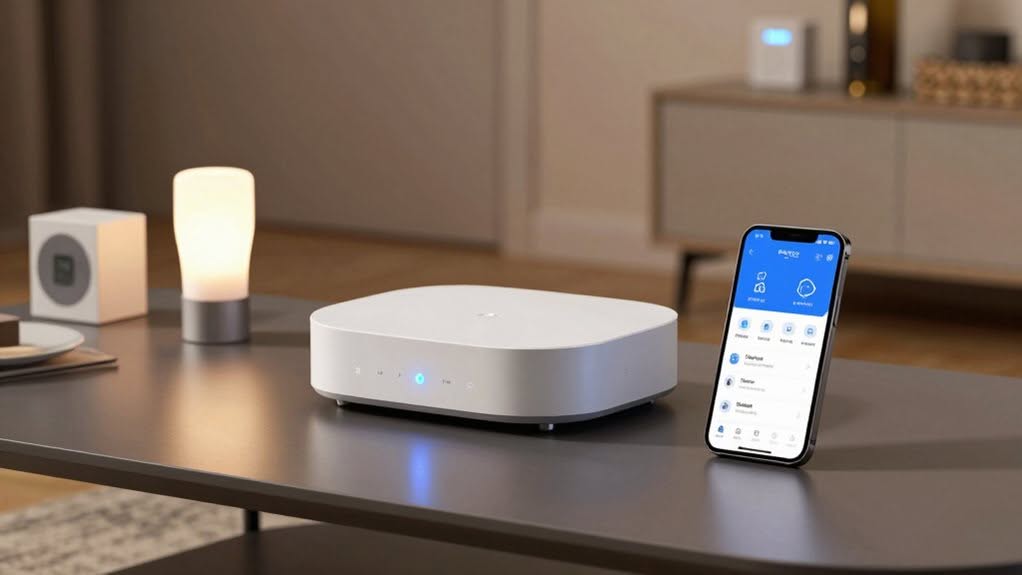
Thread, Matter, and ZBT-2 represent the future of home automation by addressing key smart home challenges. Thread offers a self-healing mesh network with IPv6 addressing for direct device communication, while Matter enables cross-platform compatibility between major tech ecosystems. The ZBT-2 controller delivers considerable performance improvements with its upgraded MG24 chipset, 4× faster baud rates, and support for both Thread and Zigbee protocols. These technologies together create a more reliable, flexible foundation for your evolving smart home ecosystem.
Understanding Thread Protocol’s Technical Advantages
While many smart home protocols compete for market dominance, Thread stands out with its impressive technical architecture designed specifically for home automation.
Thread’s self-healing mesh network eliminates single points of failure by allowing devices to communicate directly or relay through others. If one device goes offline, your network remains intact through automatic multi-path routing.
You’ll appreciate Thread’s IPv6 foundation, which enables direct IP-based communication without proprietary gateways. This simplifies integration with existing networks like Wi-Fi and Ethernet.
For battery-powered devices, Thread’s energy efficiency is remarkable. Your motion sensors and door locks can operate on a single coin cell battery for years, reducing maintenance needs. The network intelligently manages sleepy end devices that conserve power by entering sleep mode when not in use. Thread effectively supports various device configurations for flexible communication patterns throughout your home ecosystem.
When integrated with smart energy management, Thread can help optimize power consumption and reduce utility bills across your entire home.
Security isn’t an afterthought with Thread—it employs AES-128 encryption and DTLS to protect your data, guaranteeing your smart home remains secure from intrusions.
How Matter Changes the Smart Home Ecosystem
As the smart home industry evolves, Matter represents the most substantial standardization effort to date, fundamentally changing how devices interact across ecosystems. This protocol creates a unified foundation that eliminates previous compatibility barriers.
With Matter, you’ll experience four key improvements:
- True cross-platform interoperability allowing devices from Apple, Google, and Amazon to work together seamlessly.
- Enhanced security through end-to-end encryption and blockchain device registry.
- Simplified setup process with reduced dependence on proprietary hubs.
- Future-proofed investments as devices maintain compatibility with evolving technologies.
Matter empowers you to purchase smart devices based on features rather than ecosystem compatibility. The protocol was developed by the Connectivity Standards Alliance, providing a reliable framework for device manufacturers to build upon. Matter was formerly Project CHIP before its official launch and rebranding.
Your existing Wi-Fi, Thread, and Ethernet networks will support this new protocol, guaranteeing direct device-to-device communication with improved responsiveness and reduced cloud dependence.
ZBT-2 Hardware: Performance Breakthrough Analysis
The ZBT-2’s upgraded MG24 chipset and quadrupled baud rate allow it to handle considerably more network traffic than its predecessor, especially in homes with dozens of connected devices.
You’ll notice more fluid performance when multiple devices communicate simultaneously, as the increased RAM and processing power prevent bottlenecks that previously caused delays.
The adapter’s ability to support both Zigbee 3.0 and Thread protocols concurrently gives you flexibility to integrate diverse smart home ecosystems without needing separate hardware for each protocol. The ZBT-2 also ensures full Matter support for future-proof compatibility with the latest smart home standards. The free-standing antenna provides significantly better signal strength and range, enabling more reliable connections even in larger homes with challenging layouts.
Network Traffic Handling
Network traffic handling capabilities receive a considerable upgrade in the ZBT-2 hardware, delivering breakthrough performance that transforms home automation responsiveness.
The new adapter processes commands and data with markedly lower latency, guaranteeing your smart home devices respond almost instantly to your inputs. The affordable price point of only $48.95 makes this powerful technology accessible to both beginners and experienced users alike. Users will appreciate the adapter’s indoor-only design with operating temperatures between 0°C to 65°C, ensuring stable performance in various home environments.
- 4× faster baud rates (460800 vs previous 115200) reduce communication delays between your devices and Home Assistant.
- Enhanced signal processing with optimized power and low noise amplifiers cuts interference for more reliable connections.
- High-gain 4.16 dBi omnidirectional antenna extends range and improves signal quality throughout your home.
- Improved traffic management handles both Zigbee 3.0 and Thread protocols concurrently without bottlenecks.
The combined MG24 and ESP32-S3 chipset architecture efficiently manages network congestion, especially during peak usage when multiple devices communicate simultaneously.
Dual Protocol Advantages
Revolutionary in design and function, the ZBT-2 hardware delivers unprecedented dual protocol integration that transforms home automation capabilities.
The device simultaneously supports both Zigbee 3.0 and Thread protocols on a single platform, enabling seamless Matter compatibility. It’s important to note that Connect ZBT-2 cannot operate both protocols simultaneously, as this was designed to avoid inconsistencies found in previous multiprotocol testing.
You’ll experience notable performance improvements thanks to the Silicon Labs MG24 chip, which operates faster than the previous MG21 generation while offering improved signal sensitivity. The device ships with a quickstart guide for immediate setup assistance straight out of the box.
This translates to more responsive control and better detection of weak signals throughout your home.
The high-gain 4.16 dBi omnidirectional antenna extends wireless range, while optimized amplifiers reduce interference from common sources like USB 3.0 devices.
With ESP32-S3 as the USB-serial bridge, you’ll enjoy data rates four times faster than previous models through the modern USB-C connection.
Comparing Thread and Zigbee: Making the Right Choice
When choosing between Thread and Zigbee for your smart home setup, you’ll need to evaluate how each protocol balances connectivity and interoperability.
Zigbee offers superior power efficiency for battery-operated devices like sensors and door locks, while Thread’s IPv6 foundation provides easier integration with internet-connected systems.
Your decision should also factor in device availability, as Zigbee currently boasts a more mature ecosystem with thousands of compatible products, though Thread’s growing adoption through Matter may soon change this environment.
Comparing Thread and Zigbee: Making the Right Choice
Choosing between Thread and Zigbee for your home automation setup depends on understanding their fundamental differences in architecture, ecosystem, and functionality. Each protocol offers distinct advantages that might better suit your specific needs.
- Network Architecture: Thread uses IPv6 addressing with direct device communication, while Zigbee employs 16-bit network addresses requiring gateway translation for internet access.
- Ecosystem Maturity: Zigbee boasts thousands of interoperable products from many manufacturers, whereas Thread’s ecosystem is newer but growing rapidly with Matter-certified devices.
- Setup Experience: Thread offers simpler setup with QR code commissioning, while Zigbee typically requires configuring a centralized hub as its trust center.
- Performance Characteristics: Thread provides low latency through efficient IP routing, perfect for real-time applications, whereas Zigbee’s broadcast approach remains exceptionally stable in dense device networks.
Power Efficiency Tradeoffs
Although both Thread and Zigbee serve similar purposes in home automation, their power consumption profiles differ greatly, impacting device battery life and overall system efficiency.
Zigbee’s mature technology excels in ultra-low power consumption, allowing sensors and lights to operate on batteries for years without replacement. Its extensively field-tested implementations demonstrate consistent efficiency in various environments.
Thread offers competitive power efficiency but with notable differences. Its IP-based architecture requires more processing power, though some implementations benefit from leaner protocol stacks.
Thread’s self-healing mesh can reduce power-draining retransmissions, but requires always-on routers.
Network topology considerably affects power usage in both protocols. While Thread generally achieves lower latency (reducing radio-on time), Zigbee’s simpler stack requires less processing power on constrained hardware.
Your specific use case will determine which protocol’s power efficiency approach makes more sense.
Device Ecosystem Considerations
The device ecosystem surrounding a home automation protocol greatly impacts its practicality and long-term viability in your smart home setup.
When comparing Thread and Zigbee, several key factors should influence your decision.
- Zigbee offers thousands of compatible devices from numerous manufacturers, providing extensive product variety right now.
- Thread’s ecosystem is smaller but expanding rapidly due to Matter adoption, particularly with Apple HomeKit integration.
- Matter protocol aims to unify ecosystems, potentially making today’s protocol choice less crucial for future compatibility.
- Setup complexity differs considerably—Zigbee requires hub-based pairing while Thread enables smartphone-based QR code commissioning.
Your current needs versus future-proofing will determine the best choice.
If immediate device selection is paramount, Zigbee’s mature ecosystem offers advantages.
If you’re building gradually, Thread’s growing ecosystem with Matter support might better serve your long-term smart home strategy.
Implementing ZBT-2 in Your Existing Smart Home Setup
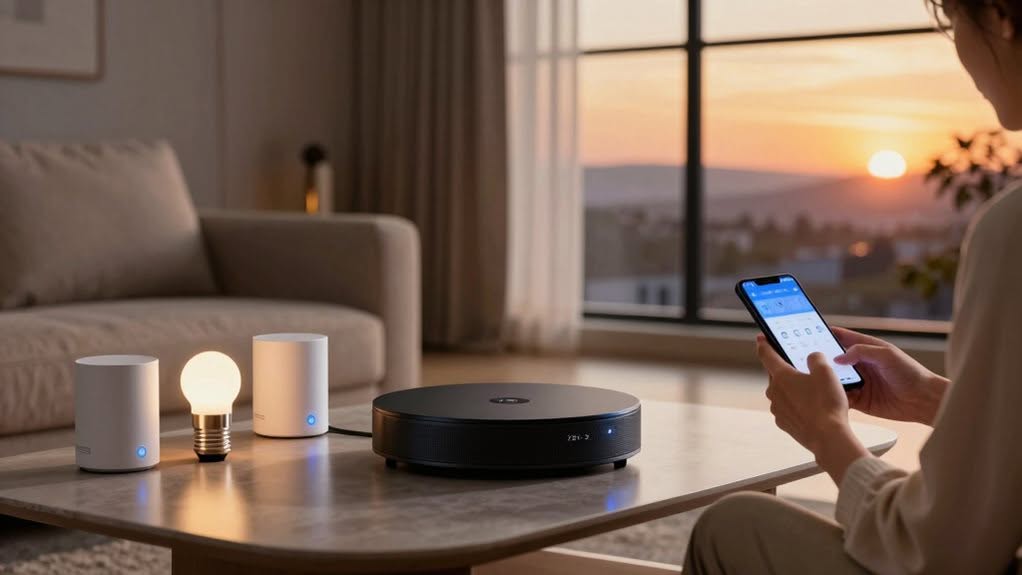
When upgrading your smart home with the ZBT-2 controller, you’ll need to follow several important steps to guarantee proper integration with your current setup.
Begin by installing the appropriate firmware—either Zigbee or Thread—through the Home Assistant interface. Position the device upright with antennas carefully attached, and connect it to a USB 2.0 port on your hub.
If you’re migrating from an existing network, back up your current configuration before transferring it to ZBT-2. The device supports migrations from Zigbee2MQTT, deCONZ, and ZHA platforms.
For peak performance, mount the ZBT-2 in a central location away from interference.
Take advantage of its improved Silicon Labs MG24 chip, which delivers 4x faster baud rates and better sensitivity for weak signals compared to previous generations.
Strategic Framework for Future-Proof Smart Home Decisions
Developing a strategic framework for future-proofing your smart home requires careful consideration of evolving protocols and technologies.
Matter certification now enables seamless interoperability across major ecosystems, while Thread provides superior mesh networking for battery-powered devices.
When building your smart home infrastructure, focus on these crucial elements:
- Select a primary protocol – Choose Thread for future-proofing, as it offers IPv6 addressing and efficient power consumption.
- Plan network expansion – Deploy dedicated border routers and quality hardware like the ZBT-2 to guarantee reliable coverage.
- Prioritize certified devices – Matter-certified products reduce fragmentation risks and guarantee ongoing firmware support.
- Consider ecosystem trends – Major manufacturers are increasingly releasing affordable Thread-enabled devices, signaling the industry’s direction.
Smart homes designed with these principles will remain adaptable as technology evolves.
Frequently Asked Questions
How Many Thread Devices Can I Control With a Single ZBT-2?
You can control 200-250+ Thread devices with a single ZBT-2. The exact maximum depends on your device types, network topology, and environment. The ZBT-2’s improved RAM and processing power supports this large-scale deployment.
Can I Use ZBT-2 With Non-Matter Devices in My Network?
Yes, you can use ZBT-2 with non-Matter devices. It supports Zigbee 3.0 devices and Thread devices, though you’ll need to choose one protocol at a time as they can’t run simultaneously.
Will ZBT-2 Improve Response Times for My Existing Zigbee Devices?
Yes, your existing Zigbee devices will respond faster with ZBT-2. You’ll notice up to 4× quicker communication times, better signal range, and reduced latency, especially for devices connecting directly to the coordinator.
Is Thread More Secure Than Zigbee for Sensitive Home Automation Tasks?
Yes, Thread is more secure than Zigbee for sensitive tasks. You’ll benefit from its mandatory AES-128 encryption, self-healing mesh network, and IPv6 architecture that eliminates translation vulnerabilities common in Zigbee’s gateway-dependent systems.
How Does ZBT-2 Performance Compare in Large Homes With Concrete Walls?
ZBT-2 excels in concrete-walled homes thanks to its external omnidirectional antenna, 4× faster speeds, and improved signal penetration. You’ll experience reliable connections up to 150ft away, even through thick walls and across multiple floors.
Final Thoughts
You’ve now seen how Thread, Matter, and ZBT-2 represent notable advancements in home automation technology. By understanding their technical advantages and compatibility features, you’re better positioned to make informed decisions. Whether you’re upgrading existing systems or planning a new smart home setup, these protocols provide the reliability, security, and interoperability you’ll need for years to come. Consider your specific requirements when choosing which technologies to implement.


