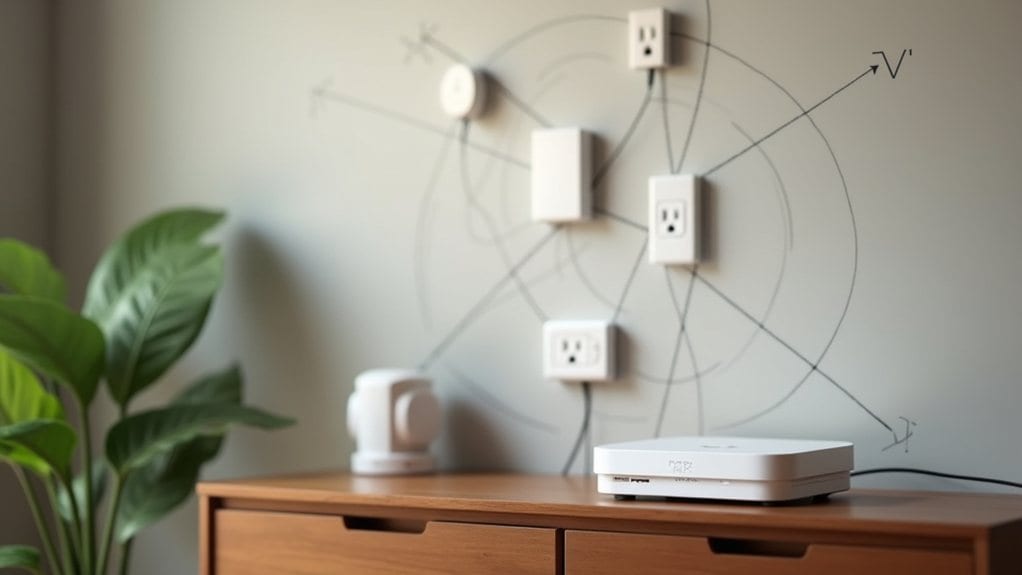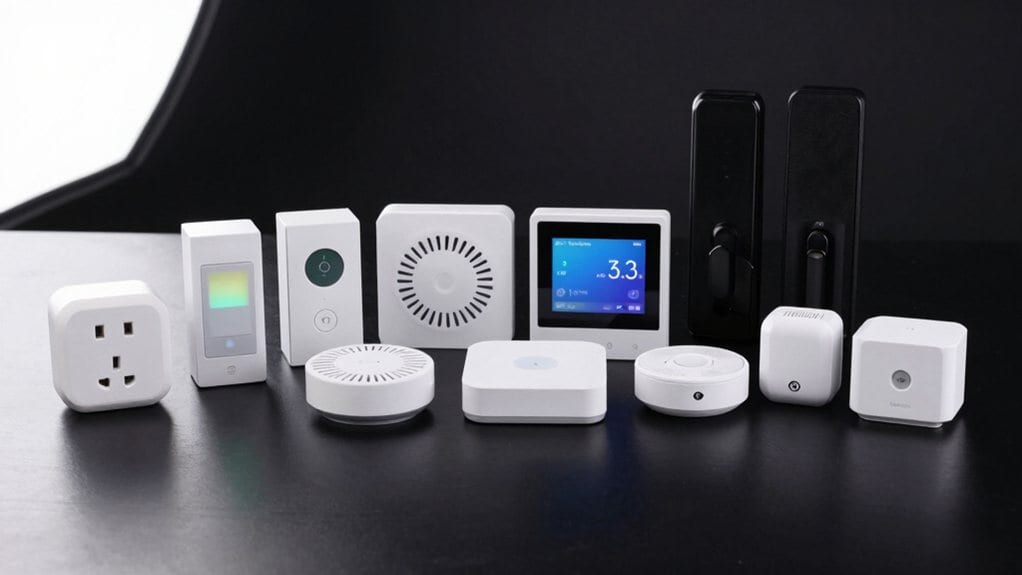
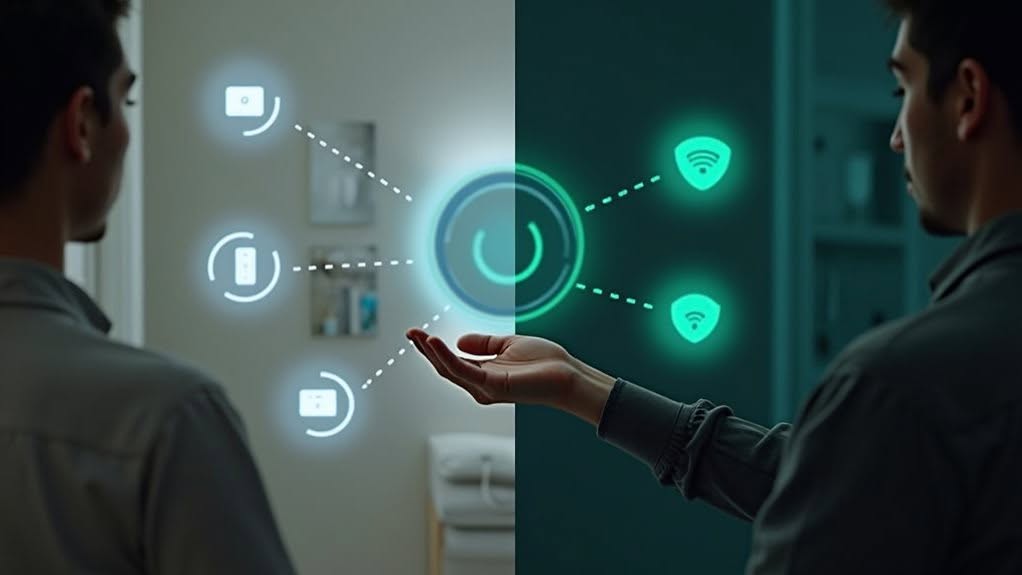
Choosing between Matter and Zigbee depends on your smart home priorities. Matter offers superior cross-brand compatibility and future-proofing with strong security features, working over Wi-Fi, Thread, and Bluetooth without requiring dedicated hubs. Zigbee provides better power efficiency for battery-operated devices and has a mature ecosystem with reliable mesh networking, though its interoperability is limited. Your decision should balance immediate device availability against long-term ecosystem viability as the industry continues its shift toward unified standards.
Understanding the Core Differences Between Matter and Zigbee

While both Matter and Zigbee serve as smart home connectivity solutions, they function in fundamentally different ways.
Smart home standards differ profoundly in their architectural approach to solving connectivity challenges.
Matter operates at the application layer, not as a radio protocol itself but as an interoperability standard running over Wi-Fi, Thread, and Ethernet.
Zigbee, in contrast, is a wireless mesh protocol that works at the network and physical layers, designed specifically for low-power communication between devices within its ecosystem.
The most notable difference is how they approach connectivity. Matter abstracts the underlying network, allowing devices to communicate seamlessly regardless of whether they use Wi-Fi, Thread, or Ethernet. Matter releases new versions regularly to add support for additional device types, ensuring continued growth of the ecosystem.
Zigbee requires all devices to use its specific protocol, which limits cross-network compatibility.
You’ll also find Matter’s security architecture more robust, utilizing Public Key Infrastructure and a blockchain-based Distributed Compliance Ledger, while Zigbee relies on 128-bit AES encryption and centralized trust centers.
Zigbee’s effectiveness in mesh networking makes it particularly reliable for large-scale deployments where signal strength might otherwise be compromised.
Smart Home Compatibility and Device Ecosystem
Every smart home enthusiast faces a critical decision when comparing Matter and Zigbee‘s compatibility features.
Matter offers superior cross-brand interoperability, supporting Wi-Fi, Bluetooth, and Thread protocols simultaneously. Your devices from different manufacturers can communicate seamlessly within one unified system.
Zigbee, while limited to its own ecosystem, boasts a mature and extensive range of available products. You’ll find sensors, locks, and lights from brands like Samsung SmartThings and Yale already on the market.
Matter doesn’t typically require a dedicated hub, as devices can connect directly via Wi-Fi or Thread networks. Matter also maintains local control capabilities, ensuring your devices function even during internet outages. This local functionality is a key advantage since Matter does not rely on cloud connectivity for basic operations.
Zigbee, however, needs a coordinator hub to manage its mesh network. Implementing a smart home networking system can significantly enhance your home’s connectivity regardless of which protocol you choose.
While Zigbee offers immediate device availability, Matter represents the future with growing manufacturer adoption and the potential to unify your entire smart home ecosystem.
Network Performance, Range, and Reliability

With your smart home ecosystem established, the actual network performance becomes your next consideration when choosing between Matter and Zigbee.
Matter offers advantages through its use of multiple frequency bands under the IEEE 802.15.4 standard, which helps reduce interference. Zigbee primarily uses the 2.4 GHz band, which can become congested in busy environments with many WiFi and Bluetooth devices. Matter is also designed to provide enhanced security features that better protect user data against potential vulnerabilities.
Leveraging diverse frequency bands, Matter combats interference issues that often plague Zigbee’s 2.4 GHz operation in device-rich homes.
For range, Zigbee’s robust mesh networking capabilities extend coverage and improve reliability across larger homes. Devices communicate through multiple hops, strengthening signal over distance. Zigbee networks can support no practical limit of devices when properly configured with sufficient routing nodes throughout the home.
Reliability differs between the two protocols. Zigbee networks tend to be stable with minimal interference, and their mesh topology provides resilience against node failures. Matter’s reliability depends on its underlying protocols like Thread or WiFi.
Setup complexity varies, with Matter aiming to simplify cross-brand integration while Zigbee offers straightforward device pairing.
Power Efficiency and Battery Life Considerations
Power efficiency stands as a critical factor when choosing between smart home protocols, especially for battery-powered devices. When comparing Zigbee and Matter, your decision may greatly impact how often you’ll need to replace batteries.
Zigbee excels specifically in power efficiency with devices routinely lasting multiple years on a single battery charge. This proven technology uses the 802.15.4 standard optimized for minimal energy consumption. For users with existing smart home setups, Zigbee offers AES-128 encryption while maintaining its impressive power efficiency.
Matter’s power efficiency varies based on its transport layer:
- Matter over Thread offers battery life comparable to Zigbee
- Matter over Wi-Fi consumes considerably more power, making it less ideal for battery-operated devices
- Matter’s flexibility comes with power trade-offs that depend on your specific implementation
For battery-powered sensors and controllers, Zigbee’s mature ecosystem still offers advantages, while Matter over Thread presents a comparable alternative.
Security Features and Data Privacy Protection

Beyond just how long your batteries last, the security of your smart home ecosystem directly affects your privacy and data protection.
Matter offers robust security through Public Key Infrastructure and a blockchain-based Distributed Compliance Ledger that continuously validates device authenticity. You’ll benefit from stronger authentication at higher OSI layers, making it harder for unauthorized devices to join your network.
Zigbee relies on pre-shared keys and AES-128 encryption, providing adequate protection within closed networks. However, it’s more vulnerable to replay and man-in-the-middle attacks if keys are compromised. Many users misunderstand the security vulnerabilities that exist when Zigbee devices are bridged to IP networks.
For data privacy, Matter enables end-to-end encryption across IP networks and tamper-resistant audit trails.
You’ll also receive more frequent security updates, as Matter benefits from biannual releases supported by major tech companies like Google, Apple, and Amazon.
Future-Proofing Your Smart Home Investment
When planning your smart home strategy, you’ll need to evaluate which protocol offers the strongest long-term investment protection.
Matter’s rising industry adoption suggests it will eventually become the dominant standard, with major manufacturers already creating migration paths from older protocols like Zigbee.
While Zigbee’s established ecosystem provides reliability today, Matter’s cross-platform compatibility and growing manufacturer support position it as the more future-proof choice for new smart home investments. Current Zigbee systems offer more proven reliability for consumers who prioritize stability over cutting-edge features. Matter simplifies smart home building by creating a unified language standard that works across various protocols, eliminating concerns about compatibility between different device types.
Industry Adoption Trends
As smart home technology rapidly transforms from novelty to necessity, understanding industry adoption trends becomes crucial for making informed investment decisions. Major manufacturers are increasingly embracing Matter as the future standard while maintaining Zigbee compatibility for legacy systems.
- Matter adoption is accelerating markedly, with 2025 identified as a key year when most major brands will offer Matter-certified products across their lineups.
- By 2030, industry projections indicate over 50% of all smart home devices will support Matter protocol, solidifying its position as the de facto standard.
- Zigbee remains prevalent in existing installations but faces declining market share as manufacturers prioritize Matter’s broader ecosystem support and unified certification process.
The connectivity environment is clearly shifting toward Matter’s open-source approach that guarantees cross-brand compatibility and improved security features.
Cross-Protocol Migration Pathways
With the industry clearly shifting toward Matter, many homeowners wonder how to manage their existing smart home devices while preparing for this new standard.
The good news is that you don’t need to replace your entire Zigbee ecosystem immediately. Cross-protocol gateways and bridges can translate between your existing Zigbee devices and Matter’s IP-based architecture, allowing for gradual migration.
Many manufacturers are developing firmware updates that will add Matter compatibility to current Zigbee hubs, effectively future-proofing your investment. These updated hubs will serve as bridges between your legacy devices and newer Matter-certified products.
This approach offers a practical pathway: continue using your existing devices while strategically adding Matter-compatible products over time. The change preserves your current investment while positioning your smart home for broader interoperability in the future.
Long-Term Ecosystem Viability
Choosing a smart home protocol today greatly impacts your system’s relevance five or ten years from now.
When evaluating Matter versus Zigbee for future viability, consider which standard offers better long-term support and adaptability.
Matter shows strong indicators of sustained growth through its:
- Backing from major technology leaders like Apple, Google, Amazon, and Samsung
- IP-based architecture that aligns with modern networking standards
- Open-source approach that encourages continuous development and improvement
While Zigbee offers extensive current device selection, Matter’s design addresses fundamental interoperability challenges that have hindered smart home adoption.
The CSA’s oversight of Matter—which includes many Zigbee proponents—suggests a potential migration pathway that won’t leave existing investments stranded.
Your decision ultimately depends on balancing immediate needs against future-proofing concerns.
Frequently Asked Questions
Can Matter and Zigbee Devices Work Together in the Same Network?
No, Matter and Zigbee devices can’t natively work together. You’ll need a bridge to connect them since they use different network technologies—Matter uses Thread, Wi-Fi, or Ethernet while Zigbee uses 802.15.4 radio.
How Difficult Is Migrating From Zigbee to Matter?
Migrating from Zigbee to Matter can be challenging. You’ll need Matter bridges to translate protocols for existing devices, or you’ll face re-pairing. Backup tools help, but success depends on your hub’s compatibility and firmware support.
Do Matter or Zigbee Devices Work During Internet Outages?
Yes, both Matter and Zigbee devices work during internet outages. Your Matter devices use local control via Thread mesh networking, while your Zigbee devices communicate directly through their mesh network without needing internet connectivity.
Which Protocol Offers Better Support for Voice Assistants?
Matter offers better support for voice assistants because it natively integrates with Alexa, Google Assistant, and HomeKit using IP protocols. You’ll experience easier setup with QR code scanning and more reliable local voice control.
Are There Subscription Fees Associated With Matter or Zigbee?
Neither Matter nor Zigbee requires subscription fees for basic operation. You’ll only pay for the devices themselves. Some related services or platforms might have fees, but the protocols themselves are free to use.
Final Thoughts
When deciding between Matter and Zigbee, consider your priorities. Matter offers broader compatibility across major platforms and future-proofs your smart home, while Zigbee provides established reliability and better battery efficiency for certain devices. There’s no universal “better” option – evaluate what matters most for your setup: wide compatibility (Matter) or mature ecosystem with low power needs (Zigbee).