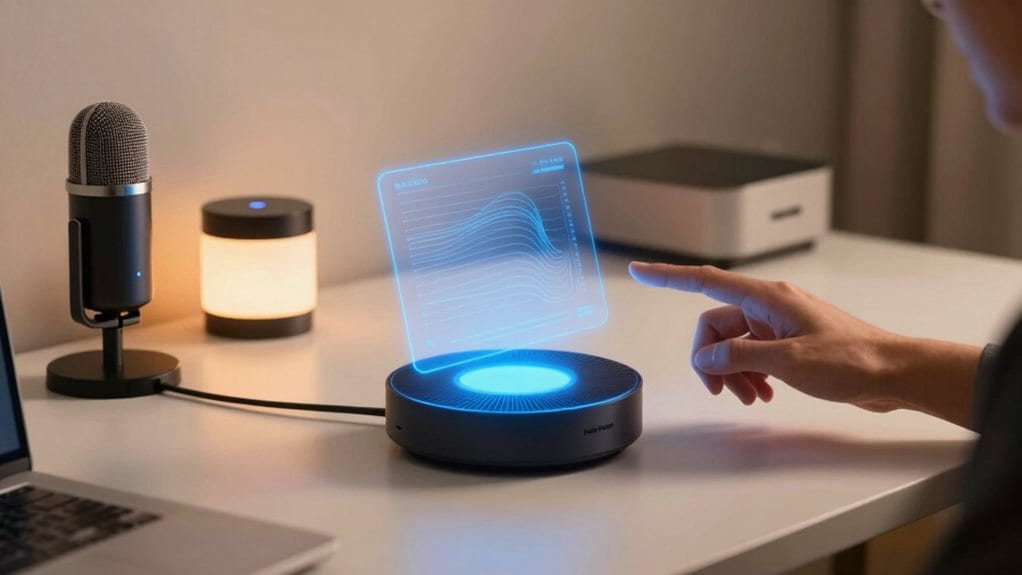

Whole-home voice control systems offer you convenience and efficiency with hands-free operation for daily tasks. You’ll benefit from improved accessibility, as 74% of consumers already adopt these interfaces. These systems can reduce energy costs by 20-30% through smart thermostats and automated optimization, while also strengthening home security with instant emergency protocols. With natural language processing that understands complete sentences and strong privacy features, these systems create a responsive environment that adapts to your needs. The following sections explore additional advantages for today’s homeowners.
Simplifying Daily Tasks With Hands-Free Operation
As smart home technology continues to evolve, voice control systems have transformed how we interact with our living spaces.
You’ll no longer need to search for remotes or find your way to light switches. Instead, you can adjust lighting, temperature, or music with simple voice commands while continuing other activities.
Voice-activated systems integrate seamlessly into daily routines, with 72% of speaker owners using them regularly. This widespread adoption reflects their genuine utility and reliability.
When you’re cooking or exercising, hands-free operation becomes particularly valuable. You can lock doors, adjust volume, or control multiple rooms simultaneously without interrupting your current task.
The technology’s natural language processing has become increasingly sophisticated, making your commands more intuitive. Voice assistants now provide important information like weather updates and delivery notifications without requiring you to check your phone.
Voice-activated technology has proven especially beneficial for elderly individuals and people with limited physical abilities who may struggle with traditional controls.
Systems from brands like Amazon Echo, Google Nest, and Philips Hue work together to create a responsive home environment.
Modern smart assistants can significantly elevate your home’s functionality by centralizing control of various devices into one user-friendly interface.
Creating a More Accessible Living Environment for Everyone
Voice control systems have revolutionized home accessibility for individuals with diverse needs and abilities. These technologies particularly benefit older adults and people with physical limitations, allowing them to maintain independence while safely engaging in daily activities.
Voice technologies create inclusive homes where independence thrives regardless of physical ability or age.
For users with mobility or dexterity challenges, voice interfaces eliminate the need for manual controls, with approximately 74% of consumers now embracing these systems at home. Recent research indicates heavy users typically fall in the 25-49 age bracket, showing strong adoption among working-age adults with diverse accessibility needs.
Despite some barriers like setup difficulties and recognition accuracy (50-60% for speech-impaired users), these systems provide essential cognitive support and reduce social isolation. Natural Language Processing has significantly improved the user experience, with NLP segment projected to gain approximately 43% revenue share by 2037.
The market is responding to these needs, with projected growth from $108.72 billion in 2024 to $2.66 trillion by 2037.
With proper guidance and focused functionality, voice control creates truly inclusive living environments where technology adapts to people, not the reverse.
Enhancing Home Security Through Voice Commands

You’ll gain substantial security advantages by monitoring your home through voice-based systems that detect unusual sounds and notify you of potential threats.
Your voice commands can instantly activate emergency protocols, such as locking all doors, turning on exterior lights, or contacting authorities without needing to reach for a phone.
These hands-free features prove especially valuable during high-stress situations when quick response times matter most, allowing you to protect your home even when physically restrained or unable to access security controls manually. However, be aware that these systems are always listening for their wake words, analyzing background noise even when not actively processing commands. Regular privacy setting reviews can help you control what data is stored and for how long, ensuring your security system protects both your home and your personal information.
Voice-Based Security Monitoring
Modern homes benefit greatly from the integration of voice control into security systems, creating a more responsive and extensive protection environment.
You’ll receive immediate alerts when your system detects security events, allowing for faster response times than traditional sensor-only systems.
Two-way audio communication enables you to speak directly with visitors or potential intruders, often deterring crime without physical confrontation.
Pre-recorded voice announcements serve as effective crime deterrence tools. Messages like “You are being recorded” increase perceived risk for intruders and complement visual alarms for multi-sensory security. Advanced audio surveillance systems can analyze unusual sounds to help verify alarms and reduce false alerts.
The growth of voice-controlled assistants is driving market expansion in smart home security, making systems more accessible and user-friendly for homeowners of all technical abilities.
When selecting voice-based security systems, consider privacy implications. Your voice commands are typically recorded and sometimes stored in the cloud, so review vendor policies regarding data retention and enable confirmation protocols for sensitive commands.
Hands-Free Emergency Protocols
Beyond standard security features, hands-free emergency protocols transform how homeowners respond to urgent situations. These systems integrate directly with emergency services, providing real-time location tracking that helps first responders reach you quickly.
You can create personalized voice commands like “Call emergency services,” enabling immediate action when every second counts. Integration with smart sensors allows your system to trigger alerts automatically when smoke or carbon monoxide is detected, even without verbal commands.
For elderly or disabled individuals, these hands-free protocols offer significant accessibility benefits, reducing response times by up to 30% compared to traditional emergency systems. With voice-activated emergency services, homeowners can ensure rapid response during critical situations without needing to physically interact with devices. Regular testing and simulation guarantee your commands are properly recognized during critical moments.
Reliable connectivity through 4G or 5G networks maintains dependable communication during emergencies, giving you confidence that help will arrive when needed.
Reducing Energy Consumption and Utility Costs
Your voice-controlled smart home can greatly reduce your monthly utility bills through automated optimization schedules that adjust your HVAC system based on occupancy.
You’ll enjoy precise temperature management as your smart thermostat learns your preferences and implements energy-efficient settings, potentially saving 20-30% on heating costs. Smart HVAC systems can pay for themselves within 1-3 years through significant energy savings.
Smarter lighting control allows you to turn off forgotten lights remotely or set automatic schedules, while integrating with energy-saving LED bulbs that have seen a 25% sales increase in 2023 due to rising energy costs.
Automated Optimization Schedules
Three key benefits emerge when integrating voice control systems with automated optimization schedules. These systems centralize management of your energy-consuming devices, creating streamlined schedules that adapt based on real-time occupancy and preferences.
Advanced machine learning algorithms can reduce operational costs by 12-18% by optimizing appliance timing around forecasted energy prices. You’ll benefit from continuous schedule improvements as the system learns your habits while balancing comfort with efficiency.
Occupancy-based automation, combining sensors with geofencing technology, saves approximately 16% of annual home energy use by activating devices only when needed. This approach also reduces peak demand by 0.2 kW per household.
Your voice commands enable easy modifications to these schedules, encouraging engagement with energy-saving routines without sacrificing convenience or comfort.
Precise Temperature Management
While smart homes offer numerous advantages, precise temperature management through voice control stands out for its substantial impact on both energy consumption and utility costs. Voice commands enable you to make immediate adjustments without physically accessing your thermostat, reducing delays and preventing energy waste.
Your voice-controlled system integrates seamlessly with other smart devices like motorized shades and occupancy sensors. This coordination optimizes heating and cooling based on room usage, natural light, and occupancy patterns.
Advanced machine learning algorithms analyze environmental data in real time, making intelligent temperature adjustments that respond to your habits and preferences. The system automatically reduces unnecessary energy use when rooms are unoccupied or during peak sunlight hours.
These responsive controls prevent overheating and overcooling, directly lowering your HVAC load and monthly utility bills through more efficient operation.
Smarter Lighting Control
Smart lighting control stands at the forefront of energy efficiency innovations in modern homes, offering considerable utility cost reductions through advanced technology.
LED bulbs consume 75% less energy than incandescent options and last up to 100,000 hours, dramatically reducing replacement frequency. When combined with voice-controlled smart systems, you’ll save an additional 7-27% on lighting energy.
Voice commands allow you to effortlessly adjust lighting schedules, intensity, and create customized scenes throughout your home without manual switches. You can set routines like “lights off at bedtime” for consistent energy savings.
With lighting representing 6-7% of residential electricity use, these smart solutions make a notable impact. Sensor integration guarantees lights operate only when needed, while remote voice control prevents accidentally leaving lights on when you’re away.
Seamless Integration With Existing Smart Home Devices
Numerous voice control systems have revolutionized smart home management by offering seamless integration with existing devices across different manufacturers. Major platforms like Amazon Alexa, Google Assistant, and Apple Siri work with thousands of smart products, from lights to thermostats to security cameras.
This cross-compatibility means you don’t need to replace your current devices when adopting voice control. Standard communication protocols such as Zigbee, Z-Wave, and Wi-Fi guarantee your devices connect reliably to your voice assistant.
You’ll appreciate having just one interface instead of juggling multiple apps. The centralized management lets you control everything through natural language commands.
One voice interface simplifies your smart home, replacing app clutter with intuitive spoken commands.
As manufacturers continue to expand their APIs, your voice control system becomes increasingly versatile, allowing you to build your smart home with products you actually want.
The Evolution of Natural Language Processing in Home Systems
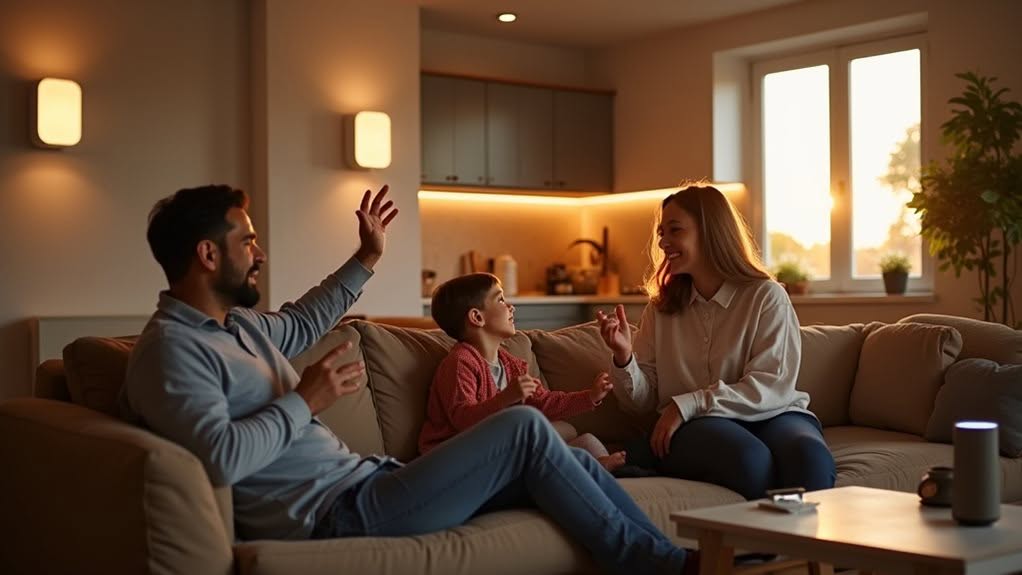
You’ll notice today’s voice systems can understand far more than single-word commands like “on” or “off” used in earlier home automation.
Modern NLP technology recognizes complete sentences, follows multi-step instructions, and maintains context across conversations with your smart home.
This contextual understanding revolution means you can speak naturally to your home system, asking follow-up questions or giving complex commands without repeating yourself or using specific trigger phrases.
Beyond Command Words
While early voice control systems relied on specific command words and phrases, today’s natural language processing (NLP) has evolved dramatically, allowing for more intuitive human-device interactions.
Your smart home can now understand contextual conversations rather than just rigid commands.
Modern NLP capabilities in your home system include:
- Emotion and context awareness that recognizes your mood and situational needs
- Real-time processing that responds instantly even in noisy environments
- Personalization that learns your preferences and adapts to your household’s habits
- Multilingual support that accommodates diverse language needs within one system
These advancements mean you’ll experience more natural conversations with your smart home.
Systems continuously learn from interactions, improving their performance over time and predicting your needs before you even voice them.
Contextual Understanding Revolution
The contextual understanding revolution in home voice control represents a fundamental shift in how systems process and respond to human language.
Modern NLP systems now recognize not only command words but their contextual meaning in conversation. This breakthrough stems largely from transformer architecture and models like BERT, which consider both sequential and non-sequential word relationships.
Your smart home can now understand environmental cues and your preferences to deliver personalized experiences. When you say, “I’m cold,” your system doesn’t only recognize words—it understands you want the temperature increased.
This contextual awareness creates a more natural interaction experience. The technology continuously learns from your interactions, improving its voice control capabilities over time.
These advancements integrate seamlessly with IoT devices, creating a unified ecosystem for intuitive home automation.
Privacy-Focused Solutions for the Modern Homeowner
As consumers grow increasingly concerned about data security in smart home technology, modern privacy-focused voice control solutions offer robust protections without sacrificing convenience.
Systems like Josh.ai prioritize local processing of voice commands, keeping your data within your home rather than sending everything to cloud servers.
These privacy-centric approaches give you complete control over your information through:
- Transparent activation with visual indicators showing when microphones are actively listening
- Local data processing that reduces cloud exposure and potential security vulnerabilities
- Strong encryption for any data that must travel outside your home network
- Customizable privacy settings that let you determine what information is stored and for how long
You’ll appreciate the peace of mind that comes from knowing exactly when your system is listening and what happens to your voice data.
Voice Control as the New Shopping and Entertainment Hub

Voice-powered shopping and entertainment experiences have transformed smart speakers from simple assistants into extensive hubs for modern homes. With Amazon Alexa leading the market at 37.1% share, these systems offer unprecedented convenience for daily activities.
You’ll join over 139 million Americans who use virtual assistants daily, accessing a market projected to reach $105.5 billion by 2033. While 93% of users report satisfaction with their voice assistants, most still use them for basic tasks only.
Your entertainment options expand dramatically with voice control, as 44% of smart homes now feature voice-integrated entertainment systems. The smart TV market alone is expected to reach $261.9 billion by 2030.
As AI and natural language processing continue advancing, you’ll soon control more complex shopping and home automation functions through simple voice commands.
Customizing Environmental Settings Room by Room
Beyond shopping and entertainment, modern voice control systems transform your home environment with remarkable precision.
You’ll gain unprecedented control over your surroundings through intuitive commands customized to each space.
Room awareness technology guarantees your commands affect only the area you’re in, creating truly personalized environments throughout your home.
Voice-controlled systems adapt to your preferences and routines, learning how you like each room configured.
- Adjust temperature settings individually per room for ideal comfort and energy efficiency
- Control lighting levels, colors, and scenes based on your activities or mood preferences
- Manage audio distribution for different music in different spaces simultaneously
- Operate motorized shades and blinds to control natural light and privacy in specific areas
This room-by-room customization makes your home more responsive and aligned with your lifestyle needs.
Future-Proofing Your Home With Cutting-Edge Technology
Investing in whole-home voice control today guarantees your living space will remain technologically relevant for years to come. These systems are designed with adaptability in mind, allowing for seamless updates as new technologies emerge.
Future-proofing your home begins with voice control technology designed for tomorrow’s innovations.
The smart home market is projected to reach an impressive $2.66 trillion by 2037, growing at a 27.9% annual rate. You’re joining a rapidly expanding movement, with 57% of U.S. households expected to use at least one smart home device by 2025.
Voice-controlled systems integrate easily with future IoT devices, improving your home’s functionality over time. They also contribute to increased property value, providing long-term financial benefits.
Additionally, these systems offer potential energy savings through automated optimization, making them both a technological and economical investment for your future.
Frequently Asked Questions
How Long Does Voice Control System Installation Typically Take?
For you, wireless system installation takes 3-5 hours, while wired systems require 1-3 days. Your home’s size, existing smart devices, and custom programming needs will affect your specific installation timeline.
Can Voice Systems Work During Internet Outages?
No, most voice systems can’t function during internet outages. Your cloud-based assistants like Alexa or Google Assistant will fail, though systems with local processing capabilities may still handle basic commands offline.
What Happens if Multiple People Give Conflicting Commands?
When multiple people issue conflicting commands, most systems follow the most recent instruction. You’ll face frustration as devices can’t prioritize users or permissions. Some advanced systems now offer user profiles to manage these conflicts better.
Are Professional Calibration Services Required After Installation?
Yes, you’ll need professional calibration after installation to optimize audio performance for your home’s unique acoustics. It guarantees balanced sound distribution, improves voice command responsiveness, and provides the best possible user experience throughout your space.
How Do Voice Systems Handle Background Noise or Soft-Spoken Users?
Voice systems use microphone arrays, beamforming, and noise reduction algorithms to isolate your speech from background noise. They’re trained on diverse datasets to recognize soft-spoken commands and continuously adapt to your specific voice patterns.
Final Thoughts
You’ll find whole-home voice control systems transform your daily life beyond convenience. They create accessibility, improve security, and reduce energy costs while integrating with your existing smart devices. With privacy protections in place, these systems serve as entertainment hubs while offering room-specific customization. By investing now, you’re future-proofing your home with technology that adapts to your family’s evolving needs and the advancing smart home ecosystem.