Matter shows strong potential to finally unify your smart home experience. This new standard, backed by over 268 companies including Apple, Google, and Amazon, addresses key fragmentation problems through multi-ecosystem device sharing and local control capabilities. You’ll benefit from simplified setup, cross-brand compatibility, and reliable operation during internet outages. Despite certification bottlenecks and varying implementation timelines, Matter’s fundamental architecture represents the first genuine cross-platform solution for a truly integrated home automation system.
The Fragmented Smart Home Landscape Before Matter
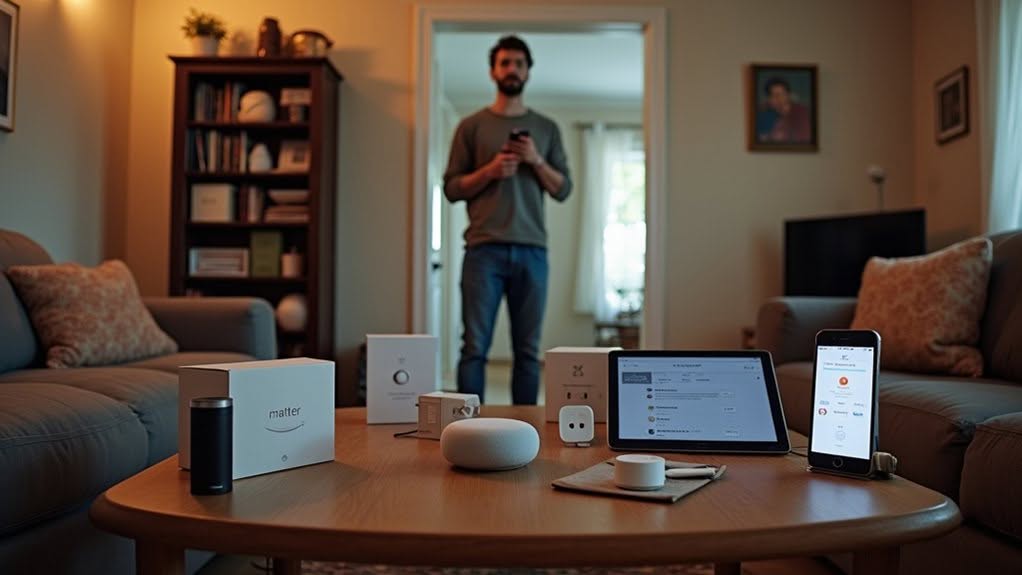
While smart home technology has exploded in popularity, its growth has created a chaotic ecosystem that frustrates even the most tech-savvy consumers.
With over 400 million smart homes globally, the industry remains deeply fragmented. Different ecosystems like Google and Amazon often fail to communicate with each other, forcing 60% of users to operate devices as standalone solutions rather than integrated systems.
You’ll likely encounter connectivity headaches as Wi-Fi, Bluetooth, and 5G technologies struggle to work together seamlessly. Despite Wi-Fi dominating with 51.7% market share, many devices still use incompatible protocols. The numbers tell the story: 52% of users report difficulties setting up multi-brand devices, while 34% face connectivity issues within a year.
Most concerning is the control nightmare—you’re forced to juggle multiple apps to manage your home’s smart features, creating considerable adoption barriers despite 74% of Americans expressing interest in smart home technology. This adoption is particularly high among younger demographics, with 44% of homeowners under age 35 using multiple smart devices daily. Smart wifi thermostats are among the most sought-after solutions to enhance home comfort while addressing some of these compatibility challenges.
What Makes Matter Different From Previous Standards
Unlike previous attempts at smart home standardization, Matter represents a fundamental shift in how connected devices work together. It mandates local control as the default, guaranteeing your devices function even during internet outages.
Matter’s development by the Connectivity Standards Alliance brings unprecedented collaboration among tech giants like Amazon, Apple, Google, and Samsung. The Multi-Admin feature allows users to control their devices through multiple smart home systems simultaneously, eliminating the need to choose just one ecosystem. The open-source specification prevents proprietary lock-in that plagued earlier standards.
You’ll recognize Matter-certified products by their logo, which assures interoperability across platforms after rigorous testing. The standard continually evolves, with biannual updates adding support for new device types. The standard utilizes IP networking for easier development and compatibility with existing technology.
Matter’s built-in security uses modern encryption protocols, while the local-first approach reduces cloud-based vulnerabilities. This combination of industry backing, open architecture, and forward-thinking design makes Matter uniquely positioned to succeed.
Key Technical Features Enabling Unified Control
Matter’s multi-ecosystem device sharing allows you to control your smart devices through Apple Home, Google Home, or Amazon Alexa without purchasing multiple compatible versions.
You’ll benefit from Thread’s efficient mesh networking, which creates a reliable network where devices pass signals to one another, eliminating single points of failure.
The protocol also ensures comprehensive security architecture for all connected devices, with mandatory authentication and protection for every data transmission.
These technical features work together to deliver the unified smart home experience that previous standards promised but couldn’t fully deliver.
Matter operates entirely without cloud dependence, enabling local control of your devices even when your internet connection is down.
Multi-Ecosystem Device Sharing
How exactly does Matter enable different smart home platforms to control the same devices? Through a feature called Multi-Admin Mode, Matter allows you to share a single smart device across multiple ecosystems simultaneously. When you set up a Matter-certified device, you’ll use its pairing code or QR code to add it to your primary ecosystem, then share it with others.
The key benefits of Multi-Admin Mode include:
- Your devices can be controlled by Apple Home, Google Home, Amazon Alexa, and other Matter controllers at the same time
- Each platform can independently control and automate your shared devices
- You’ll maintain functionality across ecosystems using a unified Matter Fabric
This sharing capability applies only to end devices, not hubs or controllers, which remain platform-specific within your smart home network. Matter’s focus on enhanced security with AES-based encryption ensures your device sharing remains protected across all connected platforms. The standard is built upon market-proven technologies from leading companies in the industry, providing a solid foundation for reliable smart home connectivity.
Thread’s Efficient Mesh Networking
While Multi-Admin Mode enables cross-platform device control, Thread networking provides the underlying infrastructure that makes this unified smart home experience possible.
Thread builds on IPv6 technology, allowing your devices to communicate directly with each other through a self-healing mesh network. When one device fails, the network automatically reroutes traffic to maintain connectivity. Modern implementations incorporate certified Thread stacks that ensure reliable interoperability between devices from different manufacturers.
You’ll appreciate Thread’s exceptional power efficiency, with typical devices drawing only 4-7mA during operation. This translates to years of battery life for sensors and other IoT products in your home. The innovative Sleepy End Devices architecture enables this efficiency by allowing low-power nodes to conserve energy while remaining part of the network.
Security is built into the foundation, with all communications encrypted end-to-end and devices authenticated before joining your network.
Despite its 250 Kbps maximum bandwidth, Thread isn’t designed for streaming video but excels at handling the control signals and sensor data that smart homes depend on.
Real-World Benefits for Everyday Smart Home Users
You’ll experience considerably easier device setup with Matter, eliminating the complex pairing processes that plagued earlier smart home systems.
Matter’s cross-brand compatibility means you can control your Philips Hue lights, Nest thermostat, and August lock from a single app of your choice, regardless of manufacturer.
Perhaps most crucially, Matter devices continue to function reliably even when your internet connection fails, as local control capabilities keep your smart home running during outages.
Frustration-Free Device Setup
Setting up smart home devices has traditionally been a pain point for consumers, but Matter’s streamlined approach promises to eliminate this common frustration.
With Matter, you’ll simply scan a QR code or use NFC tags to initiate setup, avoiding complex manual configurations.
The commissioning process establishes secure, encrypted connections automatically, requiring minimal input from you.
Android devices with Fast Pair for Matter even detect new devices via Bluetooth Low Energy signals and guide you through setup.
Key benefits of Matter’s simplified setup include:
- Automatic Wi-Fi credential sharing with proper security measures
- Local-first design that keeps devices functioning during internet outages
- Cross-platform compatibility eliminating the need for multiple brand-specific apps
This standardized approach greatly reduces setup time and technical knowledge required, making smart home technology more accessible to everyone.
Cross-Brand Control Simplicity
Beyond simplified setup, Matter’s most transformative feature may be its ability to enable true cross-brand control of smart home devices.
You’ll no longer need multiple apps to manage your smart home ecosystem. Devices from Apple, Google, Amazon, Samsung, and others can be controlled through a single app of your choice. This eliminates the frustration of switching between applications to adjust different products.
Voice assistants work seamlessly across Matter-certified devices regardless of brand. Ask Alexa to control your Apple HomeKit lights or use Siri with your Google Nest thermostat without complicated workarounds.
The Matter logo makes identifying compatible products simple when shopping. You’re free to select devices based on features rather than ecosystem compatibility, ending the era of vendor lock-in that has fragmented the smart home experience.
Offline Reliability Advantage
While internet outages have historically rendered smart homes temporarily useless, Matter’s offline reliability advantage represents a fundamental shift in connected living. Your devices continue functioning through local networking and Thread mesh technology, keeping critical systems operational even when the internet fails.
This offline capability delivers three key benefits:
- Improved security through local data processing, reducing exposure to external threats and cloud breaches
- Near-instantaneous responses for everyday commands without cloud round-trips, creating a seamless user experience
- Continued operation of crucial systems like security cameras, locks, and environmental controls during service disruptions
You’ll appreciate Matter’s self-healing network architecture, which automatically reroutes connections if one device fails. This resilience guarantees your smart home remains functional regardless of internet status, providing peace of mind and consistent performance when you need it most.
Challenges and Hurdles in Matter’s Path to Adoption
Despite Matter’s promise to unify smart homes, considerable challenges stand in its path to widespread adoption.
Technical barriers remain considerable, with Thread protocol‘s problematic rollout and border router solutions still under development across different ecosystems.
Infrastructure requirements present another hurdle. Network managers need Thread Border Routers supporting at least 150 devices and Wi-Fi access points handling 100 simultaneous connections.
The certification process creates bottlenecks, with growing queues and extended wait times for developers bringing products to market. Each device requires certification across multiple communication standards.
Security implementations further complicate adoption. Individual device authorization demands personal QR codes during setup, and each platform implements Matter security features on different timelines.
The strict requirement for encrypted connections creates complex authorization workflows that often confuse users.
The Role of Major Tech Companies in Matter’s Success
At the center of Matter’s development stands an unprecedented alliance of technology giants who serve as both architects and ambassadors for this emerging standard.
Amazon, Apple, Google, and Samsung have joined forces as key promoters within the Connectivity Standards Alliance, directly influencing Matter’s development and certification processes.
You’ll find these companies driving adoption by integrating Matter compatibility across their ecosystems. Their commitment extends beyond mere participation—they’ve updated their platforms to natively support the standard.
- Amazon Alexa, Apple HomeKit, Google Assistant, and Samsung SmartThings all work with Matter devices
- Over 268 companies participate in the ecosystem, including major brands like IKEA and LG
- The CSA enforces strict certification requirements for security and interoperability
This collaborative approach means your smart home devices can now work together regardless of brand.
What the Future Holds for Matter-Enabled Homes
As Matter evolves into its next phase, the smart home environment stands poised for unprecedented integration and growth. The market is expanding rapidly, with projections showing growth from $147.5 billion in 2025 to $633.2 billion by 2032.
You’ll see Matter’s continuous updates introducing new capabilities like ambient motion sensing, environmental monitoring, and extensive energy management features. These advancements will address the 57% of Americans concerned about smart home data security.
Future iterations will integrate support for advanced sensors and expand to Wi-Fi access points, cameras, and major household appliances. This standardization effectively resolves fragmentation issues that previously hindered adoption.
Manufacturers embracing Matter will benefit from reduced development costs and faster market entry, while recurring-revenue models from cloud services are expected to surpass hardware profits by 2028.
Frequently Asked Questions
Can Existing Smart Home Devices Be Upgraded to Support Matter?
Yes, many existing smart devices can be upgraded through firmware updates or connected via Matter-compatible bridges. Wi-Fi, Zigbee, and Ethernet devices have the best upgrade paths, though some older models lack compatibility.
Does Matter Increase Power Consumption in Battery-Operated Smart Devices?
No, Matter doesn’t increase power consumption. You’ll actually benefit from its Thread protocol support, which is designed specifically to minimize energy use and extend battery life in your smart home devices.
How Does Matter Handle Internet Outages in a Smart Home?
During internet outages, Matter keeps your smart home running locally. You’ll maintain control through your Matter Hub via Wi-Fi, Ethernet, or Thread mesh networks, though you’ll lose remote access and some advanced cloud-dependent features.
Will Matter Eliminate the Need for Device-Specific Hubs Completely?
No, Matter won’t eliminate all device-specific hubs completely. You’ll still need hubs for non-Matter devices and protocols like Zigbee and Z-Wave, though Matter will reduce the total number of hubs required.
How Does Matter Affect Data Privacy Compared to Proprietary Systems?
Matter improves your privacy through local processing, reduced cloud dependency, and standardized encryption. You’ll benefit from open-source transparency, better user control, and less data exposure compared to proprietary systems with inconsistent security practices.
Final Thoughts
You’re witnessing a crucial moment in smart home technology with Matter. While it promises to solve long-standing compatibility issues, its success depends on continued industry cooperation and consumer adoption. The coming years will reveal whether Matter truly delivers on its potential to unify your devices or becomes just another standard in an already crowded ecosystem. For now, Matter represents the most promising path toward the seamless smart home experience you’ve been waiting for.