Smart home climate scheduling has become crucial due to its notable environmental and financial benefits. You’ll reduce energy consumption by 8-20% while saving $131-$145 annually on utility bills. These systems improve comfort by creating personalized temperature zones that adapt to your lifestyle through machine learning algorithms. With remote access capabilities, you can adjust settings from anywhere and receive real-time alerts about system performance. Exploring these intelligent systems reveals how they seamlessly integrate convenience with sustainability.
The Environmental Impact of Smart Climate Control
While homeowners seek comfort in their living spaces, HVAC systems consume nearly half of all residential energy in the United States. This notable energy usage translates directly to your carbon footprint.
Smart thermostats offer a solution by optimizing your heating and cooling systems. EPA data shows these devices can reduce heating energy by 10-12% and cooling energy by 15%, with total energy savings ranging from 8-20%. Smart thermostats continuously adapt to household patterns through learning capabilities to maximize efficiency. These intelligent systems utilize IoT connectivity to communicate with other smart home devices for comprehensive energy management. WiFi programmable thermostats are increasingly popular for modern homes seeking climate control flexibility.
The environmental impact extends beyond individual households. Buildings contribute to 30% of global energy consumption and produced 3 gigatonnes of CO2 in 2022—73% more than the entire aviation sector.
When you install a smart thermostat, you’re not simply saving money. Nest users, for example, reduced their electricity use by approximately 131 kWh monthly, contributing to meaningful collective emission reductions.
Financial Benefits: How Much Can You Really Save?
When considering the investment in smart climate technology, the financial benefits often become the deciding factor for most homeowners. Smart thermostats typically cost more upfront but pay for themselves within 1-3 years through energy savings.
The savings potential is considerable and well-documented:
- Reduce heating and cooling costs by 10-20% annually, saving $131-$145 per year with devices like Nest
- Ecobee users report up to 26% HVAC savings compared to traditional thermostats
- Collect government rebates of $50-$100 through programs like Energy Star
- Shorten payback periods by up to 40% through utility incentives and rebates
- Contribute notably to the potential $427-$640 annual household energy savings
These savings are particularly noteworthy for frequent travelers, homes with irregular occupancy, or regions with high electricity costs. The U.S. Department of Energy confirms that adjusting thermostats by 7-10 degrees for 8 hours daily can yield up to 10% savings. Smart HVAC systems are becoming increasingly affordable with the average revenue per installation projected to decrease to average revenue of $19.64 by 2025.
Enhancing Comfort Through Intelligent Temperature Management
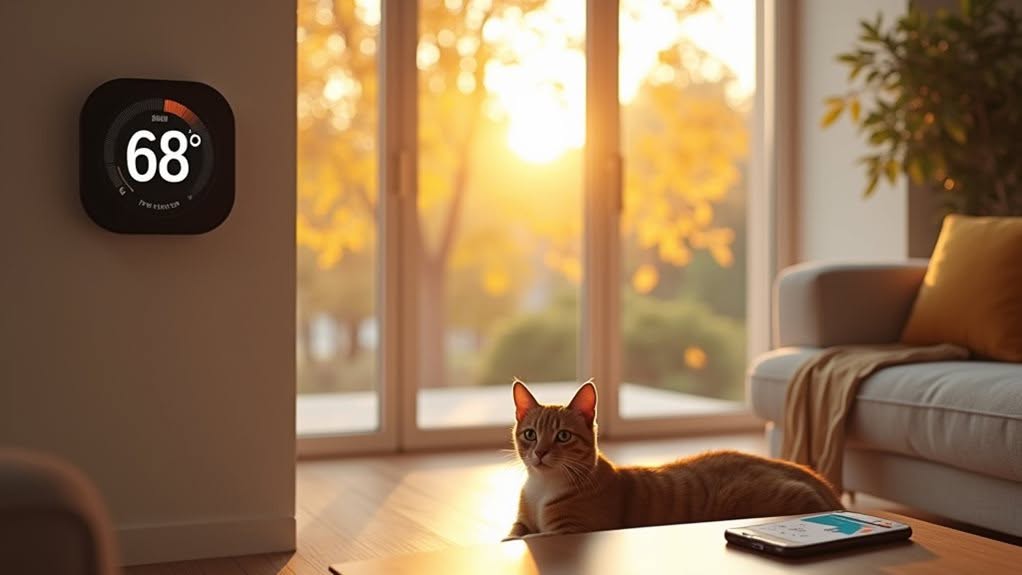
Smart thermostats create custom comfort zones customized to your preferences, allowing each family member to enjoy their ideal temperature in different areas of your home.
Your system can anticipate weather changes and adjust indoor climate before you feel discomfort, maintaining consistent temperatures despite outdoor fluctuations.
With remote access through smartphone apps, you can monitor and modify your home’s temperature from anywhere, guaranteeing you’ll always return to perfect comfort. Studies show these smart systems can reduce energy consumption by 10-30% when properly integrated with occupancy sensors. The sophisticated machine learning algorithms analyze your patterns and automatically create personalized schedules that adapt to your lifestyle.
Personalized Comfort Zones
As homeowners increasingly prioritize customized environments, today’s intelligent climate systems are revolutionizing how we experience comfort in our living spaces. These systems now offer customizable zones that adapt to your specific preferences throughout your home.
Modern smart climate technology delivers unprecedented personalization through:
- Creation of multiple comfort zones within a single residence, designed to individual preferences
- Remote control capabilities via smartphone or voice commands for seamless adjustments
- Motion-sensing technologies that automatically modify settings based on room occupancy
- Seamless integration with other smart home systems for unified comfort control
- Personalized scheduling that learns and adapts to your daily routines
This technology particularly appeals to families, where different members often prefer varying temperature settings. The market reflects this growing demand, as global consumer spending on smart home systems is expected to exceed $170 billion by 2025. Users appreciate these climate systems for saving time and enhancing their daily routine efficiency.
With 71% of users finding these systems more beneficial than expected, personalized comfort zones represent a remarkable advancement in home climate management.
Anticipatory Temperature Adjustment
Through sophisticated algorithms and real-time data analysis, today’s smart climate systems can predict your comfort needs before you even realize them. These thermostats learn your daily routines and occupancy patterns to proactively adjust temperatures ahead of time.
Your smart thermostat continuously adapts to your schedule, making gradual temperature changes that maintain comfort while reducing energy consumption. Instead of abrupt changes, the system implements slow adjustments that decrease mechanical stress on your HVAC equipment. Smart thermostats effectively contribute to lower utility bills through their optimized operation of heating and cooling systems.
Weather integration allows your system to prepare for external temperature shifts, pre-cooling your home before heatwaves or adjusting for humidity changes. Voice control integration with popular assistants enables hands-free temperature adjustments for enhanced convenience and accessibility. Motion and occupancy sensors guarantee rooms are only conditioned when necessary.
Some smart thermostats even participate in utility demand response programs, automatically adjusting during peak energy periods while balancing your comfort preferences with efficiency goals.
Remote Climate Control
Have you ever wished you could adjust your home’s temperature while still at the office or on vacation? Remote climate control transforms this wish into reality, offering unprecedented convenience and energy efficiency.
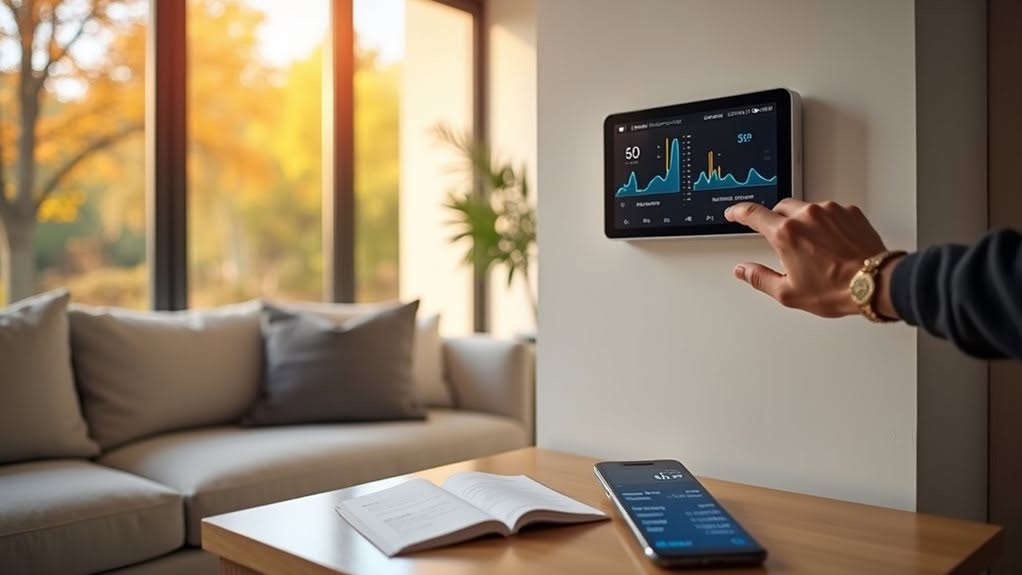
With remote access to your HVAC system, you’ll gain complete control over your home’s climate from anywhere in the world using just your smartphone.
- Adjust temperatures instantly from any location, guaranteeing comfort upon arrival
- Save up to 23% on heating and cooling costs through optimized energy usage
- Receive real-time alerts about system malfunctions or environmental issues
- Integrate with other smart home devices for coordinated automation
- Maintain healthier indoor air quality by remotely managing humidity and filtration
This technology doesn’t just improve comfort—it creates a more efficient, responsive home environment that adapts to your lifestyle while reducing your energy footprint.
Real-Time Energy Monitoring and Optimization
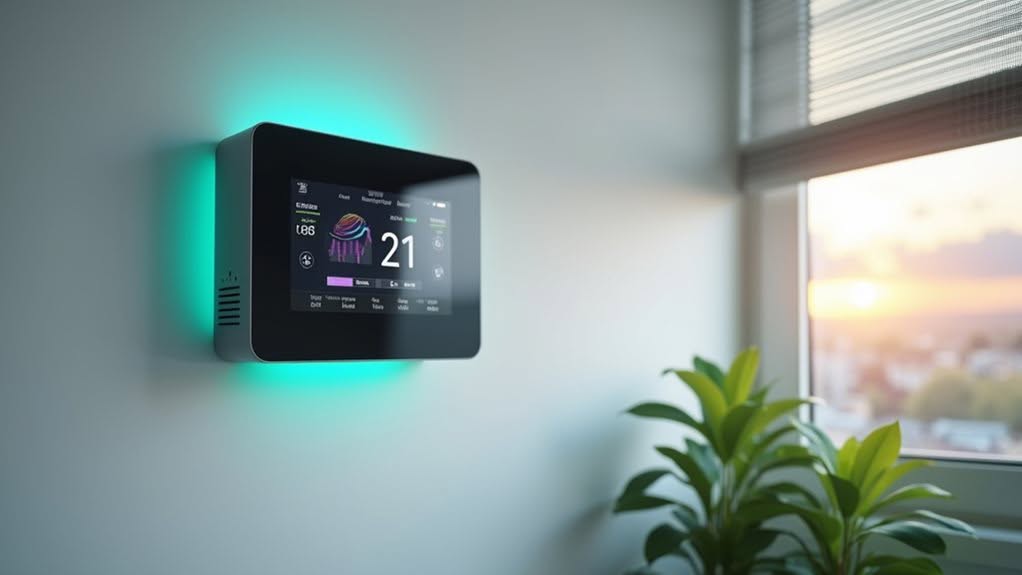
Real-time energy monitoring reveals your household’s consumption patterns, highlighting inefficiencies you can address to reduce waste and lower utility bills.
Your smart home system can automatically adjust heating and cooling based on weather forecasts, optimizing comfort while minimizing energy use during extreme temperature events.
Detailed metrics about each appliance’s performance help you identify energy-hungry devices that may need maintenance or replacement, potentially saving you hundreds of dollars annually through more efficient operation.
Usage Patterns Illuminate Waste
How effectively are you managing energy in your home without seeing what’s actually happening?
Without monitoring, you’re likely missing considerable waste. Studies show that homes with energy monitors reduce electricity use by 7-15% through awareness and behavior changes.
Real-time energy monitoring reveals:
- Phantom loads from devices consuming electricity even when “off”
- Consumption patterns that identify inefficient appliances needing repair
- Opportunities to shift usage to off-peak hours for cost savings
- Standby power waste that adds up considerably over time
- Anomalies indicating energy problems requiring immediate attention
Responsive Weather Adaptation
Once you’ve identified energy waste in your home, the next logical step involves implementing systems that respond automatically to changing conditions.
Modern smart home climate systems detect external weather variations and adjust HVAC operation accordingly, eliminating inefficiencies.
Your system’s sensors feed real-time temperature, humidity, and sunlight data into energy management platforms that trigger automated adjustments. These systems can preemptively reduce heating or cooling during favorable weather conditions without sacrificing your comfort.
Advanced machine learning models analyze historical and current data to predict your future energy needs based on weather patterns. This predictive capability enables your system to optimize HVAC cycles before conditions change.
The results are notable—households implementing weather-responsive scheduling typically see annual energy savings of 4–8%, while extending equipment lifespan through reduced cycling.
Appliance Efficiency Metrics
Visibility into your home’s energy consumption forms the foundation of effective smart climate management. Real-time monitoring reveals exactly how your appliances perform, allowing you to make informed decisions about energy usage.
Smart home systems provide valuable metrics that quantify efficiency:
- Power usage tracking identifies which devices consume the most energy
- Peak-to-average ratios help you understand demand spikes
- Load profiles show consumption patterns throughout the day
- Standby power measurements reveal hidden energy waste
- Performance comparisons against baseline standards highlight improvement opportunities
These metrics translate into actionable insights for optimizing your home’s climate control.
You’ll receive personalized recommendations based on your usage patterns, enabling adjustments that can reduce utility bills by 10-30%. This data-driven approach guarantees your climate systems operate precisely when needed, eliminating waste while maintaining comfort.
The Growing Market: Why Households Are Making the Switch
The global smart home climate scheduling market is experiencing unprecedented growth, with the overall smart home sector expected to more than quadruple from $127.80 billion in 2024 to $537.27 billion by 2030.
This rapid expansion reflects your changing priorities as a homeowner.
You’re increasingly making the switch to smart climate control for several compelling reasons.
Energy efficiency tops the list, as these systems can greatly reduce your utility bills through optimized scheduling and operation.
The convenience factor can’t be overlooked—you can now control your home’s temperature remotely through smartphone apps or voice assistants.
Government incentives and building codes promoting energy conservation provide additional motivation.
Advanced technologies like AI and IoT have made these systems more intuitive, learning your preferences and automatically adjusting to maximize both comfort and savings.
Maintaining System Efficiency for Maximum Performance
After investing in a smart climate system, maintaining its ideal performance becomes essential to realizing the full range of benefits you’ve paid for.
Regular maintenance guarantees your system continues to deliver the 20-30% energy savings that smart HVAC devices promise.
AI-based systems require proper setup to effectively learn your habits and optimize performance. Most smart thermostats achieve their full potential when they’ve collected sufficient usage data over time.
- Schedule regular filter changes to prevent airflow restrictions
- Update firmware regularly to access new efficiency features
- Clean sensors to confirm accurate temperature readings
- Verify Wi-Fi connectivity for consistent remote operation
- Review system analytics monthly to identify performance issues
Proper maintenance extends system lifespan while maintaining the 8-15% energy savings on heating and cooling that Energy Star-certified buildings typically experience with smart thermostats.
Integrating Climate Control With Your Smart Home Ecosystem
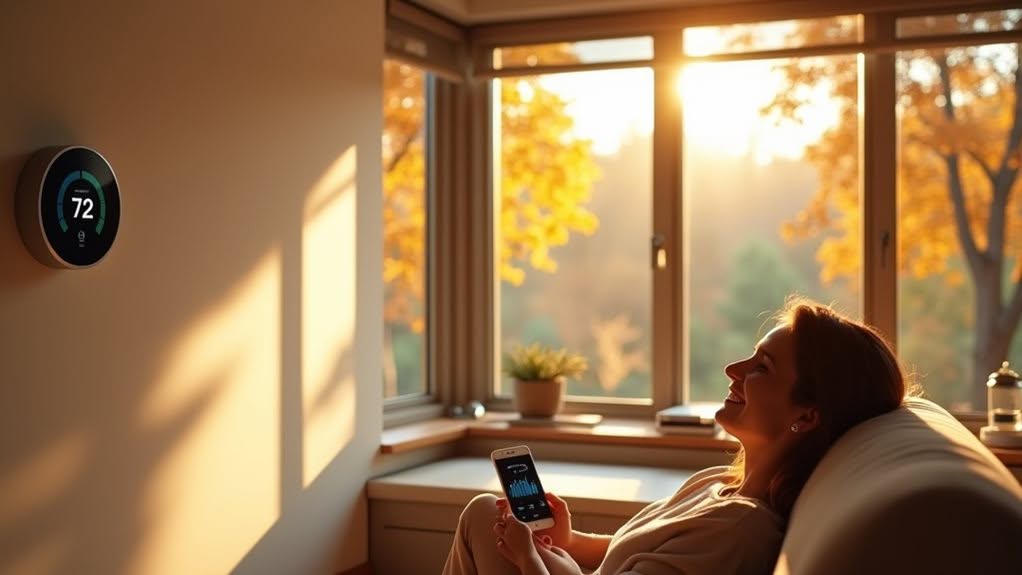
Beyond maintaining your system’s efficiency, connecting your smart thermostat to your broader home ecosystem opens up its full potential.
Your smart climate system can communicate with other devices like motion sensors, smart lights, and security systems to create a seamless experience. When integrated properly, your thermostat can respond to real-time events throughout your home.
For example, your system can automatically adjust temperatures when security devices detect you’ve left the house, or when smart blinds indicate increased sunlight.
This integration allows for voice control through assistants like Alexa or Google Home, letting you change settings with simple commands.
You’ll also benefit from consolidated control through a single app, eliminating the need to switch between different interfaces when managing your home environment.
Frequently Asked Questions
How Do Smart Thermostats Handle Multiple Users With Different Preferences?
Smart thermostats handle multiple preferences through zone-specific controls, learning algorithms that track individual inputs, multi-zone setups, and customized schedules. They monitor override patterns and adapt to balance competing comfort needs in shared spaces you occupy.
Can Smart Climate Systems Work With Older HVAC Equipment?
Yes, you can connect smart climate systems to older HVAC equipment with proper adaptation. You’ll often need a C-wire adapter, professional installation, or specially designed thermostats to bridge compatibility gaps with your existing system.
How Do Power Outages Affect Smart Climate Scheduling Systems?
Power outages disable your smart climate systems immediately, cutting off scheduling capabilities, remote adjustments, and sensor functions. You’ll lose Wi-Fi connectivity, cloud-based controls, and potentially stored schedules if your device lacks adequate battery backup.
Are Smart Thermostats Secure Against Hackers or Privacy Breaches?
Smart thermostats aren’t completely secure. You’ll face potential hacking risks from weak passwords and outdated firmware. They also collect usage data, raising privacy concerns. You can reduce risks by implementing strong passwords and regular updates.
What Happens if My Internet Connection Fails Temporarily?
Your smart thermostat will still control basic heating and cooling locally without internet. You’ll lose remote access and some automation features, but it’ll maintain set temperatures until connection is restored. No security risks are increased.
Final Thoughts
You’ve seen how smart home climate scheduling delivers environmental benefits, substantial cost savings, and improved comfort. With real-time monitoring capabilities, your system optimizes energy usage while maintaining your preferred temperature settings. As the market grows, upgrading your climate control becomes increasingly accessible. By maintaining your system and integrating it with other smart devices, you’ll maximize efficiency and convenience in your home’s energy management.