Smart thermostats can reduce your heating costs by 10-12% and cooling costs by 15%, potentially saving $131-$145 annually. You’ll maximize savings by choosing an ENERGY STAR certified model, utilizing features like geofencing and motion sensors, and participating in utility company rebate programs (typically $50 per device). DIY installation saves $100-$350 compared to professional services. For ideal efficiency, create custom seasonal schedules and integrate with other smart home systems. The following strategies will help you achieve even greater financial benefits.
Understanding Smart Thermostat Technology
When it comes to managing your home’s climate efficiently, smart thermostats represent a notable improvement over traditional models.
These devices connect to your home’s Wi-Fi network, allowing you to control temperature settings remotely through smartphone apps or web interfaces.
Smart thermostats utilize learning algorithms that adapt to your daily routines and preferences. They analyze when you’re typically home and away, automatically adjusting temperatures to optimize energy usage while maintaining comfort.
Many models feature geofencing technology that detects when you’re approaching or leaving your home. This enables automatic temperature adjustments based on your location, eliminating wasted energy when no one’s home. With built-in motion sensors, these devices can detect room occupancy and make intelligent heating or cooling decisions even when you’re moving around your home.
These devices integrate seamlessly with other smart home systems and voice assistants like Alexa and Google Assistant, offering convenient hands-free control and improved automation capabilities.
Modern homes can be equipped with WiFi programmable thermostats that provide advanced scheduling features for optimal temperature management throughout the day.
Calculating Your Potential Energy Savings
Before investing in a smart thermostat, you’ll want to understand the potential financial benefits it can provide for your home. Several manufacturers offer online calculators to help estimate your savings.
Nest thermostats typically save users 10-12% on heating and 15% on cooling, with annual savings ranging from $131 to $145. Your actual results will vary based on several key factors.
Home size, HVAC system type, and geographic location greatly impact potential savings. Your personal energy usage patterns and the condition of your heating and cooling equipment also play vital roles.
When using these calculators, remember they provide estimates based on certain assumptions. While they’re helpful for decision-making, actual savings may differ due to energy market fluctuations and changes in your usage patterns.
Choosing the Right Smart Device for Your Home
Selecting the right smart thermostat requires careful consideration of your specific home needs and budget constraints. Start by checking your HVAC system’s compatibility with potential models to avoid purchasing incompatible devices.
For extensive features, consider the Nest Learning Thermostat or Ecobee4, which offer advanced learning technology and multi-room support. If you’re budget-conscious, the Amazon Smart Thermostat or Honeywell Lyric T5 provide basic smart features at lower prices.
Look for energy-efficient models with ENERGY STAR certification, which can save you up to $180 annually. Many utility companies also offer rebates that reduce your initial investment.
Consider how the thermostat integrates with your existing smart home ecosystem. Models with voice assistant compatibility and remote access via mobile apps offer greater convenience and control. Check if your home has a C wire requirement, as models like Amazon Smart Thermostat require this for installation while others like Nest can operate without it.
DIY vs. Professional Installation: Cost Comparison
When considering smart thermostat installation, you’ll face a clear choice between DIY and professional approaches with distinct cost implications.
Professional installation typically costs $200-$500 but includes expertise, warranties, and mistake coverage that DIY approaches lack.
While DIY installation saves $100-$350 in labor costs, you’ll need to weigh this against your time investment (valued at $25/hour), potential tool purchases ($25-$300), and the risk of making costly errors that could damage your HVAC system.
Installation Cost Breakdown
The decision between DIY and professional thermostat installation involves weighing several financial factors beyond just the upfront costs.
When breaking down expenses, labor typically represents the largest component of professional installation, ranging from $75-$200.
A thorough cost analysis reveals notable differences:
- Basic installation costs $100-$200 professionally, while DIY requires only the device cost ($50-$300)
- Adding a C-wire increases professional costs by $85-$100
- Labor hours range from 1-4 hours professionally versus 10-40 hours for DIY
- Mistake correction can add $200-$600 if DIY errors damage HVAC systems
Professional installation includes configuration and testing that prevents costly errors.
Though DIY appears cheaper initially, considering the time investment and potential repair costs, professional installation often provides better long-term value.
Expertise vs. Savings
While installation costs provide a foundation for comparison, homeowners must weigh expertise against potential savings when deciding between DIY and professional thermostat installation.
DIY installation eliminates labor charges of $75-$200, but carries risks including potential damage to your HVAC control board ($200-$600) and voided warranties. These mistakes could negate your initial savings.
Professional installation typically costs $130-$220 for labor, bringing total installation to $200-$500 on average. However, professionals guarantee system compatibility, proper wiring, and complete feature configuration.
Your decision should reflect both system complexity and personal skill level. Basic replacements might suit DIY enthusiasts, while complex systems with multi-stage heating/cooling benefit from professional expertise.
Remember that professionals can optimize settings for energy efficiency, potentially offsetting installation costs through reduced utility bills over time.
Maximizing Rebates and Incentives From Utility Companies
You’ll find numerous qualifying programs from utility companies offering rebates on smart thermostats and other energy-efficient equipment.
Most rebates require Energy Star certification and have specific eligibility criteria based on your location, installation requirements, and the type of heating system in your home.
To maximize your savings, gather necessary documentation before applying, check application deadlines, and consider working with Trade Ally contractors who can handle paperwork and may offer instant discounts.
Qualifying Programs Explained
Why wouldn’t you take advantage of the substantial rebates and incentives offered by utility companies for energy-efficient upgrades?
Most utilities provide approximately $50 rebates for smart thermostats when you meet their specific requirements.
To qualify for these money-saving programs, you’ll typically need:
- An active utility service account at the time of purchase and installation
- ENERGY STAR-certified smart thermostats from your utility’s approved list
- Installation by licensed contractors who participate in the utility’s network
- Completion of installation within program dates, with applications submitted within 60-90 days
Applications can usually be completed online through utility portals with proof of purchase documentation.
Some programs even offer instant discounts at participating retailers, eliminating paperwork entirely.
Many utilities also allow you to combine their rebates with manufacturer promotions or federal tax credits for maximum savings.
Rebate Application Tips
Successfully maneuvering the rebate application process requires preparation and attention to detail before you make any purchases.
First, verify that your utility company’s smart thermostat rebate program is currently active and has available funding. Check that your home qualifies by confirming it’s within the service area and meets the eligible rate class requirements.
For older homes, confirm if there’s a construction date requirement, as some programs only accept homes built more than 24 months ago.
Purchase your device from authorized retailers only, as refurbished or resale units typically don’t qualify for rebates. Keep your original receipt showing the purchase date, model number, manufacturer, and retailer information.
If you have a lower income, investigate special income-qualified programs that might offer additional benefits or even free smart thermostats.
Optimizing Temperature Settings Throughout the Year
When outdoor temperatures fluctuate with the seasons, your thermostat settings should adapt accordingly to maximize both comfort and energy savings.
Smart thermostats excel at this task by analyzing weather forecasts and learning your household preferences over time. Your device can make automatic seasonal adjustments that align with your daily routines while reducing energy waste.
This optimization happens through sophisticated learning algorithms that recognize patterns in your behavior.
To maximize your smart thermostat’s seasonal efficiency:
- Enable weather integration features to allow preemptive temperature adjustments
- Create custom schedules for each season based on your family’s activities
- Review the energy consumption data your device provides to identify improvement areas
- Participate in utility demand response programs that reduce usage during peak periods
Integrating Your Smart Thermostat With Other Home Systems
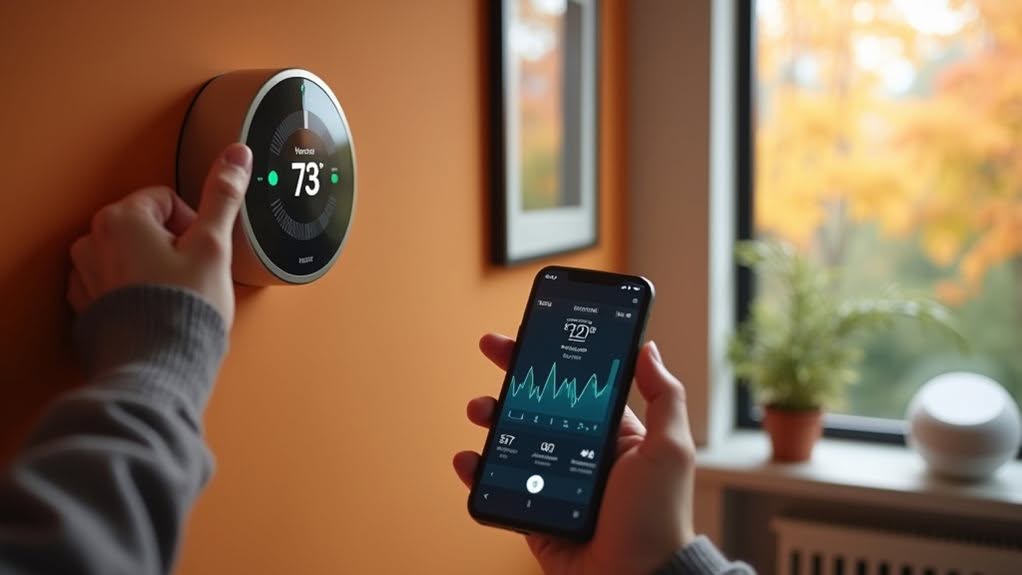
While maximizing your smart thermostat’s capabilities requires thoughtful integration with your existing home systems, the effort yields considerable energy savings and improved comfort.
Compatibility with your HVAC system should be verified before purchase, and professional installation guarantees proper connection.
Connect your thermostat to platforms like Amazon Alexa or Google Home to enable voice commands and automated routines.
This integration allows temperature adjustments based on occupancy, time of day, or other smart device triggers.
Add sensors throughout your home for more precise control.
Door and window sensors can pause HVAC operation when openings are detected, while motion and temperature sensors enable room-specific climate management.
Link your thermostat with energy monitoring systems to track consumption patterns and receive maintenance alerts, helping you identify further opportunities for efficiency improvements.
Remote Control Features That Reduce Energy Waste
You’ll save considerable energy by using your smartphone to create heating and cooling schedules that align with your daily routine.
Setting up automated adjustments through your thermostat’s app allows you to make changes even when you’re away from home, preventing wasted energy during unexpected schedule changes.
Voice commands through integrated smart speakers offer convenient hands-free control, letting you adjust temperature settings without interrupting your activities, which makes you more likely to optimize settings regularly.
Smartphone Scheduling Solutions
Today’s smart thermostats offer unprecedented control over your home’s heating and cooling systems through innovative smartphone applications.
These apps allow you to create customized schedules with remarkable precision, setting temperatures in 15-minute intervals for each day of the week.
You can save multiple seasonal schedules and switch between them as weather patterns change, eliminating the need for constant adjustments.
When plans change unexpectedly, you can easily override your pre-programmed settings remotely from anywhere with internet connectivity.
Here’s how smartphone scheduling helps you save money:
- Set lower temperatures overnight automatically to reduce heating costs
- Program different temperatures for individual rooms with multiple thermostats
- Create energy-saving schedules when you’re away from home
- Receive notifications about energy usage patterns to optimize efficiency
Voice Command Convenience
The evolution of voice-activated thermostats represents one of the most notable advancements in home climate control technology.
These systems encourage more frequent temperature adjustments, leading to optimized energy use and savings of 5-8% on utility bills.
With voice commands, you’ll reduce carbon emissions by optimizing heating and cooling cycles without lifting a finger.
When you’re away from home, remote control features prevent unnecessary HVAC operation, further cutting costs.
These smart devices learn your daily routines and preferences, automatically adjusting temperatures based on occupancy patterns.
The integration with other smart home systems maximizes natural heating and cooling opportunities, reducing your reliance on artificial climate control.
The convenience of voice commands translates directly to efficiency—you’re more likely to make energy-saving adjustments when it’s as simple as speaking.
Many utility companies now offer energy rebates to homeowners who install smart thermostats, making these devices even more cost-effective in the long run.
Seasonal Strategies for Enhanced Efficiency
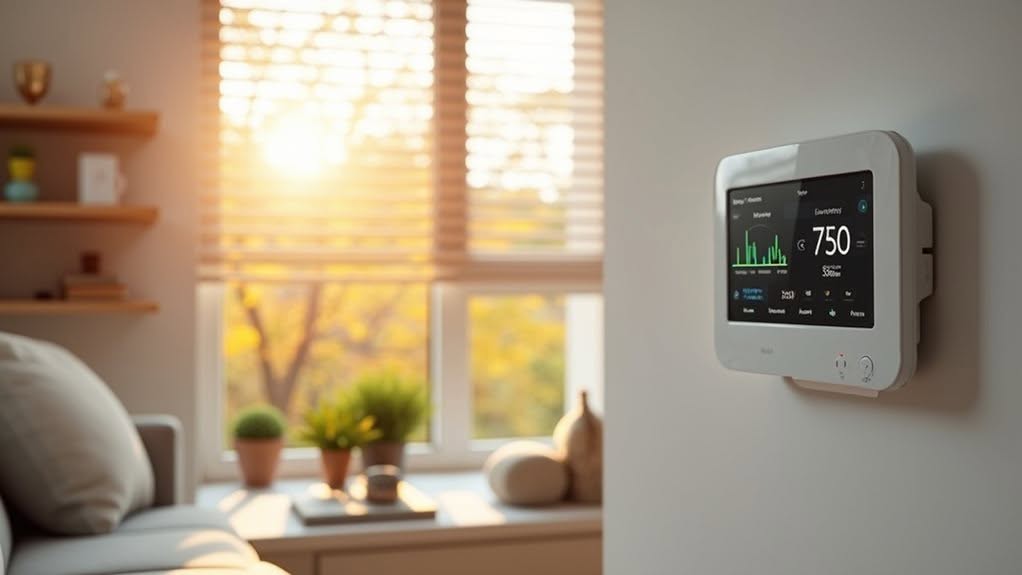
Adapting your home’s climate control strategy with the changing seasons can dramatically reduce energy costs while maintaining comfort year-round.
Smart thermostats excel at automating these seasonal shifts, eliminating the need for manual adjustments.
In winter, set your thermostat to 68°F when you’re home and awake, lowering it to 63-65°F during sleep or absence.
This simple change can reduce heating bills by approximately 10%.
For summer efficiency:
- Set your thermostat to 78°F while home
- Increase to 85-88°F when away or sleeping
- Use pre-cooling functions during cooler parts of the day
- Combine with closed blinds during peak sunlight hours
Advanced models utilize weather-responsive scheduling to automatically adjust your home’s temperature based on local weather forecasts.
Consider enrolling in the Seasonal Savings Program which makes small temperature adjustments that maximize efficiency without compromising comfort.
During mild seasons like fall and spring, allow indoor temperatures to drift slightly with outdoor conditions to maximize energy savings without sacrificing comfort.
Long-Term Return on Investment: Beyond the Initial Purchase
While seasonal adjustments provide immediate energy savings, investing in smart technology delivers financial benefits that compound over time. Smart thermostats typically pay for themselves within 1-2 years through energy cost reductions of 10-20% annually.
The average homeowner saves $131-$145 per year, with ENERGY STAR certified models delivering verified savings of about 8% on heating and cooling bills. Your actual return depends on several factors: local energy rates, home size, climate conditions, and your personal usage patterns.
Homeowners with irregular schedules or who travel frequently see the greatest financial benefits. Many utility companies offer rebates that reduce initial costs, accelerating your payback period.
Additionally, smart thermostats can increase home value and reduce HVAC maintenance expenses by optimizing system operation.
Frequently Asked Questions
Are Smart Thermostats Compatible With Older HVAC Systems?
Some smart thermostats work with older HVAC systems, but you’ll need to check compatibility factors like voltage (24V required), wiring configuration (C-wire often needed), and system type before purchasing. Adapters may solve certain issues.
How Do Power Outages Affect Smart Thermostat Programming?
During power outages, your smart thermostat stops functioning but retains its programming. When power returns, it automatically resumes scheduled temperature adjustments without requiring reprogramming. Some models even have battery backup for limited functionality.
Can Smart Thermostats Detect When Windows Are Open?
Yes, smart thermostats can detect open windows by sensing rapid temperature drops, typically 5°C within 15 minutes. They’ll pause your HVAC system to save energy, and some integrate with dedicated window sensors for direct detection.
Do Smart Thermostats Require Continuous Internet Connection?
No, smart thermostats don’t require continuous internet connection. They’ll still control your heating and cooling offline, but you’ll lose remote access, voice control, and advanced features like weather adaptation and energy optimization.
How Often Should Smart Thermostat Sensors Be Recalibrated?
You should recalibrate your smart thermostat sensors annually. Consider more frequent calibration (every 3-6 months) in harsh environments or if you notice temperature inconsistencies. Always check calibration when readings don’t match your comfort level.
Final Thoughts
You’ll find that smart thermostats and cooling devices represent a worthwhile investment for your home. The initial costs are quickly offset by energy savings, utility rebates, and increased comfort. By implementing seasonal adjustments, taking advantage of remote controls, and integrating your devices with other home systems, you’ll create an efficient environment that saves money while reducing your carbon footprint.