Smart lighting serves as your entry point to home automation, requiring minimal installation while connecting to major voice assistants like Alexa and Google Home. These systems can reduce your energy consumption by 7-27% through automation, translating to 5-22% savings on monthly utility bills. They create the infrastructure for whole-home intelligence by integrating various wireless protocols through central hubs. This foundation supports advanced features like security improvement, personalized routines, and thorough device communication throughout your connected home.
The Gateway Technology: How Smart Lighting Leads Home Automation Adoption
While many homeowners hesitate to plunge into full home automation, smart lighting often serves as their entry point due to its accessible gateway technology.
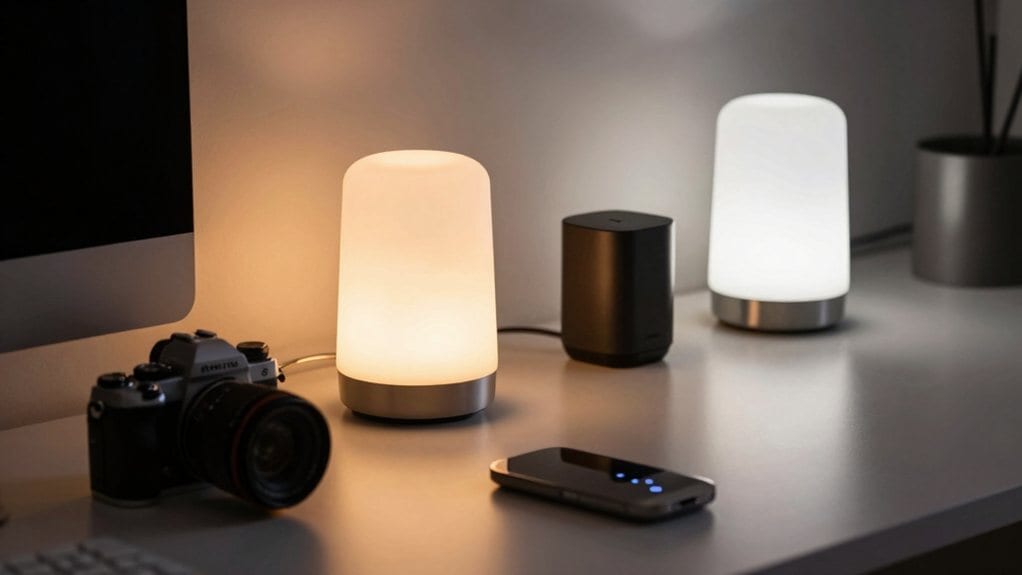
The central hubs or gateways that power smart lighting systems act as command centers for your entire smart home. These hubs seamlessly translate between different wireless protocols like Z-Wave, Zigbee, and Wi-Fi, allowing devices from various manufacturers to work together. The ability to support multiple communication standards ensures robust wireless coverage throughout your home regardless of device brand or type. Systems like the SMRT LOGIC platform exemplify this versatility by offering cloud-based control for both lighting and other landscape features.
You’ll find that these gateways integrate easily with existing electrical systems, requiring minimal rewiring or professional assistance. Their compatibility with voice assistants like Alexa and Google Home further simplifies adoption. By installing smart lighting, you can begin transforming your space while maintaining simplicity and user-friendliness.
Once you’re comfortable with controlling your lights through an app or voice command, you’re more likely to expand into other automation categories. Smart lighting fundamentally becomes your stepping stone to a fully connected home.
Energy Efficiency: Tangible Cost Benefits of Smart Lighting Systems
Smart lighting systems offer considerable financial benefits through measurable energy efficiency improvements.
These systems reduce household lighting energy consumption by 7-27% through intelligent automation and scheduling features.
LED smart bulbs consume up to 90% less energy than traditional incandescent options, with ENERGY STAR certified models using at least 75% less power.
When you combine modern LED technology with smart controls, you’ll cut lighting energy use by up to 60%.
The direct impact on your utility bills is noteworthy. Homeowners typically see reductions of 5-22% on monthly expenses.
With LEDs lasting up to 25 times longer than conventional bulbs, you’ll also save on replacement costs.
Smart lighting’s integration with sensors guarantees lights operate only when needed, eliminating waste through precise control.
The evolution of smart home technology has significantly improved user interfaces, making lighting control more intuitive through smartphone apps and voice commands.
Implementing smart lighting with occupancy-sensing features can deliver energy savings of 3% to 60% based on room usage patterns.
Seamless Integration With Voice Assistants and Mobile Applications
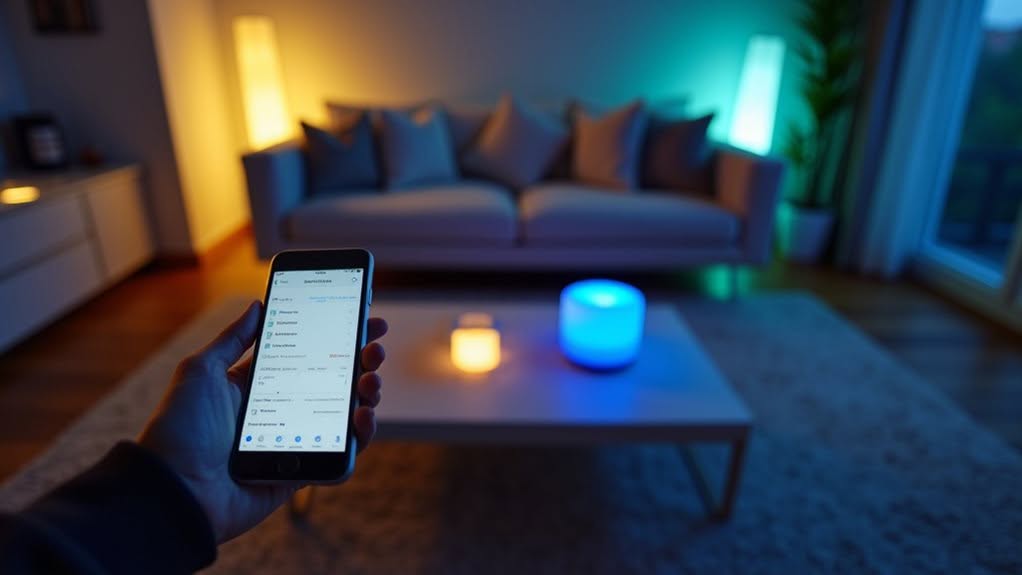
Smart lighting systems now work with popular voice assistants like Alexa, Google Assistant, and Siri, allowing you to control your lights through natural speech commands.
You’ll find this voice integration is driving considerable market growth, with the voice-activated lights segment expected to reach $22.8 billion by 2033 at a 24.8% CAGR.
Leading companies like Philips Lighting and Lutron Electronics continue to invest in R&D for innovation to enhance smart lighting capabilities.
Your smart lighting can also connect across multiple platforms using Wi-Fi, Bluetooth, and protocols like Z-Wave or ZigBee, guaranteeing compatibility with different ecosystems and mobile apps that 84% of smart home users regularly use.
This market is projected to grow exponentially, reaching approximately USD 127,455.2 million by 2032 with a remarkable CAGR of 20.6% from 2025 onward.
Voice Control Evolution
As technology continues to evolve, voice control has transformed from a novelty feature into an essential component of modern smart lighting systems.
Today’s AI-powered assistants like Amazon Alexa, Google Assistant, and Apple Siri understand your commands with impressive accuracy, even recognizing different accents and speech patterns. These systems use multiple microphones and noise-cancellation to hear you clearly in busy households. By 2025, smart lighting systems will offer enhanced integration standards to ensure seamless compatibility with these popular voice assistants.
You’ll appreciate how voice commands can trigger complex routines—saying “I’m home” can activate lights, adjust your thermostat, and open blinds simultaneously. This hands-free operation particularly benefits accessibility needs.
Your experience improves over time as continuous learning algorithms adapt to your specific behaviors and frequently used commands. Industry data shows that 72% of owners use their smart speakers daily, indicating the central role voice technology plays in smart home interaction.
Meanwhile, companion mobile apps work alongside voice control, allowing you to fine-tune settings and manage your lighting remotely when voice commands aren’t practical.
Cross-Platform Compatibility
While voice control provides intuitive hands-free operation, the true power of modern smart lighting lies in cross-platform compatibility. The emergence of standardized protocols like Matter guarantees your devices from different manufacturers can communicate seamlessly.
You’ll appreciate how smart lighting systems now integrate effortlessly with mobile applications, allowing remote control and customization of your lighting based on occupancy or time of day.
These apps also provide valuable data analytics to help optimize your energy consumption.
Your smart lighting can simultaneously work with voice assistants including Alexa, Google Home, and Siri, making control even more convenient through simple voice commands. Yeelight exemplifies this integration through its user-centric design approach that enhances the overall smart home experience.
This cross-platform compatibility isn’t just about convenience—it’s future-proofing your investment.
Devices supporting standardized protocols will remain compatible with emerging technologies, augmenting your smart home experience while expanding functionality over time.
As the global smart lighting market continues to grow, we’re seeing increased development of AI-integrated lighting that can learn from user behavior patterns and adjust automatically to preferences.
Creating the Connected Infrastructure for Whole-Home Intelligence
Network-ready control hubs serve as the command centers for your smart lighting ecosystem, allowing you to manage multiple devices from a single interface.
You’ll find these hubs can connect with various protocols like Wi-Fi, Zigbee, and Z-Wave, creating a unified platform that supports seamless device integration across brands and technologies.
This interconnected foundation enables your smart lighting to communicate with other home systems, forming the backbone of a thorough home automation network that can expand over time.
Network-Ready Control Hubs
The central nervous system of any modern smart home begins with a network-ready control hub, which coordinates all connected devices regardless of their communication protocols.
These sophisticated controllers serve as translators between different device languages, allowing your Z-Wave door locks to communicate with Zigbee light switches and Wi-Fi cameras.
Your hub offers critical capabilities that make whole-home automation possible:
- Acts as a bridge between multiple wireless protocols (Zigbee, Z-Wave, Wi-Fi, Bluetooth)
- Executes automation rules locally, reducing response time and cloud dependency
- Offloads device traffic from your Wi-Fi network to improve overall connectivity
- Processes data through embedded processors for real-time command handling
- Provides remote access capabilities for monitoring and control when you’re away
With a properly configured hub, you’ll enjoy seamless device interoperability and future-proof your system as new protocols like Matter emerge.
Seamless Device Integration
Building upon your control hub foundation, seamless device integration weaves together diverse smart products into a cohesive, intelligent system. Your smart lights can communicate across multiple protocols like Zigbee, Z-Wave, and Wi-Fi, guaranteeing compatibility with existing home automation components.
Open standards enable your lighting to work harmoniously with devices from various manufacturers, eliminating fragmentation concerns when adding new products. This interoperability creates a unified infrastructure where lighting coordinates with HVAC, security, and entertainment systems.
Your integrated lighting contributes valuable data through IoT sensors, which feeds machine learning models to optimize schedules based on your preferences. This integration supports complex automation scenarios triggered by occupancy, time of day, and environmental conditions.
The result is a synchronized ecosystem where your lighting doesn’t just illuminate rooms but actively participates in your home’s collective intelligence.
Personalization and Automation: Beyond Basic Illumination
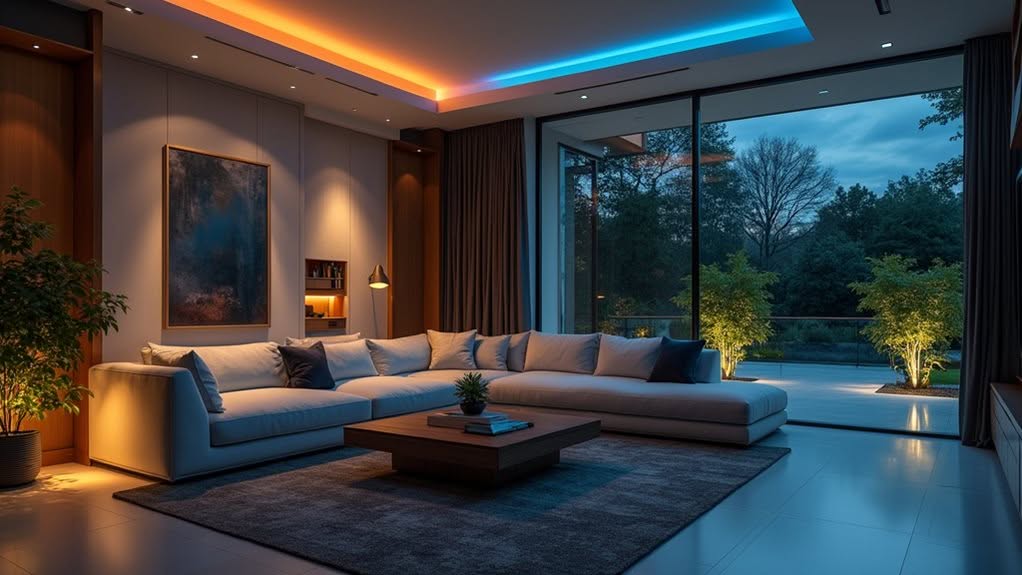
Modern smart lighting systems have evolved far beyond merely turning lights on and off. They now offer unprecedented personalization capabilities that transform how you experience your home environment. These systems learn your preferences and adapt to your daily routines, creating the perfect ambiance for any occasion.
Your smart lighting can improve your life through:
- Custom scenes that activate specific lights when you arrive home
- Color and brightness adjustments that match your mood or activity
- Automated schedules that eliminate the need for manual control
- Integration with other smart devices for a cohesive experience
- Health benefits from lighting that regulates your circadian rhythm
With these features, you’re not only controlling illumination—you’re creating personalized experiences while saving energy.
Smart lighting systems typically reduce lighting costs by 25-35%, paying for themselves within 2-3 years while providing greater comfort and convenience.
Security Enhancement Through Intelligent Lighting Control
While improving your home’s aesthetics, smart lighting systems also serve as a powerful security layer that deters potential intruders and protects your property.
Motion-activated lights detect movement up to 30 feet away, immediately illuminating entry points and dark areas when someone approaches. This sudden brightness startles intruders and improves visibility for your surveillance systems.
You can program randomized lighting schedules that simulate occupancy, creating the illusion that someone’s home even when you’re away. These unpredictable patterns confuse potential burglars who prefer dark, vacant homes.
Your lighting can integrate with security cameras and alarms for coordinated responses during suspicious activity. When a camera detects movement, lights activate to improve image clarity and trigger notifications to your smartphone.
Remote control capabilities let you adjust lighting from anywhere, providing flexible security that adapts to your changing needs.
Market Growth Trajectory: From Luxury to Mainstream Necessity
You’re witnessing a remarkable shift as smart lighting transforms from an exclusive luxury feature into a mainstream home necessity.
This change has accelerated in recent years, with the global market projected to grow from $18.57 billion in 2025 to over $43 billion by 2030, representing an impressive 18.5% compound annual growth rate.
Europe currently leads adoption with 37% market share, while Asia Pacific regions show the fastest growth trajectory at nearly 24% annually, illustrating how smart lighting is rapidly becoming a standard component in homes worldwide.
Luxury-to-Mass Market Evolution
The transformation of smart lighting from exclusive luxury products to mainstream household necessities represents one of the most notable shifts in home technology adoption over the past decade.
This evolution has been driven by remarkable market growth, with projections showing expansion from $18.6 billion in 2025 to over $43 billion by 2030.
You’re witnessing the democratization of smart lighting through several key factors:
- Declining LED component costs making products more affordable
- Integration with popular voice assistants like Alexa and Google Assistant
- Open standards such as Matter improving device compatibility
- Energy efficiency gains providing measurable utility bill savings
- Manufacturing scale reducing prices while increasing feature sets
As smart lighting becomes integrated with broader home automation systems, you’ll find these products increasingly accessible across all price points, not solely premium segments.
Adoption Rate Acceleration
Smart lighting’s shift from luxury to mainstream necessity has gained remarkable momentum in recent years. The market is projected to grow from $18.6 billion in 2025 to a staggering $43.4 billion by 2030, representing an 18.5% annual growth rate.
You’ll find this acceleration driven by multiple factors. IoT integration allows you to control lights remotely and access real-time analytics. AI-powered features automatically adjust brightness based on occupancy, optimizing your energy use.
The convenience of voice assistant compatibility with Google and Alexa makes everyday control effortless. Additionally, new connectivity standards like Matter improve how your devices work together across brands.
Energy efficiency incentives from utilities and building codes further encourage adoption, helping you reduce electricity bills while supporting sustainability goals that align with modern living priorities.
Global Penetration Patterns
While once considered a high-end luxury for tech enthusiasts, smart lighting has steadily evolved into a mainstream necessity across global markets.
The global smart lighting market is expected to grow from $18.6 billion in 2025 to between $43-56 billion by 2030, with projections reaching as high as $166 billion by 2034.
Regional adoption shows distinct patterns:
- Europe leads with strong IoT integration and sustainability initiatives, projected to reach $63 billion by 2034.
- Asia-Pacific commands the largest market share driven by rapid urbanization and infrastructure investments.
- North America benefits from utility-funded incentives and high interoperability standards.
- Government programs like India’s Smart City initiative prioritize smart lighting for public infrastructure.
- Commercial and industrial sectors show accelerated adoption alongside residential growth due to efficiency benefits.
Environmental Impact and Sustainability Advantages
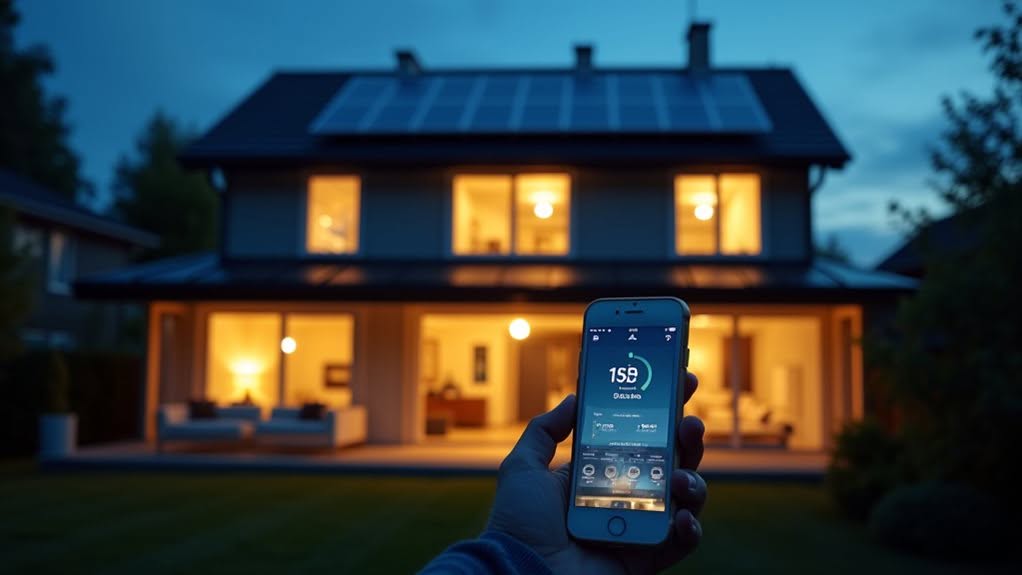
As our world faces growing environmental challenges, smart lighting systems represent one of the most accessible and effective ways to reduce your household’s carbon footprint.
LED technology forms the foundation of smart lighting, using 75% less energy than traditional bulbs while lasting up to 25 times longer. This greatly reduces waste and replacement frequency.
Smart controls amplify these benefits through motion sensors, dimming capabilities, and scheduling features. You’ll cut energy waste by making sure lights operate only when needed, with dimming alone reducing consumption by up to 19%.
The environmental impact extends beyond your home. When widely adopted, smart lighting decreases electricity demand, reduces strain on power grids, and supports integration with renewable energy sources like solar power.
These systems directly support global energy efficiency goals and climate change mitigation efforts.
Technological Evolution: AI and Machine Learning in Modern Lighting
The evolution of smart lighting technologies now centers on artificial intelligence and machine learning capabilities that transform ordinary fixtures into responsive, intelligent systems.
These advanced systems analyze data from IoT sensors to learn your habits and anticipate your needs before you even flip a switch.
- AI algorithms study your behavioral patterns, including time-of-day activity and preferred settings
- Visual recognition technology syncs lighting with on-screen content for immersive experiences
- Dynamic adaptive lighting automatically adjusts based on natural light and occupancy
- Integration with other smart home technologies creates holistic automation solutions
- Predictive maintenance detects potential issues before lights fail, extending system lifespan
You’ll experience seamless environmental adjustments as AI-powered lighting responds to your presence, activities, and preferences without manual intervention, creating personalized comfort while maximizing energy efficiency.
The Economic Case: Return on Investment for Smart Lighting Adopters
Investing in smart lighting systems delivers compelling economic returns that extend far beyond simple energy savings. These systems can reduce energy consumption by up to 75% compared to standard lighting, with typical payback periods of just 2-3 years.
After this initial period, you’ll enjoy sustained annual savings of 25-35% on lighting costs. When combined with smart thermostats, your overall household energy usage can drop by 10-30%.
Smart lighting also adds tangible property value, increasing home worth by 3-5%. With 78% of homebuyers willing to pay more for smart home features, your investment becomes a market advantage.
For property managers, these systems reduce maintenance costs through predictive capabilities and remote monitoring, while increasing tenant attraction and retention rates.
Frequently Asked Questions
How Do Smart Lights Affect Sleep Quality and Circadian Rhythms?
Smart lights affect your sleep by influencing melatonin production. You’ll sleep better when you use red light before bed, gradually dim lights at night, and program morning brightness to naturally regulate your circadian rhythms.
Can Hackers Access My Home Network Through Smart Lighting Systems?
Yes, hackers can access your home network through smart lighting systems. Vulnerabilities in protocols like ZigBee and weak security settings allow attackers to hijack your bulbs, then use them as entry points to your broader network.
What Happens to Smart Lighting During Power or Internet Outages?
During power outages, your smart bulbs typically turn on at full brightness when power returns. Without internet, you’ll lose remote control but can still use physical switches until connectivity is restored.
How Do Smart Lighting Systems Impact Home Resale Value?
You’ll boost your home’s resale value with smart lighting systems. They typically increase property values by up to 1%, offer a competitive advantage in the market, and appeal to tech-savvy buyers seeking modern conveniences.
Are Smart Lighting Components Recyclable or Biodegradable?
Most smart lighting components are recyclable, including metals, glass and some plastics, but rarely biodegradable. You’ll find return programs that help recycle LEDs, though their complex materials containing rare elements present recycling challenges.
Final Thoughts
As you’ve seen, smart lighting serves as the cornerstone of modern home automation. It offers immediate energy savings, seamless technology integration, and creates the infrastructure for expanding your smart home ecosystem. With falling prices and increasing compatibility, you’ll find smart lighting isn’t just convenient—it’s a practical investment that pays dividends in efficiency, comfort, and home value. The foundation you build today will support tomorrow’s intelligent living spaces.