Advanced smart climate control now leverages AI algorithms that analyze your habits, weather patterns, and room occupancy to create personalized temperature profiles. You’ll benefit from multi-zone sensors that enable precise room-by-room management and voice-activated controls integrated with virtual assistants. Predictive analytics can reduce energy costs by up to 30% through weather pattern integration and consumption learning, while IoT-connected sensors monitor system health for automated maintenance. These innovations promise both improved comfort and notable energy savings.
Leveraging AI Algorithms for Personalized Temperature Profiles
As technology continues to reshape our homes, AI algorithms are revolutionizing climate control through personalized temperature profiles.
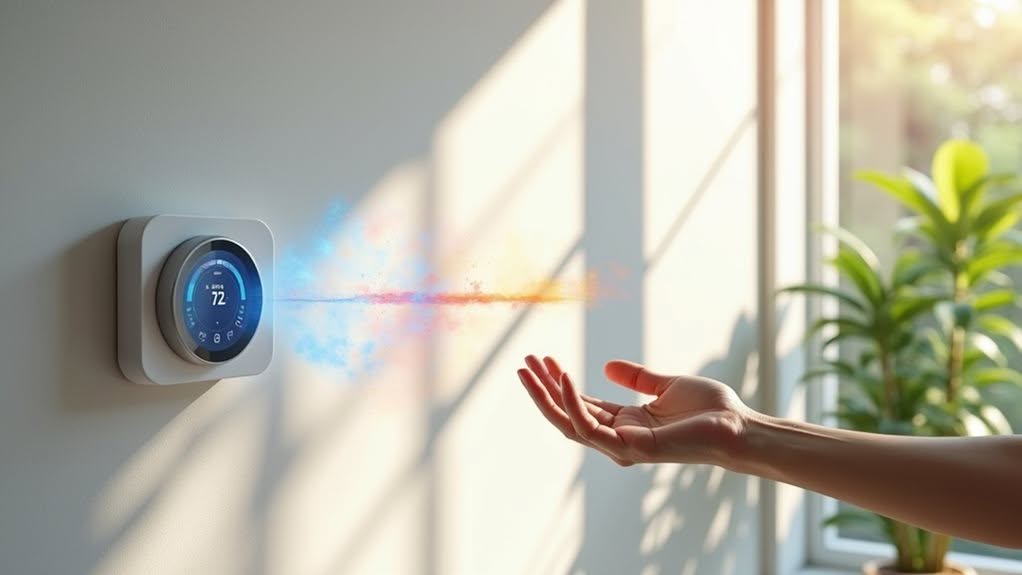
These sophisticated systems analyze your interactions, local weather conditions, and room occupancy to create adaptive temperature schedules customized specifically to your needs.
The algorithms continuously learn from your behavioral patterns and preferences, improving accuracy over time. You’ll benefit from predictive capabilities that forecast heating and cooling needs based on historical data, potentially saving up to 15.8% on energy costs compared to traditional thermostats.
Reinforcement learning methods optimize your HVAC operations by balancing comfort with energy efficiency.
The system uses dynamic reward functions that prioritize your preferences while avoiding over-optimization through clipped loss techniques.
AI-driven thermal balance modulation also compensates for external changes, guaranteeing consistent comfort throughout your home.
Many modern homes are now integrating smart thermostats with comprehensive security systems for a complete automated living experience.
Multi-Zone Smart Sensors for Precision Climate Management
While traditional thermostats offer whole-home temperature control, multi-zone smart sensor systems revolutionize climate management by delivering precise, room-by-room customization.
These systems deploy wireless temperature and humidity sensors throughout your home, communicating real-time data to a central control unit.
You’ll benefit from occupancy detection that adjusts climate settings only when rooms are in use, considerably reducing energy waste.
Strategic sensor placement in frequently used rooms captures accurate conditions, while multiple sensors per zone account for temperature variations.
The system intelligently regulates airflow through smart radiator valves and dampers based on sensor input.
You can manage your personalized climate preferences remotely through mobile apps, with zones defined by occupancy patterns and room function.
This approach minimizes temperature fluctuations while delivering up to 20% energy savings.
Voice-Activated Controls and Virtual Assistant Integration
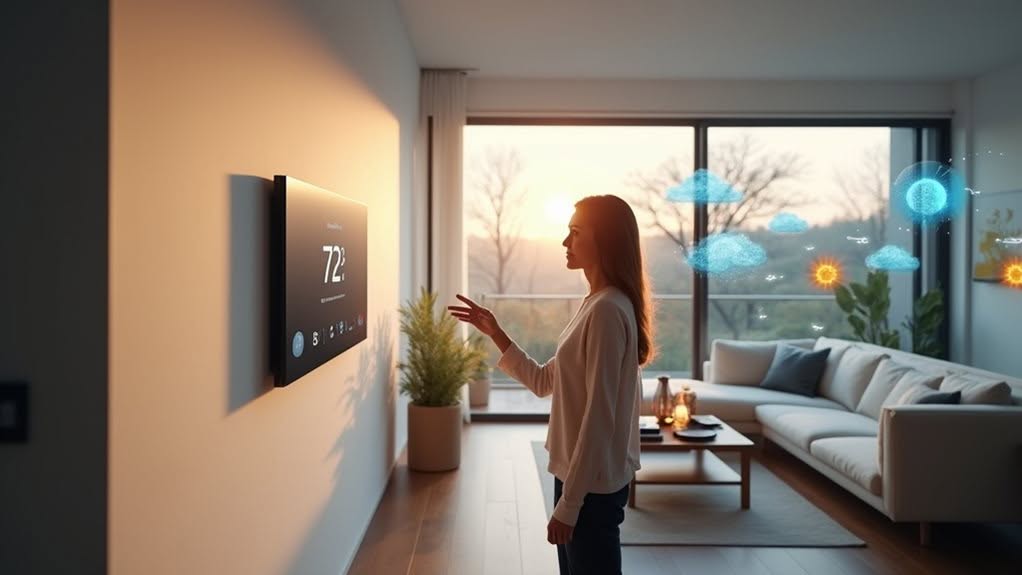
Modern voice-activated controls have transformed climate management systems by enabling hands-free operation of your home environment.
The market for these technologies is growing rapidly, expected to reach $20 billion by 2033 with a 6% annual growth rate.
You’ll find considerable energy benefits when implementing voice control, with potential HVAC cost reductions of up to 30%.
These systems can detect when you’re present and adjust settings accordingly for peak efficiency.
Integration with virtual assistants like Alexa and Google Assistant makes operation intuitive, with over 50% of consumers now willing to invest in these smart technologies.
You can create automated scenes that activate pre-set energy-saving configurations with simple voice commands.
Despite initial high costs, voice-controlled climate systems typically provide return on investment within 1-2 years through energy savings and improved comfort.
Energy Optimization Through Predictive Analytics
Modern climate control systems now leverage predictive analytics to optimize your home’s energy usage through three powerful strategies.
Weather pattern integration allows your system to adjust heating and cooling in advance of temperature changes, saving energy by anticipating rather than reacting.
Your system learns your consumption patterns over time, automatically adjusting temperature settings to match your schedule and preferences while minimizing waste.
Smart load balancing distributes energy efficiently across your home’s devices during peak usage times, preventing overconsumption and reducing your utility bills.
Weather Pattern Integration
Today’s climate control systems have evolved beyond simple temperature regulation, now incorporating sophisticated weather pattern integration capabilities. These advanced systems connect to weather forecasting data to prepare your HVAC equipment for upcoming conditions.
Proper sensor placement is vital for these systems to function effectively. Strategically positioned sensors provide accurate environmental data, allowing your system to make real-time adjustments. When correctly installed, weather-adaptive controls can improve your HVAC efficiency by up to 30%.
You’ll appreciate how these systems optimize energy use by adjusting dehumidification and cooling based on current humidity and temperature levels. The technology integrates seamlessly with other smart home devices, creating an all-encompassing automation network for your home.
Unlike traditional systems requiring manual seasonal adjustments, weather-integrated climate controls automatically adapt to changing conditions throughout the year.
Consumption Pattern Learning
While weather-integrated systems react to external conditions, consumption pattern learning takes climate control to a new level of personalization. These systems analyze your daily routines and preferences to optimize energy use.
Smart thermostats employ machine learning algorithms to track when you’re home, away, or asleep. They then adjust temperatures accordingly, reducing unnecessary heating or cooling by up to 30%.
Cluster analysis identifies your consumption patterns, while predictive models forecast future energy needs based on historical data. These insights help systems prepare for your typical usage cycles.
IoT sensors continuously monitor temperature, humidity, and occupancy, providing real-time data that refines the system’s understanding of your preferences.
Over time, your HVAC system adapts to your feedback, maintaining comfort while minimizing energy waste and reducing peak demand by 15-20%.
Smart Load Balancing
By harnessing the power of advanced data analysis, smart load balancing transforms how energy systems manage demand and supply dynamics. This technology leverages predictive analytics and machine learning to enhance energy distribution efficiently.
Your climate control system can benefit from these intelligent balancing capabilities:
- Predictive forecasting that shifts energy usage away from peak hours, reducing costs by aligning with lower-rate periods.
- Reinforcement learning algorithms that adapt to your specific usage patterns for ideal temperature control.
- IoT sensors that provide real-time monitoring and automatic adjustments based on occupancy and weather changes.
- Automated dispatch systems that redistribute energy loads during high-demand periods, maintaining comfort while preventing system overload.
This integration of AI and data analytics guarantees your climate control operates with maximum efficiency while maintaining desired comfort levels.
Automated Maintenance Scheduling and System Health Monitoring
Modern climate control systems have evolved beyond simple temperature regulation into sophisticated networks that can monitor their own health and schedule their maintenance needs.
These systems use IoT-enabled sensors to track critical parameters like airflow, vibration, pressure, and temperature in real time.
Cloud platforms compare current system behavior against normal operational profiles, detecting anomalies before they cause failures.
You’ll benefit from condition-based servicing rather than fixed calendar maintenance, optimizing service intervals based on actual wear.
AI and machine learning analyze historical data to predict maintenance needs, reducing unnecessary interventions and emergency repairs.
Smart platforms automatically generate work orders, coordinate technicians, and manage documentation.
The result? Studies show 20-30% energy savings in commercial environments, extended equipment lifespan, and notably reduced operational costs through prevention of expensive system failures.
Weather-Responsive HVAC Adjustments via IoT Connectivity
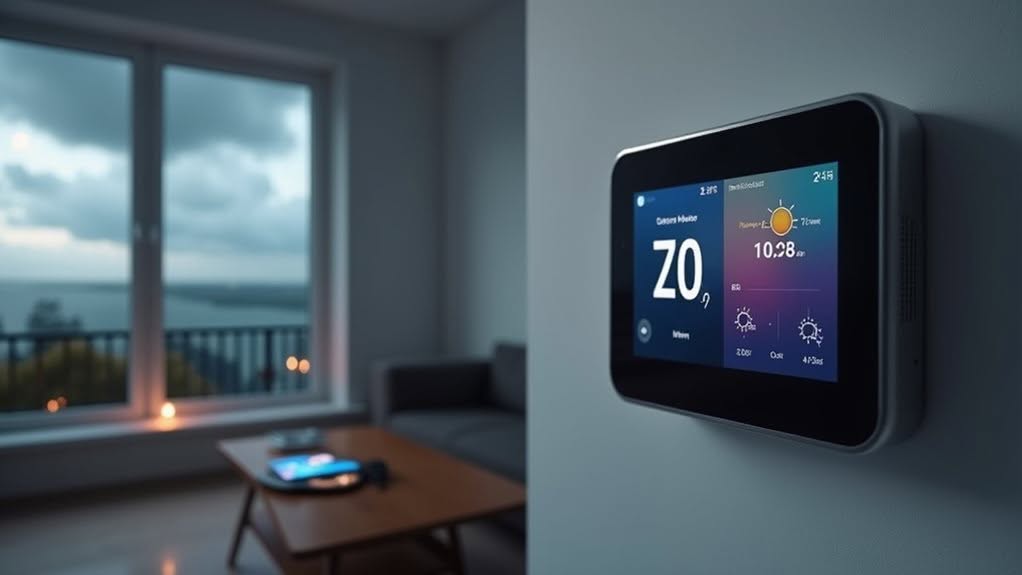
Weather-responsive HVAC systems now leverage IoT connectivity to adapt intelligently to changing environmental conditions in real time.
These systems utilize hyperlocal weather forecasts and environmental data to enhance indoor comfort while reducing energy consumption.
Your smart climate control can respond to weather changes before they impact your building:
- Advanced sensors continuously monitor indoor temperature, humidity, occupancy, and CO₂ levels, enabling zone-specific adjustments
- Machine learning algorithms predict ideal settings based on historical patterns and upcoming weather conditions
- Edge computing processes data locally for rapid adjustments without cloud communication delays
- Remote access through smartphone apps or voice assistants lets you control settings from anywhere
This technology can reduce energy waste by up to 30% in commercial buildings while maintaining consistent comfort levels.
The system integrates with other building automation for unified, efficient operations.
Integrating Smart Climate Control With Comprehensive Home Automation
Integrating smart climate control with extensive home automation systems creates a unified ecosystem where temperature management becomes just one component of an intelligent, interconnected home environment.
Your smart thermostat can work alongside motorized blinds and occupancy sensors to maintain peak comfort while minimizing energy usage. When you’re away, geofencing automatically adjusts settings based on your location, preventing unnecessary operation of your HVAC system.
Voice control through Alexa, Google Assistant, or Siri enables hands-free temperature adjustments throughout your home. For customized comfort, multi-zone control allows independent temperature management in different areas.
The integration extends to air quality management, with sensors detecting pollutants and automatically triggering purifiers when needed.
This all-encompassing approach guarantees your home remains comfortable, efficient, and responsive to your lifestyle.
Frequently Asked Questions
How Much Do Smart HVAC Systems Typically Increase Property Value?
You’ll typically see a 3-5% increase in your property value with smart HVAC systems, though it can reach 8-10% in markets that highly value energy efficiency. You’ll also enjoy 10-15% energy savings.
Can Smart Climate Systems Work With Existing Older HVAC Equipment?
Yes, many smart climate systems can work with your older HVAC equipment. You’ll need to check compatibility, and might require a C-wire adapter or professional installation, but retrofitting options exist for most existing systems.
What Backup Systems Exist During Internet or Power Outages?
You can rely on UPS systems like Tesla Powerwall or EcoFlow DELTA Pro during outages. They provide power within milliseconds, last for hours or days, and work with solar panels for extended backup capability.
How Are Privacy Concerns Addressed With Data Collection?
Privacy concerns in smart climate data collection are addressed through encryption, clear user consent options, data minimization practices, and controls that let you limit what’s shared with third parties or delete your information entirely.
What Security Measures Prevent Hacking of Smart Climate Systems?
You’ll prevent hacking through network segmentation, robust access controls, regular firmware updates, and strong encryption. Implement zero-trust architecture, use MFA, monitor systems continuously, and maintain strict vendor security assessments to protect your climate systems.
Final Thoughts
You’re witnessing a revolution in climate control through smart automation. By embracing AI algorithms, multi-zone sensors, and predictive analytics, you’ll achieve both comfort and efficiency. These systems continuously adapt to your preferences while reducing energy consumption. As voice controls and weather-responsive adjustments become standard features, your climate management will seamlessly integrate with broader home automation. The future of comfortable, sustainable living is already within reach.