
Yes, you can use Python extensively in Home Assistant. The platform itself is built with Python, offering multiple integration methods including Python Script, PyScript, and AppDaemon. To start, add `python_script:` to your configuration.yaml file and create a python_scripts folder for your custom code. While the native environment has sandbox limitations, tools like AppDaemon provide expanded capabilities. These Python-based options extend functionality beyond standard automations, making it powerful for creating customized smart home solutions.
Python’s Role in the Home Assistant Ecosystem
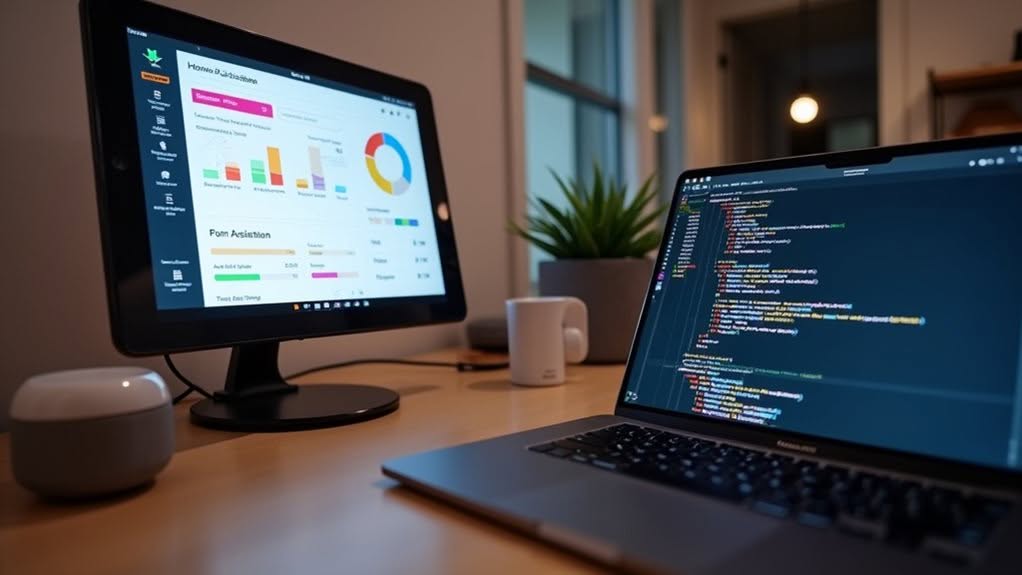
While Home Assistant offers various automation methods, Python stands at the core of its functionality, providing both built-in scripting capabilities and pathways for extended customization.
At its foundation, Home Assistant itself is built using Python, making the language integral to how the platform operates. You’ll find several ways to leverage Python within your smart home setup, each offering different levels of complexity and capability.
Python forms the backbone of Home Assistant, offering smart home enthusiasts multiple pathways to automation—from simple scripts to complex integrations.
The built-in Python Scripts integration allows you to create simple automations stored in your configuration directory. These scripts run in a sandboxed environment with access to only specific variables like `hass`, `data`, and `logger`. Each script you create can trigger custom events using the hass.bus.fire method, which can then be viewed in Developer tools. PyScript supports organizing your code into separate subfolders with independent requirements files for better dependency management.
For more advanced needs, you can explore PyScript for expanded functionality or AppDaemon, which operates as a separate Python application communicating with Home Assistant through its API.
Enabling the Python Script Integration
Before you can leverage Python scripts in your Home Assistant setup, you’ll need to enable the Python Script integration.
The process is remarkably straightforward. Simply add the line `python_script:` to your main `configuration.yaml` file, then restart Home Assistant for the change to take effect.
No additional configuration is required under this section unless you’re creating custom scripts. The single line is sufficient to activate the integration.
After restarting, verify that the integration is properly enabled by checking under Configuration > Integrations in the Home Assistant UI.
If you’re using HACS (Home Assistant Community Store), it will automatically recognize the Python Script integration once it’s activated in your configuration file. Once downloaded, your Python scripts will be stored in the python_scripts folder within your Home Assistant configuration directory.
For more advanced Python capabilities, you can also install Pyscript integration which provides enhanced scripting features and access to Home Assistant services.
Building Your First Home Assistant Python Script

Now that you’ve enabled the Python Script integration, it’s time to create your first script.
First, find your way to your Home Assistant configuration directory and create a folder named `python_scripts` if it doesn’t already exist.
Place your Python script files in this directory. Home Assistant automatically exposes them as callable services without requiring a restart, since scripts aren’t cached. Remember that you can call these scripts using the format `python_script.
Your scripts have access to specific built-in objects: hass, data, logger, time, datetime, dt_util, and output. You can’t import external libraries beyond these sandbox limitations. However, the improved custom component offers advanced capabilities for running Python scripts with external libraries and more flexible execution options.
Python scripts in Home Assistant operate within a controlled sandbox with limited access to predefined objects and no external library imports.
Here’s what a basic script might do:
- Log information using the logger object
- Call Home Assistant services with hass.services.call()
- Process input parameters from the data dictionary
- Return information through the output dictionary
Core Python Objects Available in Home Assistant Scripts
The foundation of Python scripting in Home Assistant rests on several core objects that provide essential capabilities for your custom automations.
The `hass` object serves as your central interface to the Home Assistant system. Through this object, you’ll access critical components like configuration, states, and services. Home Assistant’s focus on local control makes Python scripts extremely powerful for privacy-conscious users.
With `hass.config`, you can retrieve geographic location settings and temperature preferences that influence your automations’ behavior.
The `hass.states` object lets you check, update, or track entity states—fundamental for responding to changes in your smart home environment.
For event-based programming, `hass.bus` allows you to listen for system events or trigger custom ones. You can also access `hass.services` to register service actions that can be called from anywhere in your Home Assistant instance.
Remember that Python scripts run in a sandbox with limited objects: `hass`, `data`, `logger`, and certain datetime modules.
The `output` dictionary returns values from your scripts.
Overcoming the Sandbox Limitations

While Home Assistant’s built-in Python scripts operate in a restricted sandbox environment, you’ll eventually encounter limitations when attempting more complex automations.
You can overcome these restrictions through several methods, including AppDaemon, Pyscript, shell commands, and custom dashboards that allow access to external libraries and greater functionality.
Each approach offers unique advantages for escaping the sandbox constraints, but requires careful consideration of security implications when implementing in your smart home system. Integrating an AI security system can enhance your monitoring capabilities while working alongside Python-based automations. The limited documentation available makes it challenging for users to fully understand these workarounds and their implementation. Remember that using custom integrations may introduce security vulnerabilities that could potentially expose sensitive information in your Home Assistant setup.
Escaping the Sandbox
Despite the restrictive nature of Home Assistant’s Python sandbox, you can employ several effective strategies to break free from its limitations.
When you need full Python functionality, consider switching to AppDaemon, which runs complete Python applications outside the sandbox environment.
Pyscript integration offers another viable alternative, providing more advanced scripting capabilities without the same constraints. You’ll find this particularly useful for complex automation tasks.
For occasional needs, you can create helper buttons in the UI that trigger automations running your python_scripts. This workaround maintains the Home Assistant interface while accessing more functionality.
Shell commands provide yet another option, allowing you to call external Python scripts with full language features and library access. This approach bypasses sandbox restrictions entirely while still integrating with your Home Assistant ecosystem.
External Libraries Access
Accessing external libraries within Home Assistant’s Python environment presents a notable challenge for developers seeking advanced functionality. The sandbox limitations restrict direct importing of external libraries in standard Python scripts, requiring alternative approaches.
You can overcome these limitations through several established methods:
- Use frameworks like AppDaemon or pyscript that provide expanded access to Python’s library ecosystem.
- Create custom integrations that can import and utilize external dependencies.
- Install external libraries via HACS or manual pip installation in the Home Assistant environment.
For more complex projects, developing a custom integration offers the most flexibility. This approach allows you to define required dependencies that Home Assistant will automatically install.
Many developers leverage both synchronous and asynchronous libraries, with async libraries using aiohttp being particularly well-suited to Home Assistant’s architecture.
Advanced Scripting With Pythonscriptspro and Appdaemon
When developers need more advanced automation capabilities in Home Assistant, they often turn to specialized Python-based tools like Pythonscriptspro (Pyscript) and AppDaemon.
Pyscript operates within Home Assistant as a HACS custom component, allowing your Python functions to trigger on schedules, state changes, or events. It enables direct binding of state variables and lets you call Home Assistant services as if they were Python functions.
In contrast, AppDaemon runs as a standalone application outside Home Assistant’s core. This separation provides access to full Python features including imports, classes, and standard libraries.
You can develop with professional IDEs and debugging tools.
Both options greatly expand automation possibilities beyond Home Assistant’s native capabilities, with AppDaemon offering more programming flexibility while Pyscript provides tighter integration with the Home Assistant environment.
Debugging Python Scripts in Home Assistant

Effectively debugging Python scripts within Home Assistant requires specific approaches customized to the platform’s unique environment. The platform offers several methods to identify and resolve issues in your code.
- Use logging functions like `logger.info()`, `logger.warning()`, and `logger.error()` to output debug information directly to Home Assistant logs.
- Set up remote debugging with Visual Studio Code using the `debugpy` integration, configured in your `configuration.yaml` file to inspect variables and set breakpoints.
- For command-line access environments, insert `pdb.set_trace()` statements in your code to create breakpoints for step-through debugging.
Scripts run in a sandboxed environment with limited library access, so testing changes is straightforward as scripts aren’t cached.
When developing custom components, you’ll benefit from IDE-based debugging with breakpoints for more complex troubleshooting scenarios.
Real-World Applications and Use Cases
You can leverage Python in Home Assistant to process complex data streams and transform them into actionable insights for your smart home.
Custom device integration allows you to connect unsupported hardware through Python scripts, extending the capabilities of your system beyond standard offerings.
Python’s flexibility enables you to implement sophisticated logical conditions that would be difficult to achieve with standard automations, such as adjusting your home environment based on multiple factors like weather, time of day, and occupancy patterns.
Advanced Data Processing
As smart home enthusiasts expand their Home Assistant setups, Python’s advanced data processing capabilities reveal powerful real-world applications that transform raw sensor data into actionable insights.
The integration of data science libraries through custom add-ons enables sophisticated analysis beyond basic automation. You can leverage Python’s analytical power to extract meaningful patterns from your smart home data.
- Energy optimization systems using Python can predict consumption patterns and automate responses to reduce costs.
- Anomaly detection algorithms can identify unusual patterns in sensor data, alerting you to potential issues.
- Jupyter notebooks connected to your Home Assistant database allow for exploratory analysis and visualization of historical data.
These capabilities empower you to make data-driven decisions about your home environment while maintaining system responsiveness through efficient data handling techniques like the DataUpdateCoordinator.
Custom Device Integration
Custom device integration in Home Assistant reveals powerful capabilities through Python’s flexibility and extensive libraries.
You can create integrations by placing Python modules in the `
Each integration requires a `manifest.json` file that specifies its domain, name, requirements, and version. Your Python code must define a DOMAIN constant and a setup function that returns a boolean success indicator.
For specific device types, you’ll typically subclass Home Assistant’s entity classes like `LightEntity` or `SwitchEntity`.
This approach works for various connection methods including Bluetooth (using libraries like `Bleak`) and REST APIs.
While powerful, custom integrations can present challenges with device registry representation and require familiarity with Home Assistant’s async patterns and internal APIs.
Automating Complex Logic
While Home Assistant offers built-in automation capabilities, Python opens the door to implementing substantially more complex logic for smart home control. You can create sophisticated systems that go beyond simple trigger-action relationships.
Real-world applications where Python excels in Home Assistant include:
- Creating meta device trackers that combine multiple location sources (GPS, router presence, mobile apps) to boost accuracy of presence detection
- Implementing advanced lighting controls that count active lights and adjust settings based on occupancy patterns or time of day
- Building queue management systems for controlling device states with precise timing and conditional logic
These implementations become possible through AppDaemon’s full Python environment or Pyscript’s improved features. The ability to leverage external libraries enables AI-driven automations and complex state management that standard automations simply can’t handle.
Integrating External Services Using Python
Once you’ve mastered Home Assistant’s basics, integrating external services with Python can considerably expand your smart home’s capabilities.
The built-in Python Scripts integration has limitations for external services due to sandbox restrictions. For external integrations, you’ll want to use AppDaemon or Pyscript.
AppDaemon runs outside Home Assistant’s core environment, allowing full Python functionality including external package installation. Pyscript offers a Pythonic environment with support for Python functions and callable services.
Both solutions overcome the sandbox limitations that prevent standard Python Scripts from accessing external libraries. Your code can listen for Home Assistant events and then communicate with external APIs or hardware devices.
For more complex needs, developing custom integrations provides the deepest integration, though this requires creating Python modules in the custom_components directory with proper manifest configuration.
Performance Considerations and Best Practices

When implementing Python in Home Assistant, you’ll need to carefully manage resources to avoid overutilization and maintain system stability.
You can optimize execution time by utilizing AsyncIO, keeping scripts concise, and leveraging the newer Python 3.10 features that contribute to improved performance.
Incorporating robust error handling in your scripts will prevent automation failures, which you can achieve through proper exception catching and logging techniques that allow you to troubleshoot issues more effectively.
Resource Management Strategies
Effective resource management stands as a crucial consideration for Home Assistant (HA) implementations, especially on devices with limited computing capacity like Raspberry Pi.
Running HA on Alpine Linux can greatly improve Python’s memory efficiency, with performance gains of up to 40% reported by users.
To optimize your HA installation, consider these strategies:
- Leverage Docker and add-ons to isolate resource-intensive processes, preventing memory contention with core HA functions.
- Offload complex computations to separate microservices using shell or REST command integrations.
- Store persistent data like sensor history in SQLite or MySQL databases rather than memory-resident Python objects.
For CPU-intensive operations such as energy dashboard calculations, implement careful batch processing techniques to avoid memory bloat while maintaining system responsiveness.
Execution Time Optimization
Python’s execution speed within Home Assistant can greatly impact your smart home’s responsiveness and reliability. To maximize performance, you’ll benefit from several optimization techniques that have been implemented in the platform.
Using AsyncIO with Python’s `async` and `await` syntax markedly improves stability, particularly on devices like Raspberry Pi. This approach allows multiple operations to run concurrently without blocking the main thread.
Compiler optimizations such as `-O3` flags can boost Python’s execution speed. Additionally, pre-built wheels for specific architectures reduce installation times and improve system performance.
For complex operations, consider leveraging custom Python types that access data directly as C structs, reducing overhead in compiled code.
JSON and YAML processing has been optimized in Home Assistant, resulting in faster startup and automation reload times.
Error Handling Approaches
Beyond optimizing execution time, error handling represents a critical aspect of Python development in Home Assistant. While the platform currently lacks native try/catch constructs in automations, you can still implement effective error management strategies.
When developing Python components for Home Assistant, consider these key practices:
- Use structured logging instead of print statements to verify errors are properly captured in Home Assistant’s logs for easier troubleshooting.
- Implement context managers for resource-intensive operations to confirm proper cleanup even when exceptions occur.
- Localize your try/except blocks rather than using broad exception catching, which helps prevent masking important bugs.
For automations, utilize the `continue_on_error` flag when possible, or create conditional branches that check for potential error conditions before executing sensitive operations.
Frequently Asked Questions
Can Python Scripts in Home Assistant Access the File System?
No, python scripts in Home Assistant can’t directly access the file system. They run in a restricted sandbox limiting operations to predefined variables. You’ll need add-ons like Samba Share for file system access.
Do Python Script Changes Require a Home Assistant Restart?
No, changes to existing Python scripts don’t require a restart. Your updates take effect immediately. Only when adding new scripts or editing services.yaml should you call the python_script.reload service.
How Do I Schedule Python Scripts to Run Periodically?
Create an automation with a time-based trigger that calls your Python script. Set the trigger to run at your desired interval (every few minutes, hourly, etc.) through the Home Assistant interface.
Can Home Assistant Python Scripts Interact With GPIO Pins?
Yes, your Home Assistant Python scripts can interact with GPIO pins through the rpi_gpio integration or custom components. You’ll need to configure GPIO access in configuration.yaml or use libraries like gpiozero in your scripts.
Is Python Knowledge Necessary to Use Home Assistant Effectively?
No, you don’t need Python knowledge to use Home Assistant effectively. Basic setup, automations, and most integrations work through the UI or YAML configurations without any programming skills required.
Final Thoughts
By embracing Python in Home Assistant, you’re enabling powerful automation possibilities that extend far beyond basic configurations. You’ll find that Python scripts can solve complex problems, integrate external services, and create custom logic that standard automations can’t handle. While working within the sandbox has limitations, the flexibility gained is well worth the effort. As you develop your skills, you’ll transform your smart home into a truly intelligent, responsive environment.


