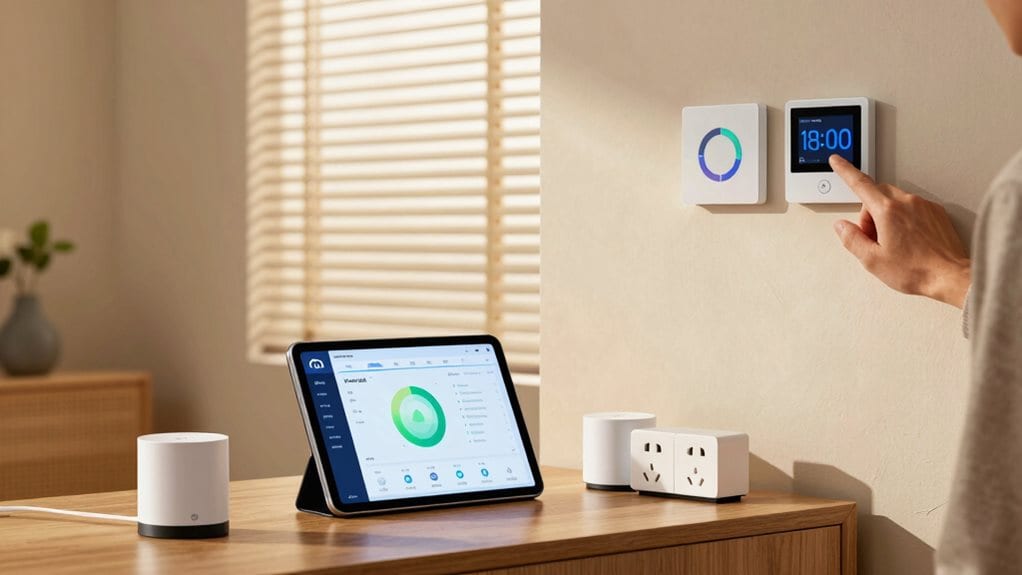
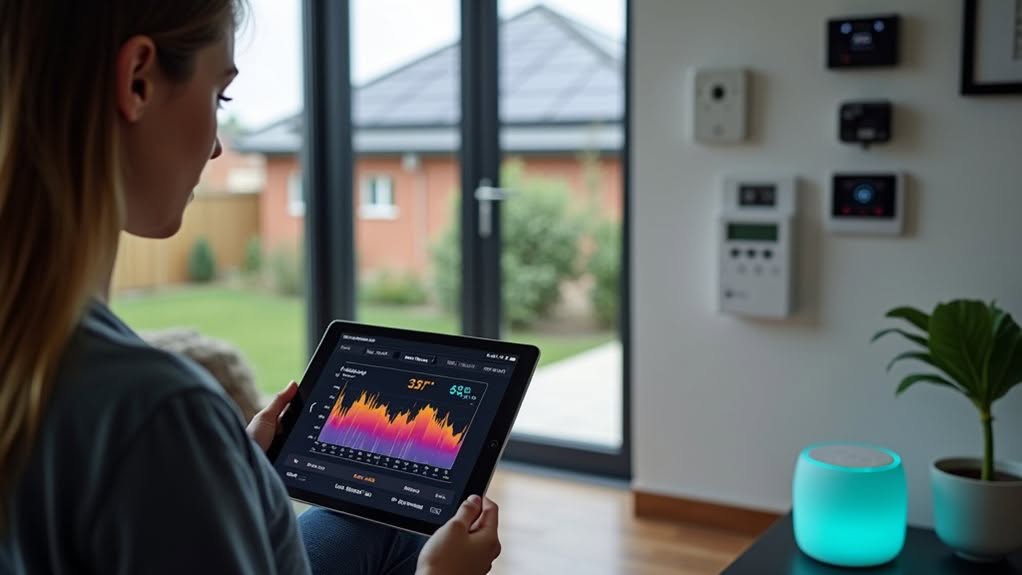
Smart home devices can greatly reduce your climate impact through detailed energy monitoring. IoT sensors track real-time usage patterns while smart thermostats cut heating and cooling costs by up to 15%. AI-powered systems analyze your consumption, suggesting optimization strategies that could slash your carbon footprint by up to 40%. Water monitors detect leaks, and integration with renewable energy sources allows you to schedule high-energy activities during peak solar production. The complete system transforms your home from a passive energy consumer into an active climate solution.
The Science Behind Smart Home Energy Monitoring
While traditional energy monitoring only tracks overall household consumption, modern smart home systems explore much deeper into understanding and optimizing energy use patterns.
These systems employ IoT sensors that collect real-time data from individual household devices, providing granular insights into exactly how energy is being used.
The technology relies on a sophisticated hardware backbone of smart meters, sensors, and controllers that measure power usage with precision.
These components communicate through secure networks, transmitting data while maintaining privacy.
What makes these systems truly powerful is their use of machine learning algorithms.
AI technologies like LSTM, RNN, and SVM analyze consumption patterns and predict future usage based on your behavior and external factors.
This intelligence helps identify unnecessary energy usage and suggests targeted opportunities for savings.
The market for these advanced monitoring solutions is experiencing rapid growth, projected to reach USD 8,514.2 Million by 2033 as consumers increasingly prioritize energy efficiency.
Many homeowners are now choosing to transform their homes with smart energy monitoring systems that provide comprehensive visibility into their daily consumption habits.
Key Smart Devices for Tracking Your Carbon Footprint
As more homeowners seek to understand and reduce their environmental impact, smart devices have emerged as vital tools for tracking and managing household carbon footprints. These technologies provide detailed insights into consumption patterns while automating energy-saving behaviors.
Three fundamental smart devices for carbon footprint tracking include:
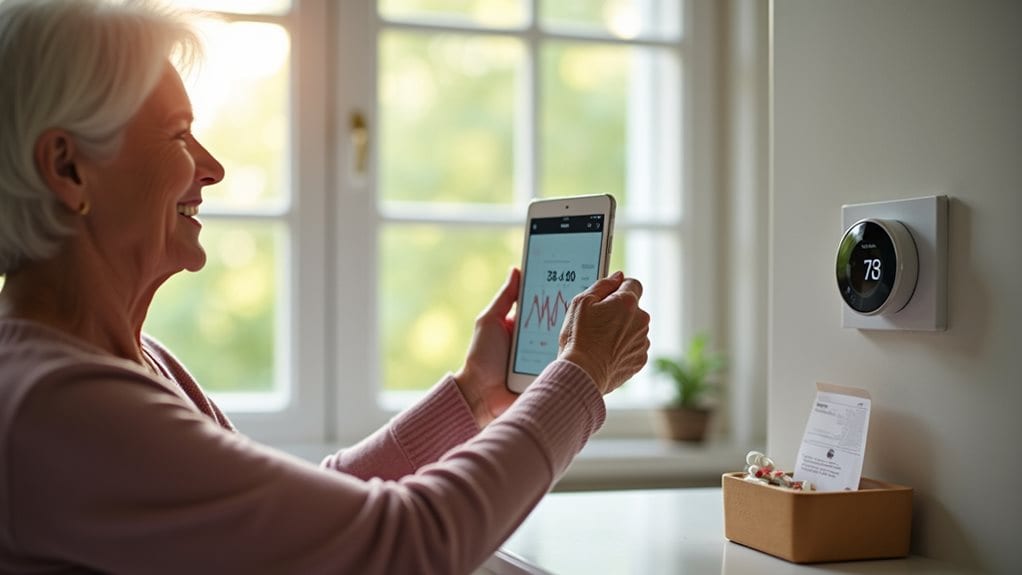
- Smart thermostats that optimize HVAC systems, reducing energy bills by approximately 8% annually while learning your occupancy patterns.
- Smart plugs and power monitors that reveal granular data on individual device energy usage, enabling targeted waste reduction.
- Water monitoring systems that detect leaks and track consumption, indirectly saving energy used for water heating and treatment.
Smart hubs centralize control of these devices, collecting data that informs adjustments to your household’s environmental impact while supporting integration with future sustainable technologies. The increasing adoption of these smart climate control appliances is driven by homeowners looking to lower energy bills while contributing to a greener environment.
Setting Up Your Home for Comprehensive Energy Reporting
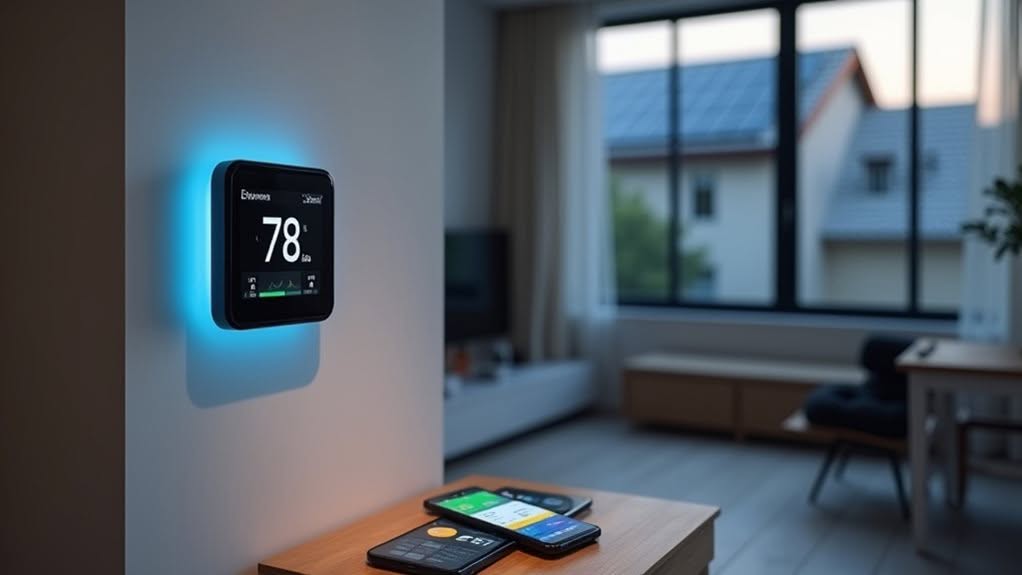
Establishing an extensive energy reporting system in your home builds upon the smart devices you’ve already installed.
You’ll need to decide between whole-home monitoring for overall consumption or plug-level systems that track individual appliances.
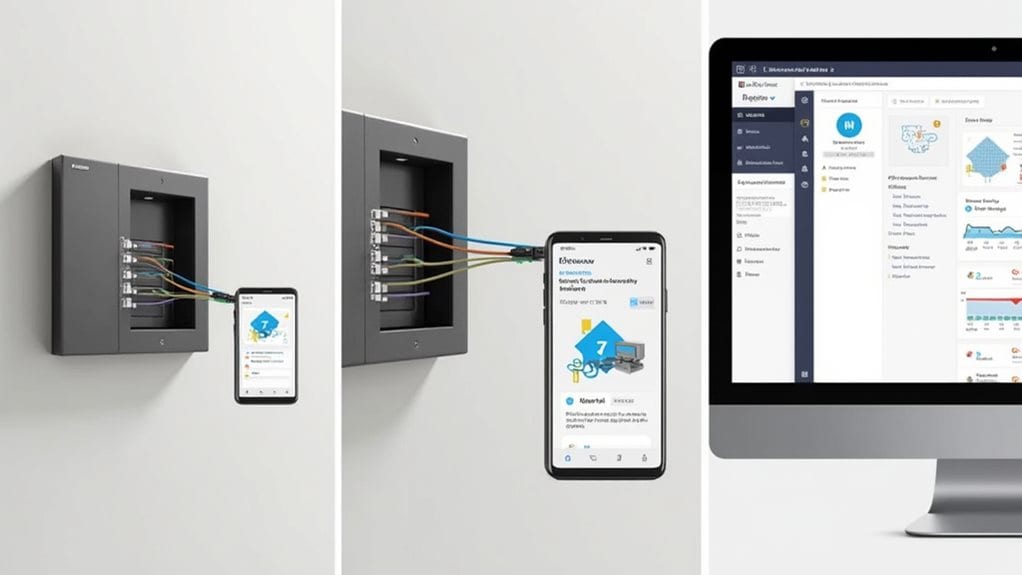
Safety should be your top priority during installation. Always turn off power before placing sensors around service mains, making sure labels face the power source.
Most systems transmit data via Wi-Fi or Bluetooth for real-time monitoring.
Consider professional installation for complex setups, as experts can guarantee proper calibration and accuracy.
Integration with existing smart home infrastructure allows for automated energy management.
Place special focus on high-energy devices like HVAC systems and refrigerators.
Circuit-level monitoring options such as Shelly em3 provide detailed tracking, helping you identify consumption patterns that change with seasons.
When installing current transformers, ensure they clamp around only the line conductor for accurate readings, as encircling both line and neutral wires will result in zero or minimal readings due to current cancellation.
Systems like Emporia offer comprehensive monitoring solutions at reasonable costs of approximately $175 while providing extensive tracking capabilities for multiple circuits.
Interpreting Your Household Climate Impact Data
Understanding what your household energy data actually means requires more than just reading numbers on a screen. Your smart devices track electricity, gas, and water usage, but these represent only part of your total climate impact.
When analyzing your household data, focus on these key elements:
- Distinguish between direct emissions (from your gas heating) and indirect emissions (from purchased electricity).
- Normalize your consumption by household size or dwelling area for meaningful comparisons.
- Consider regional factors like your local electricity grid’s carbon intensity.
Remember that smart devices typically capture scope 1 and 2 emissions but miss most scope 3 impacts from purchased goods and services.
For thorough climate reporting, you’ll need to supplement device data with information about your transportation, food choices, and consumption patterns.
Leveraging AI for Automated Energy Optimization
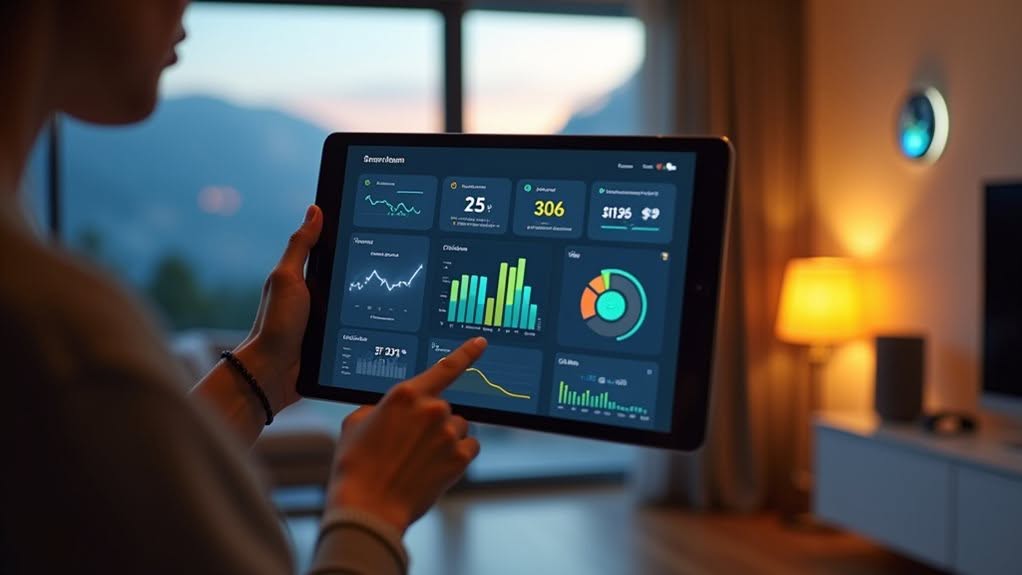
While smart homes have made energy monitoring accessible, artificial intelligence now transforms this data into actionable optimization strategies.
AI-powered thermostats learn your daily patterns and preferences, automatically adjusting temperature settings to reduce unnecessary heating and cooling. These systems can achieve up to 39% energy savings during peak consumption periods.
Smart lighting responds to natural light levels, while AI manages your appliances to minimize idle power consumption. Voice-controlled assistants prevent energy waste from forgotten devices left running.
Behind the scenes, neural networks and machine learning algorithms process data from sensors throughout your home. They create personalized recommendations and can shift energy-intensive tasks to off-peak hours, saving you money on utility bills. Dynamic energy pricing enables households to schedule high-consumption activities when electricity costs are lowest.
AI’s continuous learning adapts to changes in your routine, facilitating real-time energy management without sacrificing comfort. Advanced systems can detect appliance malfunctions to prevent energy waste while ensuring your home remains safe.
Integration With Renewable Energy Sources
AI’s energy optimization capabilities become even more powerful when paired with renewable energy systems. Your smart home can automatically shift high-energy activities to coincide with peak solar production, maximizing the use of clean energy and minimizing grid reliance.
Integration of smart devices with solar panels enables real-time monitoring and automated energy management through centralized controls like the Tesla Powerwall or smart hubs. These systems connect to your home network, providing thorough control through apps. Smart inverters can be utilized for precise monitoring of energy consumption and production patterns across the home.
Key benefits include:
- Improved energy independence during outages or price spikes
- Reduced carbon footprint through maximized clean energy usage
- Long-term cost savings that offset the initial investment
Battery storage systems complement this integration by storing excess solar energy for use during low-production periods, further boosting self-sufficiency.
Real-World Success Stories and Energy Savings Metrics
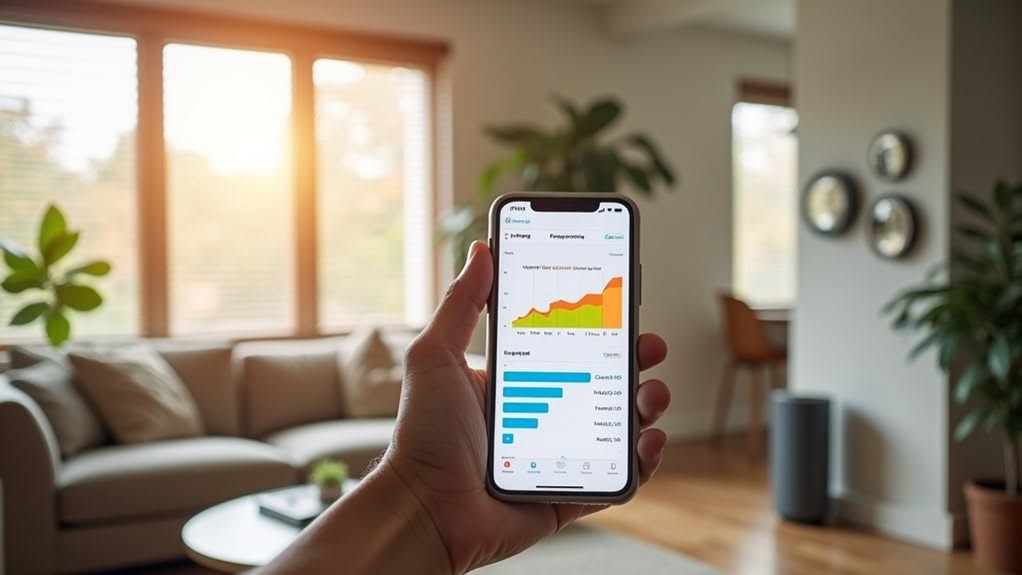
Homeowners across the globe have witnessed remarkable energy savings after implementing smart home technologies. Studies show these systems reduce energy consumption by 15-30% on average, with smart homes using 30-40% less energy than traditional homes.
The numbers speak for themselves. Smart thermostats like Nest can save up to 15% on heating and cooling bills, while smart lighting cuts electricity usage by up to 75%. Integrated smart home systems achieve greater efficiency through optimization and monitoring of multiple energy-consuming devices.
Globally, smart home automation saved 8.4 billion kWh of energy in 2025. Real-time monitoring provides immediate feedback on consumption patterns, allowing you to make informed decisions.
By 2025, 63% of U.S. households had adopted at least one smart device, contributing to the industry’s $149.43 billion market value.
Even simple actions like controlling temperature remotely can save you approximately $50 annually.
Future Trends in Smart Home Climate Impact Technology
Your smart home will soon interface directly with power grids, enabling real-time energy price adjustments and automated load balancing during peak demand.
You’ll benefit from carbon tracking tools that measure your household’s exact emissions footprint, connecting daily habits to specific environmental impacts.
These advances will transform homes from passive energy consumers into active participants in regional climate stability, with systems that adapt to both utility needs and your personal sustainability goals.
Grid-Interactive Homes
As our energy infrastructure evolves, grid-interactive homes are emerging as vital components in the battle against climate change. These smart residences communicate with utility grids, optimizing energy consumption and production in real time.
Your home can become a mini power station with these key capabilities:
- Integration of solar panels and wind turbines to reduce dependence on traditional power sources
- Advanced battery systems that store excess energy during off-peak hours for later use
- Smart load balancing that automatically distributes power to minimize waste
With AI-driven tools analyzing your usage patterns, you’ll receive customized energy-saving strategies that can slash your carbon footprint by up to 40%.
The financial impact is equally impressive, with potential annual savings of $1,200-$2,000 through optimized energy management.
Carbon Tracking Capabilities
Building upon grid-interactive infrastructure, carbon tracking capabilities represent the next frontier in smart home climate technology.
These systems leverage AI-driven energy management to analyze your usage patterns and improve appliance schedules, greatly reducing waste.
With real-time energy monitoring, you’ll receive immediate feedback on consumption, empowering you to make eco-friendly choices throughout the day.
Smart homes can now integrate renewable energy sources like solar panels, while AI maximizes their efficiency through ideal positioning and storage management.
The technology extends beyond electricity—smart water meters detect leaks, preventing waste of this valuable resource.
Meanwhile, data analytics continuously examine consumption patterns to identify additional opportunities for carbon reduction.
As Matter protocol guarantees device compatibility across manufacturers, you’ll benefit from simplified setup and improved automation without replacing existing equipment.
Frequently Asked Questions
Are Smart Home Energy Devices Secure Against Cyber Attacks?
No, your smart home energy devices often have security vulnerabilities. They’re frequently affected by weak passwords, outdated firmware, inconsistent security standards, and design flaws that hackers can exploit to gain unauthorized access.
How Much Does a Complete Smart Energy Monitoring System Cost?
You’ll spend between $200-$800 for a complete smart energy monitoring system. Basic models start at $20, while advanced options like Sense cost around $300. Don’t forget potential installation costs of $100-$300.
Can Renters Install These Systems Without Landlord Permission?
No, you can’t install these systems without landlord permission. Your lease likely prohibits unauthorized modifications. Choose wireless, non-invasive alternatives instead and always get written approval to avoid penalties or eviction.
Do Energy Monitoring Systems Work With Older Home Electrical Systems?
Yes, energy monitoring systems can work with older homes, but you’ll face compatibility challenges like missing neutral wires. Consider retrofitting your electrical system or choosing wireless monitors that don’t require direct circuit integration.
What Happens to My Energy Data and Who Has Access?
Your energy data is typically accessed by utility companies and device manufacturers. They use it for billing, system improvements, and optimization. Third parties may also access it if you’ve authorized them through service agreements.
Final Thoughts
You’ve now learned how smart home technology can transform your approach to energy management and climate impact. By installing the right devices, analyzing your usage data, and implementing AI-driven optimizations, you’ll reduce both your carbon footprint and utility bills. As these technologies continue to evolve alongside renewable energy integration, your home can become an increasingly powerful tool in the global effort to combat climate change.