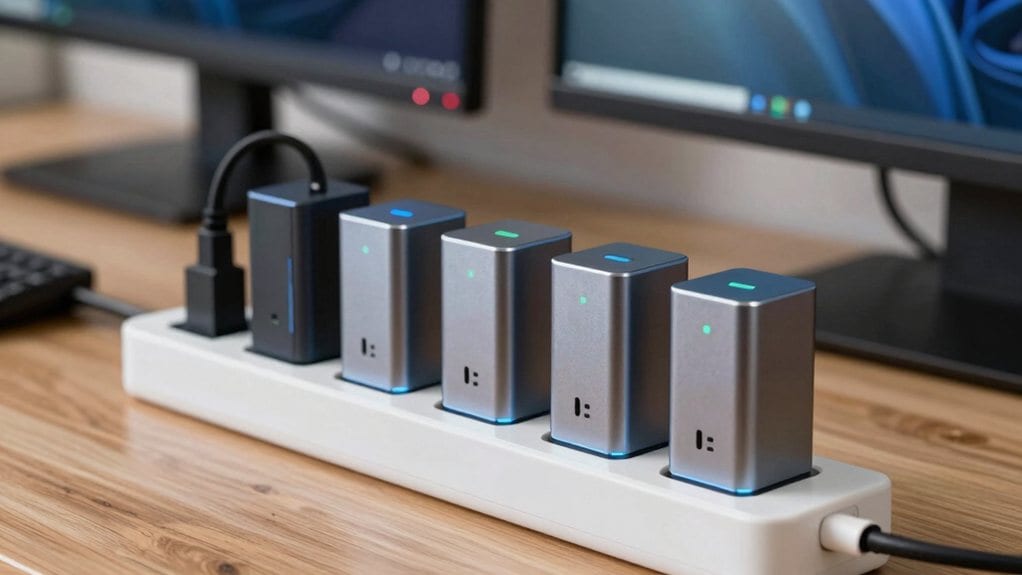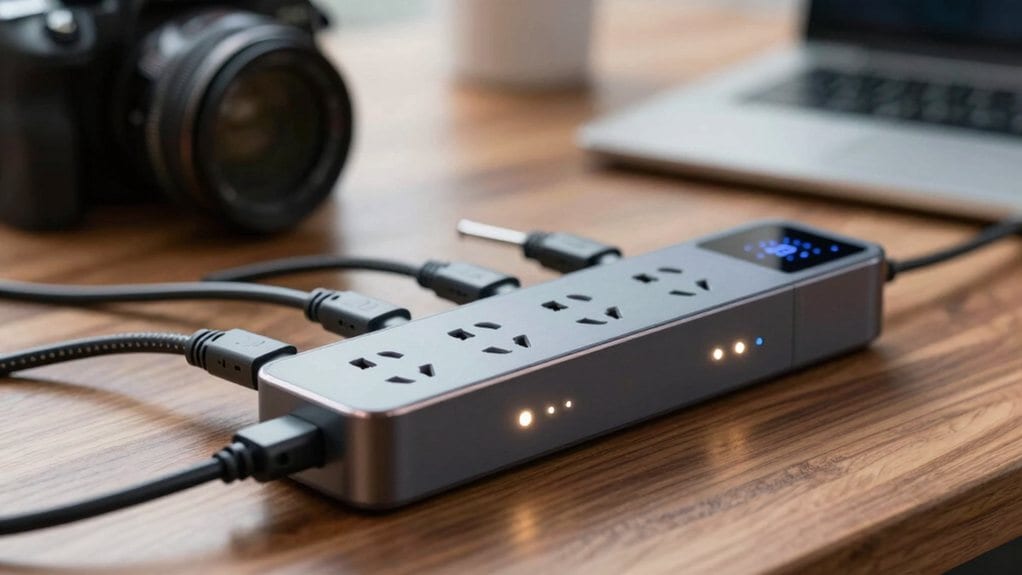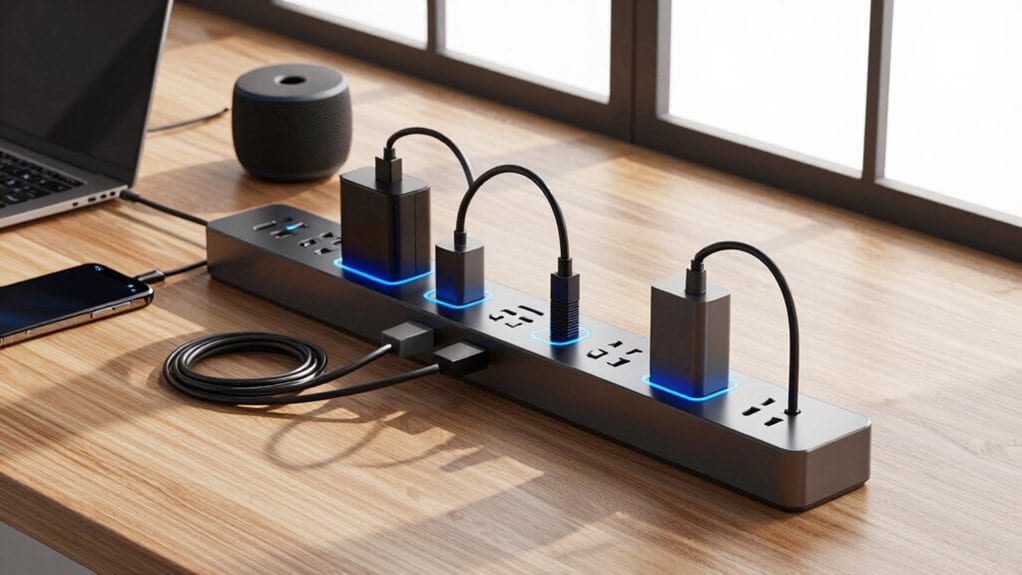
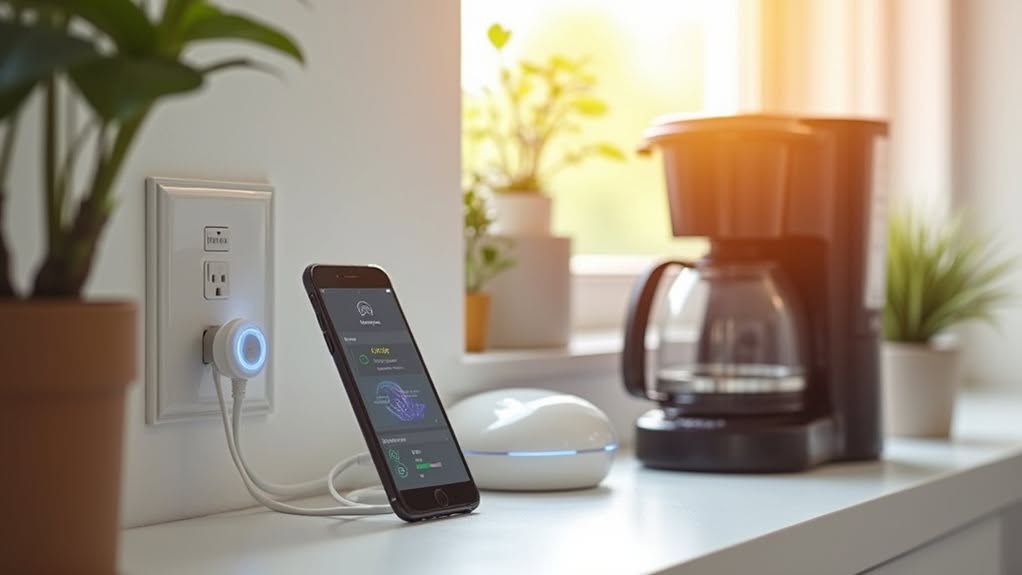
In 2025, the smart plug market offers options for every budget and need. Top choices include the Kasa Smart Plug Mini EP10 ($13-$18) for budget-conscious users, while Matter-compatible devices like Shelly Plug S MTR Gen3 provide cross-platform compatibility with improved security. Look for energy monitoring capabilities to track consumption, compact designs that won’t block adjacent outlets, and local control options that function during internet outages. The newest models combine seamless voice assistant integration with advanced automation capabilities for truly effortless smart home control.
The Evolution of Smart Plugs in 2025: What’s Changed
While once considered novelty gadgets for tech enthusiasts, smart plugs have transformed into essential components of modern home automation systems in 2025.
The market has expanded dramatically, growing from $3.2 billion to a projected $5.64 billion by 2032, with some forecasts suggesting even more aggressive growth rates. This expansion reflects how deeply smart plugs have integrated into everyday life.
Today’s models offer unprecedented connectivity options, supporting Wi-Fi, Bluetooth, Zigbee, and Z-Wave simultaneously. This multi-protocol approach eliminates the frustrating vendor lock-in you’ve likely experienced with earlier generations. The industry is experiencing a steady CAGR of 8.35% as more consumers recognize the energy efficiency benefits these devices provide. The residential segment continues to dominate the market as homeowners increasingly embrace smart home technologies to enhance convenience and reduce energy consumption.
Design improvements have addressed common complaints too. You’ll find newer models are notably more compact, preventing the blockage of adjacent outlets while incorporating advanced energy monitoring features that track your consumption in real-time.
Top Budget-Friendly Smart Plugs Under $25
Budget-conscious consumers can now access impressive smart home functionality without breaking the bank. Several reliable options deliver excellent value under the $25 mark.
The Kasa Smart Plug Mini series, particularly the EP10 and HS103 models, offers compatibility with major voice assistants at just $13-$18. Their slim profile guarantees you can use adjacent outlets without blockage.
Wyze Smart Plugs provide similar functionality at approximately $25 for a two-pack, featuring a compact design ideal for tight spaces.
Other remarkable contenders include the surprisingly capable Aoycocr Smart Plug, the dual-outlet Govee Smart Plug, and Amazon’s own Smart Plug for seamless Alexa integration. For large-scale automation, the GHome Smart Mini Plug offers exceptional value at less than $6 per plug when purchased in a 4-pack. The GE – Cync Outdoor Smart Plug is an excellent choice for outdoor lighting needs at $17.99 with easy setup.
Most budget options include standard features like app control, scheduling, and voice commands, though energy monitoring typically requires higher-end models.
Premium Smart Plug Options for Power Users
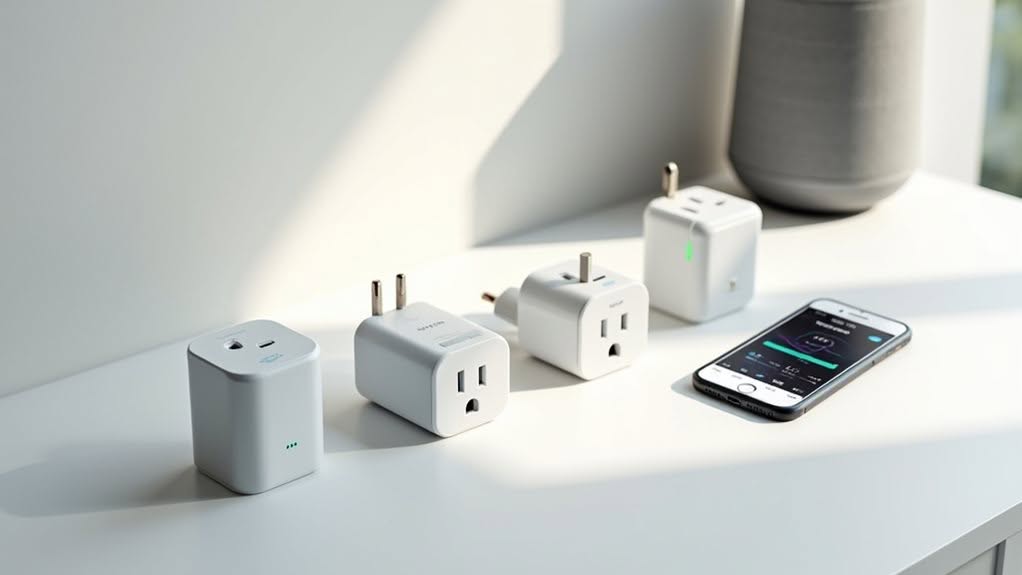
Power users seeking advanced home automation will find considerable benefits in premium smart plugs that extend well beyond basic on/off functionality.
Models like the Shelly Plug S MTR Gen3 offer overheating protection and robust Wi-Fi connectivity, guaranteeing reliability during extended use.
For outdoor automation, the Kasa Matter Outdoor Plug delivers all-season durability with weatherproof construction.
Security-conscious users will appreciate smart plugs featuring away mode, which mimics occupancy through randomized on/off cycles of lights and appliances. This deters potential intruders during your absence.
For cross-platform compatibility, look for plugs supporting the Matter protocol, which facilitates seamless integration with Apple HomeKit, Amazon Alexa, and Google Assistant. Premium smart plugs often feature voice control capabilities that significantly enhance user convenience through hands-free operation.
Advanced options also offer real-time energy monitoring, allowing you to track consumption and identify power-hungry appliances for potential savings. The Aqara Smart Plug stands out with high stability ratings of 9.5/10 while providing comprehensive energy monitoring capabilities.
Matter Protocol: Why It’s Revolutionizing Smart Plug Connectivity
Matter Protocol stands to transform your smart plug experience by enabling universal compatibility across Amazon, Apple, Google, and Samsung platforms, freeing you from ecosystem lock-in.
You’ll enjoy dramatically simplified setup with just a QR code scan and no account linking required, eliminating the frustration of multiple apps and complex pairing processes. The protocol operates smoothly on Wi-Fi and Thread networks, ensuring reliable connectivity throughout your home.
Your smart plugs will operate more reliably with Matter’s local control capabilities, reducing cloud dependencies while maintaining bank-level security protocols that protect your home network from unauthorized access. Matter delivers enhanced protection through AES-based encryption and zero-trust principles that verify every device interaction.
Universal Ecosystem Integration
As smart home technology continues to evolve, the introduction of the Matter protocol represents a watershed moment for universal ecosystem integration in smart plugs.
With Matter certification, you’ll no longer be limited to a single ecosystem. Your smart plugs can now work seamlessly with devices from different manufacturers, regardless of brand loyalty. This breakthrough means your Eve Energy plug will function perfectly with both your Apple HomeKit setup and Google Home system. The coalition of major tech companies behind Matter, including Apple, Google, Amazon, and Samsung, ensures widespread industry support for this revolutionary standard.
Matter operates over Wi-Fi, Ethernet, Thread, and Bluetooth LE, guaranteeing extensive connectivity options for your devices. Matter also serves as a bridge for existing non-Matter devices, making it easier to integrate your current smart home equipment.
You’ll enjoy compatibility with Alexa, Siri, and Google Assistant voice commands without switching between apps.
This unified approach eliminates the frustration of fragmented compatibility, expanding your device options and simplifying how you interact with your smart home.
Simplified Device Setup
When it comes to revolutionizing smart home setups, the Matter protocol stands at the forefront of simplified device connectivity. This universal standard drastically reduces the complexity of adding smart plugs to your home network.
You’ll appreciate how Matter mimics familiar Bluetooth pairing experiences, typically requiring just a few simple steps to complete setup. The process consolidates device discovery, authentication, and configuration into one streamlined workflow.
Matter supports multiple transport protocols, allowing your smart plugs to communicate via Wi-Fi, Bluetooth LE, or Thread networks. This flexibility guarantees your devices work seamlessly in various home environments without additional hubs.
The protocol’s controller-based management handles device authentication through secure certificates, eliminating complicated security configurations.
You can even use multiple controllers simultaneously, making it easy to manage your smart plugs from different apps or devices.
Enhanced Local Control
The revolutionary shift toward improved local control represents one of Matter protocol’s most important advantages for smart plug users. Your Matter-certified plugs communicate directly with local hubs rather than relying on cloud services, resulting in noticeably faster response times.
You’ll appreciate that basic functions like turning plugs on and off continue to work during internet outages, guaranteeing reliability when you need it most. This local communication also bolsters your privacy by reducing data transmission to external servers.
Matter’s local processing supports offline automations, allowing your routines to run seamlessly regardless of cloud status. Your scheduled events will execute reliably without internet dependency.
The protocol’s local communication design delivers another practical benefit: reduced energy consumption compared to cloud-dependent systems, contributing to a more sustainable and efficient smart home setup.
Energy Monitoring Features Worth Paying For
Today’s advanced smart plugs go beyond simple on/off functions with energy monitoring features that track your device’s electricity usage in real time.
You’ll get detailed breakdowns of what each appliance costs to run, helping you identify energy hogs and make informed decisions about replacements or usage patterns.
Some models can even automate power cycling during off-peak hours, allowing you to schedule energy-intensive tasks when electricity rates are lowest without having to remember yourself.
Real-time Usage Insights
Smart plugs with energy monitoring capabilities transform how you’ll understand your home’s power consumption. The most accurate devices utilize CSE7766 chips, which provide precision measurements of voltage, current, power, and cumulative energy usage.
These insights appear instantly on your smartphone or home hub, allowing you to identify energy-hungry appliances and track consumption patterns over time. Many models display daily, monthly, and yearly usage graphs, helping you recognize opportunities for savings.
For data enthusiasts, plugs like the Shelly Plug S offer exportable usage statistics for detailed analysis in spreadsheets. This information isn’t just interesting—it’s practical for identifying faulty appliances through abnormal consumption patterns.
The best models respond quickly to power changes, making them reliable triggers for automated actions when specific energy thresholds are reached.
Appliance Cost Breakdown
When considering which energy monitoring features justify a premium price, effective appliance cost breakdown capabilities stand out as essential. Smart plugs that accurately convert usage data into financial metrics help you make informed decisions about your electricity consumption.
The most valuable energy monitoring features include:
- Accurate measurement chips (like CSE7766) that provide precise consumption readings, guaranteeing your cost calculations reflect true usage.
- Real-time and historical data tracking that reveals both immediate costs and long-term spending patterns for each connected device.
- Integration with ecosystem apps that automatically apply your local electricity rates to convert kilowatt hours into actual expenses.
These features help identify energy-hungry appliances that drain your wallet. By understanding which devices cost more to operate, you’ll prioritize energy-saving actions and potentially save hundreds on your annual utility bills.
Off-peak Savings Automation
Beyond identifying cost-draining appliances, premium smart plugs offer advanced off-peak savings automation that can dramatically reduce your electricity bills.
Models like Shelly and Kasa allow you to schedule devices to run during lower-cost periods, helping you take advantage of time-of-use pricing from your utility. You’ll find this particularly valuable for high-consumption appliances like dishwashers or electric vehicle chargers.
The most sophisticated plugs integrate with third-party apps such as Zerofy, enabling real-time responses to electricity pricing changes. You can set energy thresholds to trigger automatic shutdowns when power consumption exceeds preset levels.
For maximum flexibility, look for plugs with Home Assistant compatibility, allowing you to create complex automations that factor in your local utility’s peak/off-peak schedules, presence detection, and even weather conditions.
Smart Plugs for Outdoor Use: Weather-Resistant Options
Selecting outdoor smart plugs requires careful evaluation of weather resistance capabilities to guarantee reliable performance in varying environmental conditions.
Look for IP65 ratings when purchasing plugs that will face direct rain or snow exposure, while IP64 might suffice for covered areas.
Most outdoor smart plugs connect via 2.4GHz Wi-Fi, offering connectivity up to 300 feet in open spaces, perfect for backyards and patios.
They’re designed to withstand temperatures from -4°F to 122°F, making them suitable for year-round use.
Key factors to weigh when choosing outdoor smart plugs:
- Weather protection ratings (IP64/IP65) and protective outlet covers
- Operating temperature range and UV resistance for seasonal exposure
- Power capacity (typically up to 15A/1875W) and individual outlet control capabilities
Size Matters: Compact Smart Plugs for Crowded Power Strips
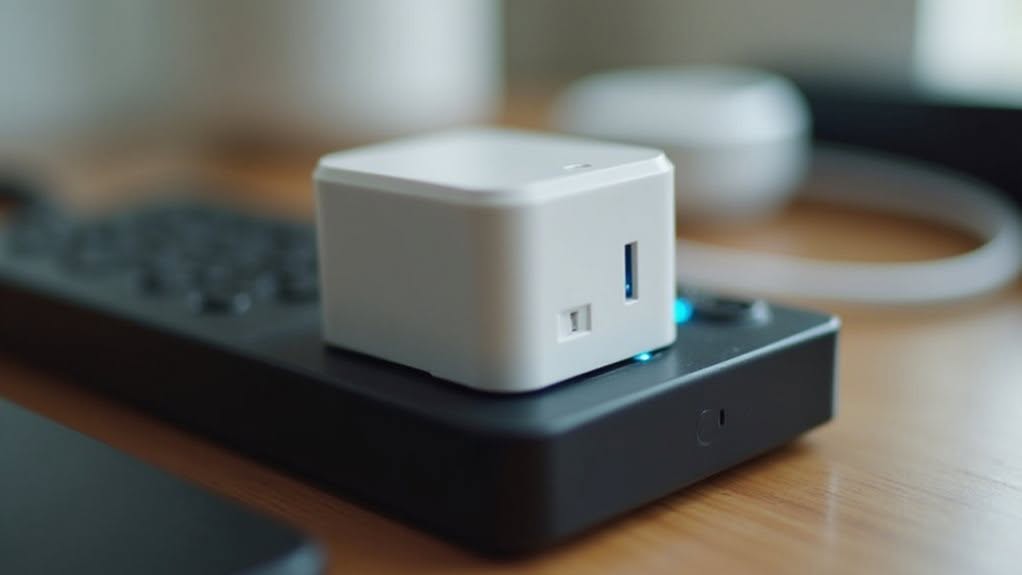
While outdoor smart plugs handle environmental challenges, indoor setups face a different obstacle: limited space.
When your power strips are crowded, compact smart plugs like the Eightree ET20 with its round design can be a game-changer. These mini plugs occupy minimal space while allowing adjacent outlets to remain accessible.
Despite their small size (typically under 60mm in width and depth), these devices don’t sacrifice functionality. You’ll still find features like energy monitoring, Wi-Fi connectivity, and compatibility with voice assistants.
For those prioritizing privacy and customization, look for models compatible with open-source firmware like ESPHome or Tasmota. These options typically cost between €15-€23 and work seamlessly with Home Assistant or MQTT protocols.
Multi-outlet smart power strips such as the Kasa HS300 offer another space-efficient solution, providing independent control of six outlets plus USB charging ports.
Voice Assistant Compatibility: Alexa vs. Google vs. HomeKit
When choosing a smart plug, you’ll want to evaluate how well it works across multiple voice assistants rather than just one.
Most premium models like Kasa and TP-Link EP25 respond equally well to Alexa, Google Assistant, and HomeKit commands, eliminating the frustrating delays or misunderstandings that plague cheaper alternatives.
Your commands to turn devices on or off, adjust schedules, or activate scenes should work seamlessly regardless of whether you’re speaking to a HomePod, Echo Dot, or Nest Mini.
Cross-Assistant Performance
The ideal smart plug should operate reliably across different voice assistants, giving you the freedom to use your preferred ecosystem. Matter certification has considerably improved this cross-platform functionality, with Meross Wi-Fi plugs standing out for their seamless integration with Alexa, Google Home, and Apple HomeKit.
For consistent cross-assistant performance, consider these key factors:
- Use matching device names and room assignments across all assistant apps to guarantee voice commands work consistently.
- Choose Thread-enabled smart plugs for more reliable local communication and reduced response latency.
- Select Matter-certified devices to simplify setup and reduce ecosystem lock-in.
While HomeKit offers superior security with end-to-end encryption, Alexa provides greater flexibility with third-party device integration. Google Home strikes a balance but tends to favor Nest-compatible products. A Matter smart home hub can significantly enhance cross-assistant compatibility by providing a central control point for all your connected devices.
Seamless Voice Commands
Voice commands transform smart plugs from mere remote switches into responsive home automation tools. Each major voice assistant offers distinct advantages when paired with compatible smart plugs.
Kasa Smart Plug HS103P4 works seamlessly with Alexa over your 2.4GHz Wi-Fi network, offering remote control and scheduling for around $29.99 per 4-pack.
Roku Smart Plug integrates with Google Assistant without requiring a hub, though placement matters during setup. It communicates through your router and includes energy monitoring features.
For Apple users, Wyze Plug Outdoor supports HomeKit (Siri) and offers quick setup through the Wyze app. It enables useful if/then automations at a more affordable price point.
Many smart plugs now support multiple voice assistants simultaneously, allowing you to control devices hands-free and improve home security through automation.
Local Control Options for Enhanced Privacy and Reliability
Smart home enthusiasts seeking greater control over their data will find local control options particularly appealing for their network of devices.
Local control eliminates cloud dependencies, keeping your usage patterns private and protecting sensitive information from third-party exposure.
Z-Wave and Zigbee smart plugs offer notable advantages through their hub-based architecture, maintaining functionality even during internet outages.
- TP-Link Kasa Smart Plugs support local-only mode, providing documented API access without cloud requirements.
- Shelly Plug US features built-in local control with power monitoring capabilities.
- Smart plugs compatible with Tasmota firmware enable complete customization and integration with Home Assistant.
Setting Up Smart Plug Automations: Beyond Basic Scheduling
While basic scheduling represents the entry point for most smart plug users, advanced automation capabilities enable substantially more powerful and responsive home control options.
These automations can trigger based on device state changes, energy consumption patterns, or integration with other smart home elements.
Energy monitoring features allow your plugs to detect when appliances finish cycles, sending notifications when your laundry completes or alerting you to abnormal power consumption.
This data-driven approach helps prevent overcharging batteries and identifies potential appliance issues early.
You’ll gain improved functionality by connecting smart plugs to ecosystem hubs like SmartThings or voice assistants.
These integrations support conditional triggers, such as activating devices based on motion sensors or other environmental factors.
For maximum home safety, configure automatic shutoffs after periods of inactivity or when unusual energy patterns suggest potential hazards.
Frequently Asked Questions
Can Smart Plugs Work Without Wi-Fi After Initial Setup?
Most smart plugs can’t work remotely without Wi-Fi after setup. While physical buttons may still function, you’ll lose app control, scheduling, and voice assistant features until your Wi-Fi connection is restored.
Do Smart Plugs Increase Electricity Consumption When Devices Are Off?
No, smart plugs actually decrease your total electricity consumption. While they use 1-2 watts standby power, they eliminate larger phantom loads from connected devices when you turn them off, resulting in net energy savings.
Can I Control Smart Plugs When Away From Home?
Yes, you can control smart plugs when away from home. They connect to your WiFi and work through smartphone apps, allowing you to turn devices on/off, create schedules, and monitor usage from anywhere with internet access.
Are Smart Plugs Compatible With Non-Smart Appliances?
Yes, smart plugs are fully compatible with non-smart appliances. You can simply plug any device with a basic on/off switch into them to gain remote control capabilities through your smartphone or voice assistants.
How Many Devices Can a Single Smart Plug Safely Power?
You should only power one or two devices per smart plug, never exceeding its rated amperage (typically 15A). Don’t use power strips with smart plugs as this can overload circuits and void safety ratings.
Final Thoughts
You’re now equipped to make an informed smart plug decision for your 2025 home automation setup. Consider your specific needs—whether it’s budget constraints, energy monitoring capabilities, or local control options. With Matter protocol integration becoming standard, connectivity issues are largely resolved. Remember to evaluate physical size and voice assistant compatibility before purchasing. Smart plugs continue to offer one of the most accessible entry points to transform your ordinary home into a responsive, intelligent living space.