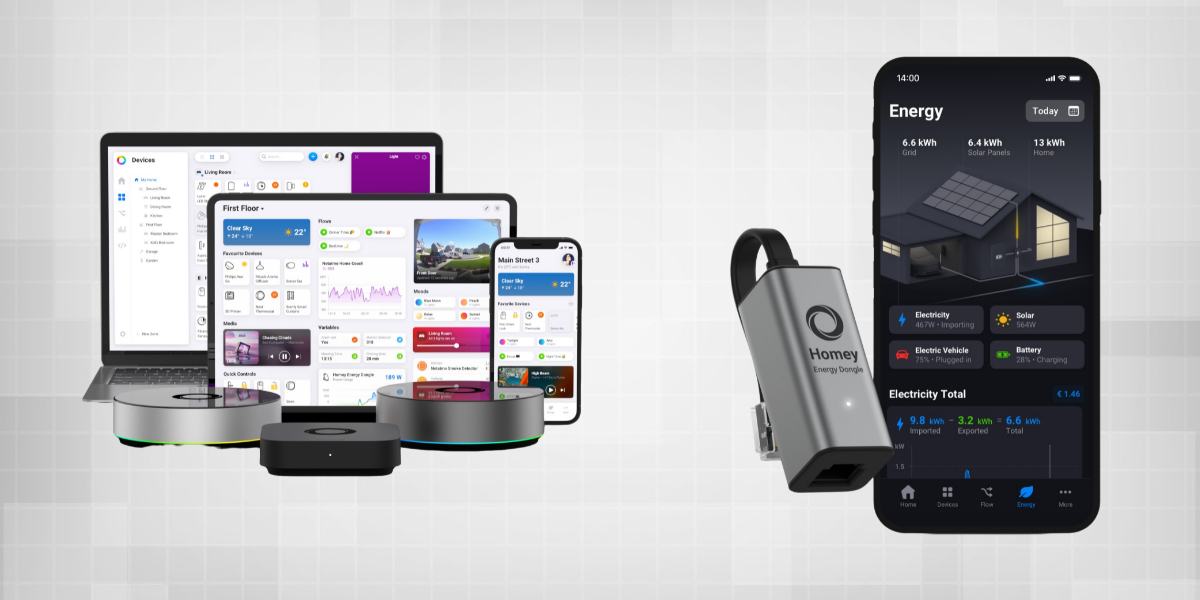
If you’ve been watching your energy bills seesaw with dynamic prices—or noticed how much of your solar gets pushed back to the grid—you’ll know that timing is everything. Today, Athom, the company behind Homey, and Jackery announced a partnership designed to put timing (and control) firmly in your hands. Their new integration lets Jackery’s SolarVault 3 plug-in home battery respond to what’s happening in your home in real time, using live data from the Homey Energy Dongle and your P1 smart meter.
Why this matters now
Across Europe, and especially in the Netherlands, self-consumption is becoming the smarter play. As net metering winds down and grid congestion grows, simply setting a battery to fixed charge/discharge windows isn’t enough. You need your system to read the room: when the kettle’s on, when the heat pump kicks in, or when a cloud pulls solar production down. That’s exactly what this partnership aims to deliver.
“Energy prices are volatile, and the case for self-consumption has never been stronger,” says Stefan Witkamp, CEO at Athom. “A plug-in battery becomes much more useful when it can respond to what’s happening at home. With Homey, Jackery’s SolarVault 3 can do exactly that.”
How it works (without a rewiring project)
- Plug in the Homey Energy Dongle to your P1 smart meter.
- Link the dongle with your Jackery SolarVault 3 via the Homey app.
- That’s it—no electrical modifications needed.
From there, SolarVault 3 gets a live feed of your household’s energy use. Instead of relying on static rules, the battery can dynamically adjust its output to meet actual load: easing back when demand is low, stepping up when appliances start, and aligning operation with the moments that matter for your bill.
Immediate benefits for energy-conscious households
- Boost self-consumption: Use more of your own solar in real time instead of exporting it.
- Cut unwanted grid feed-in: Reduce pushback when the grid doesn’t need it (or won’t pay much for it).
- Ride dynamic pricing: Better timing of charge and discharge to take advantage of cheaper or avoid costly hours.
This responsiveness helps smooth daily peaks and troughs, improves comfort, and can translate into tangible savings—without you micromanaging settings.
What’s coming next
Athom and Jackery aren’t stopping at live load matching. A deeper software integration is slated to begin rolling out in early July, bringing:
- Smarter charge/discharge based on weather forecasts and your household’s routines.
- Strategies tailored to dynamic electricity tariffs to buy low and use high.
- Coordination with connected devices—think EV chargers, heat pumps, and smart plugs—for whole-home optimization.
In practice, that could mean precharging the battery ahead of a cloudy afternoon, pausing EV charging during price spikes, or letting the heat pump preheat when rates are low. It’s the kind of orchestration that squeezes more value from every kilowatt-hour.
See it in action
If you’re heading to smarter E Europe in Munich, you can experience the system firsthand. Jackery will showcase the SolarVault 3 plug-in home battery with Homey integration from June 23–25 at booth C2.150.
About the partners
- Athom (Homey): Founded in the Netherlands in 2014, Athom created Homey, a platform that unifies control, automation, and energy management across more than 50,000 devices from over 1,000 brands. Athom became part of LG Electronics in 2024. For more information, visit homey.app.
- Jackery: Known for portable power and solar products, Jackery is expanding into European home energy storage with the SolarVault 3 plug-in series. For more information, visit jackery.com.
The bottom line
For European homeowners who want simpler savings and smarter self-consumption, plug-in storage just took a meaningful step forward. By pairing Jackery’s SolarVault 3 with Homey’s real-time energy data, your battery can finally behave like a thinking partner—adapting to your home, your tariffs, and your day.
With easy setup today and deeper automation arriving in July, this collaboration offers a practical path to lower bills, better comfort, and less grid dependency—no electrician required.


