
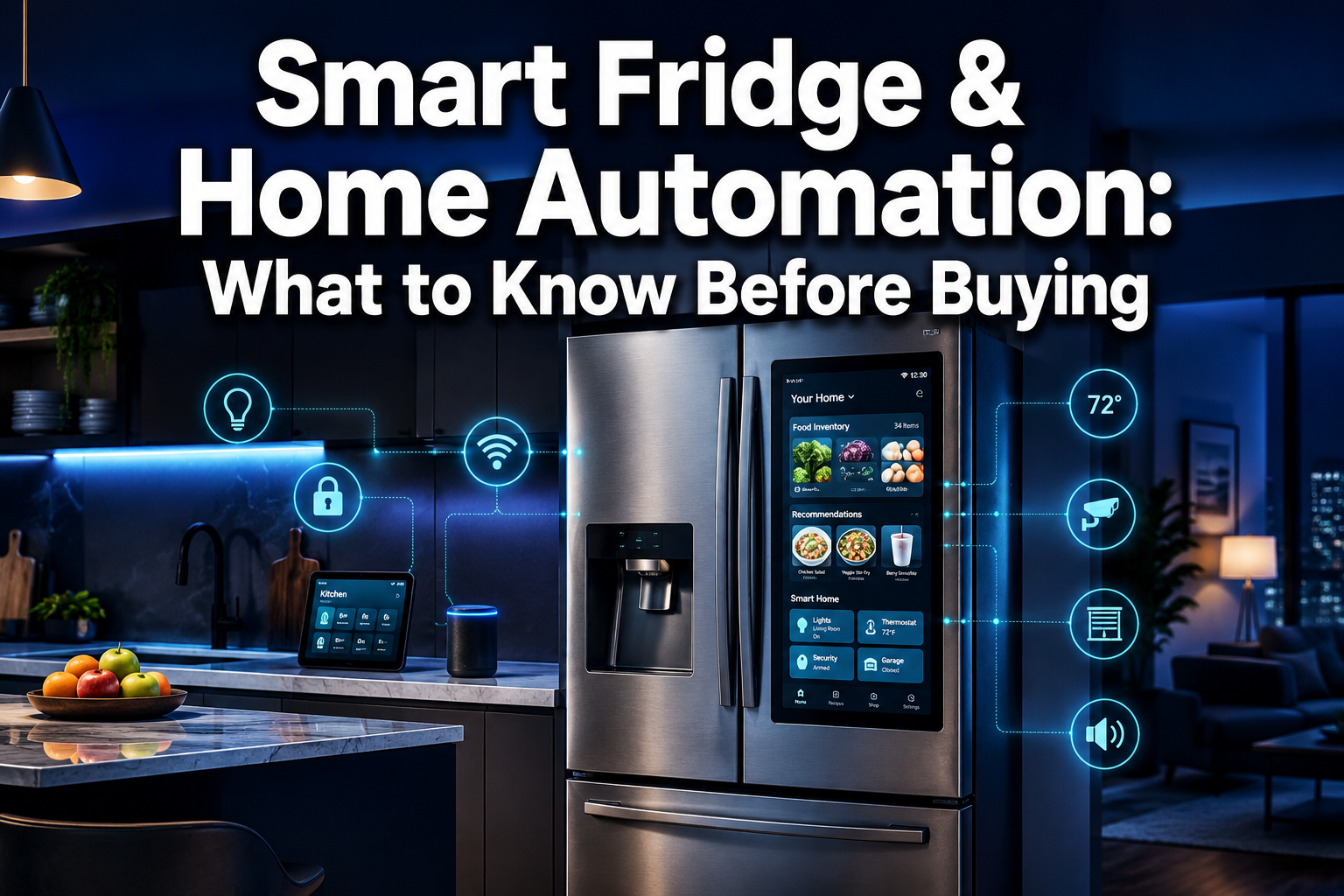
By 2026, the average smart refrigerator does far more than keep food cold — it tracks expiry dates, suggests recipes, manages grocery orders, and connects directly into your wider home automation ecosystem. Yet most buyers still walk into a showroom focused only on capacity and colour. That gap between what smart fridges can do and what buyers actually know costs real money and causes real frustration.
This guide covers everything you need before investing in smart fridge home automation — from the latest AI features to energy savings, integration tips, and the privacy questions worth asking before you swipe your card.
Key Takeaways
- Smart fridges in 2026 offer AI-powered food tracking, voice control, and deep integration with smart home hubs.
- Energy savings from IoT-enabled appliances can exceed 46% compared to always-on models.
- Compatibility with your existing ecosystem (Google Home, Amazon Alexa, Apple HomeKit, SmartThings) is the most important pre-purchase check.
- Privacy and data security deserve serious consideration — some models now display ads and collect usage data.
- The best smart fridge home automation setup is one that fits your daily routine, not just your kitchen.
What Is a Smart Fridge and How Does It Fit Into Home Automation?
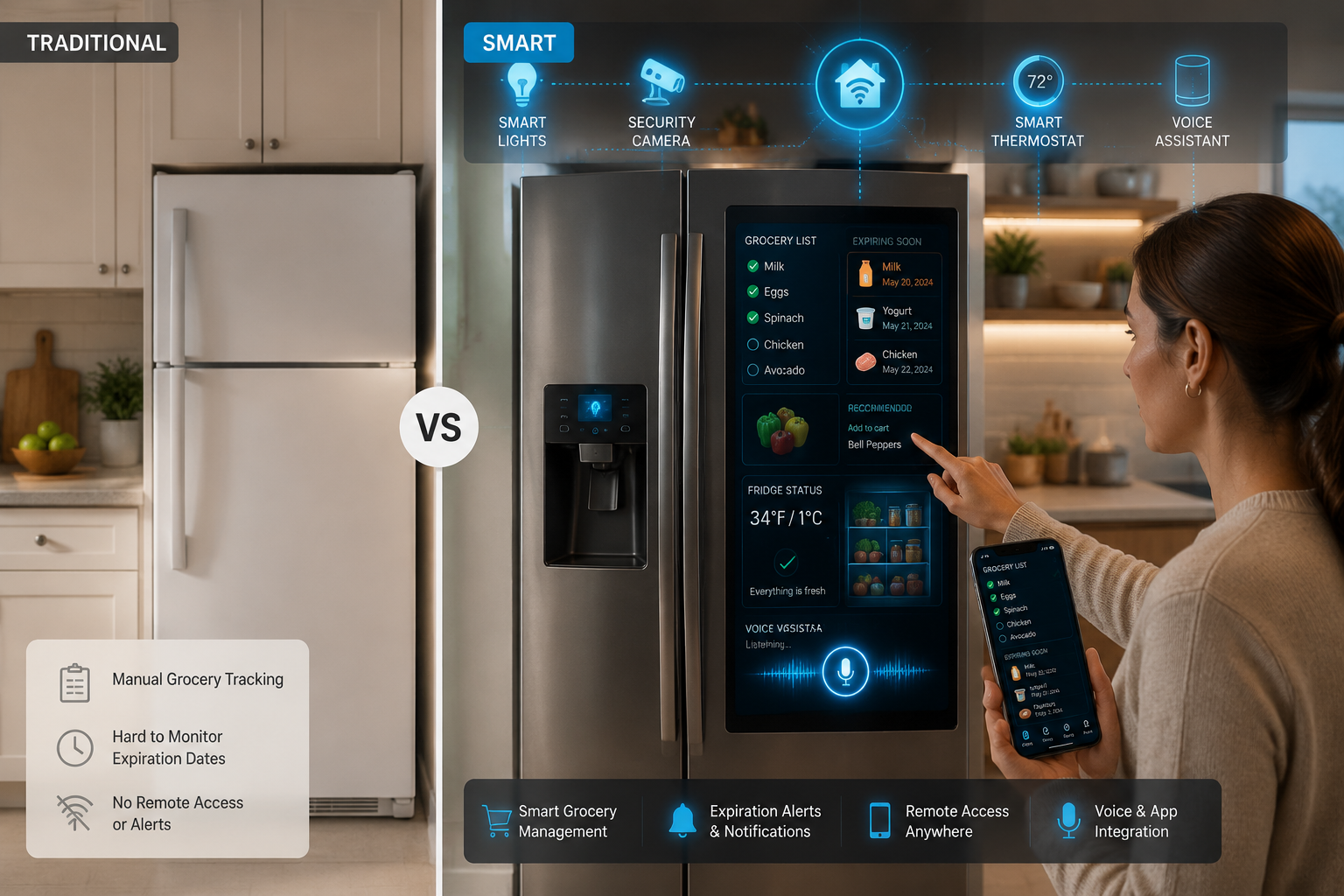
A smart fridge is a Wi-Fi connected refrigerator that can communicate with other devices, apps, and platforms in your connected home. Think of it as the centrepiece of a smart kitchen — one appliance that ties together grocery management, meal planning, energy monitoring, and voice control.
In a fully integrated setup, your smart fridge home automation system might:
- Alert your phone when the door is left open
- Sync with your smart speaker to read out shopping lists hands-free
- Connect to your smart energy management system to run defrost cycles during off-peak hours
- Trigger routines — for example, dimming kitchen lights when you open the fridge at night
This is smart living made simple. Rather than managing every appliance separately, your fridge becomes one node in a wider network that works around your routine.
The Latest Smart Fridge Features in 2026
The pace of innovation in 2026 has been remarkable. Here is what the leading manufacturers are bringing to market right now.
AI-Powered Food Recognition
Samsung’s Bespoke AI Refrigerators with Family Hub received a major update in May 2026, introducing enhanced AI Vision that identifies food items automatically, tracks quantities, and suggests recipes based on what is actually inside. Bixby voice control was also improved, making hands-free convenience genuinely practical for busy households.
Samsung has also integrated Google Gemini AI into select models, boosting food recognition accuracy and enabling more personalised meal recommendations.
Built-In Barcode Scanners and Live Cameras
At CES 2026, GE Profile unveiled a 4-Door French-Door Refrigerator with a built-in barcode scanner and live internal camera system. Scan items as you load them in, check what is inside from the supermarket aisle, and let the AI kitchen assistant build your shopping list automatically. Food waste reduction becomes a genuine outcome rather than a marketing promise.
See-Through Doors and Smarter Preservation
Hisense launched its PureView series in June 2026, featuring a See-Through Door that illuminates when you approach or touch it — so you can check contents without opening the door at all. Less door-opening means less cold air lost, which directly supports energy-efficient living.
Haier’s Horizon Cooling collection, also launched in June 2026, goes further with NutriBank technology that keeps meat and fish fresh up to five times longer without freezing, alongside Active Fresh Zones for precise humidity control.
The Concept That Raised Eyebrows
Dreame’s N1 Refrigerator concept, shown in April 2026, features a robotic arm that unpacks and organises groceries, tracks expiry dates, and suggests recipes using AI cameras and sensors. Impressive? Absolutely. But its biometric scanning features have already sparked genuine privacy debate — something worth keeping in mind as the technology matures.
Smart Fridge Home Automation: Integration and Compatibility
Before buying, compatibility is the single most important question to answer. A smart fridge that does not talk to your existing ecosystem is just an expensive fridge.
Key Platforms to Check
| Platform | Common Brands | Voice Assistant |
|---|---|---|
| Google Home | Samsung, LG, Haier | Google Assistant |
| Amazon Alexa | Samsung, GE, Hisense | Alexa |
| Apple HomeKit | Limited appliance support | Siri |
| SmartThings | Samsung ecosystem | Bixby / Alexa / Google |
| Matter Protocol | Growing support | Multiple |
💡 Pro tip: If you already use a smart home hub like SmartThings or a platform like Home Assistant, confirm your chosen fridge is listed as a compatible device before purchasing.
What Integration Actually Looks Like
With a properly integrated smart fridge home automation setup, you can build routines that genuinely save time. For example:
- Ask your smart speaker to add milk to the shopping list — the fridge confirms it is running low
- Set your smart thermostat and fridge to coordinate energy use during peak tariff hours
- Receive a smartphone notification if the fridge temperature rises unexpectedly while you are away
Explore more about smart kitchen appliances to see how your fridge can work alongside smart ovens, multicookers, and washing machines in a joined-up home.
Energy Efficiency and the Real Cost of a Smart Fridge
Smart fridges carry a higher upfront cost — typically £1,200 to £3,500+ in the UK market. But the long-term picture is more encouraging.
Research published in May 2026 found that IoT-enabled smart home automation systems can achieve energy savings exceeding 46% compared to always-on models. Features like off-peak defrost scheduling, door-open alerts, and adaptive cooling all contribute to lower energy bills over time.
A rough cost-benefit snapshot:
- 🔋 Smart defrost scheduling: reduces compressor run time
- 🌡️ Adaptive temperature zones: prevents overcooling
- 📱 Door-open alerts: cuts cold air loss
- ⚡ Off-peak energy use: lowers electricity costs on time-of-use tariffs
For households already using smart energy management tools, a smart fridge slots in naturally and amplifies those savings further.
A separate concern flagged in May 2026 research is the longevity of embedded software in IoT devices. Unlike a traditional fridge that runs for 15–20 years, a smart fridge depends on software support from the manufacturer. If updates stop, features degrade — and security risks can emerge. Factor this into your long-term cost assessment.
Privacy, Security, and the Downsides to Know
Smart living made simple comes with trade-offs worth understanding clearly.
Advertising on Your Fridge Screen
In late 2025, reports confirmed that Samsung’s Family Hub refrigerators would begin displaying advertisements on their touchscreens — with no option to disable them. This is a significant shift in how manufacturers monetise smart appliances, and it is a reasonable concern for buyers who value a clean, distraction-free kitchen.
Data Collection and Security
Smart fridges collect data about your food habits, usage patterns, and household routines. Samsung’s Knox Matrix security framework offers meaningful protection within its ecosystem, but buyers should still:
- Review the manufacturer’s privacy policy before purchasing
- Use a separate IoT network (a guest Wi-Fi network) to isolate smart appliances
- Keep firmware updated to close known security vulnerabilities
For more on keeping your connected devices secure, browse our smart home security resources.
How to Choose the Right Smart Fridge for Your Home
Use this checklist to narrow down your options before visiting a showroom.
✅ Pre-Purchase Checklist
- Does it work with your current smart home platform?
- What AI features are included — and are they genuinely useful to you?
- How long does the manufacturer commit to software updates?
- Does the screen display ads? Can they be disabled?
- What is the energy rating, and does it qualify for any UK energy tariff benefits?
- Does it support Matter or other open protocols for future-proofing?
- Is the internal camera or barcode scanner something you will actually use?
Matching features to your actual routine — rather than buying the most impressive spec sheet — is what makes smart fridge home automation genuinely worthwhile. Control at your fingertips only matters if those controls fit how you live.
Smart Fridge Comparison: Key Features at a Glance
🧊 Smart Fridge Feature Finder
Answer two quick questions to find the features that matter most for your home.
FAQ
Q: Do smart fridges work without Wi-Fi? Yes — the core cooling functions always work. But smart features like remote monitoring, voice control, AI food tracking, and app notifications all require a stable Wi-Fi connection.
Q: Can a smart fridge connect to any smart home system? Not always. Compatibility depends on the brand and platform. Samsung works best with SmartThings, while LG and GE integrate well with Google Home and Alexa. Always check before buying.
Q: Are smart fridges worth the extra cost? For households that actively use the features — food tracking, energy scheduling, voice control — yes. For buyers who just want cold storage, a premium traditional fridge may offer better value.
Q: How long will a smart fridge receive software updates? This varies by manufacturer and is not always clearly stated. Ask the retailer directly, and check the manufacturer’s support policy. Lack of updates is a genuine long-term risk for IoT appliances.
Q: Can I add smart features to my existing fridge? Partially. Smart temperature sensors, door-open alerts via smart home sensors, and connected plug-in cameras can add some intelligence to a standard fridge — though not the full AI experience.
Q: What about privacy — who can see my fridge data? Manufacturers collect usage data per their privacy policies. Use a dedicated IoT Wi-Fi network, review your privacy settings in the app, and keep firmware updated to reduce exposure.
Conclusion
Smart fridge home automation in 2026 has moved well beyond novelty. AI food recognition, see-through doors, energy-efficient scheduling, and deep smart home integration make these appliances genuinely useful — when chosen carefully.
Your next steps:
- Audit your current ecosystem — know which platform you use before browsing models.
- Prioritise the features you will actually use — food tracking, energy savings, or hands-free convenience.
- Check software support commitments from the manufacturer.
- Review privacy settings and plan to use a dedicated IoT network.
- Explore the wider picture — see how a smart fridge fits into your smarter everyday living setup alongside other connected appliances.
The right smart fridge does not just store food — it saves time, cuts waste, lowers bills, and slots seamlessly into a home that works for you. That is smart living made simple.


