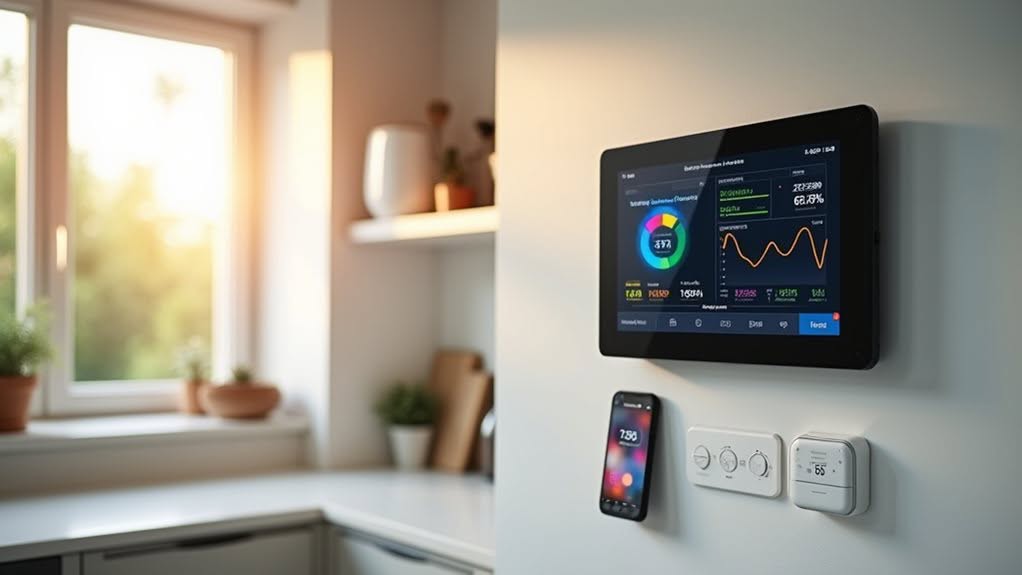
Smart home energy monitoring becomes truly efficient through a combination of real-time data visibility, personalized feedback, and seamless device integration. You’ll see immediate insights into your electricity usage patterns, allowing you to identify power-hungry appliances and vampire loads that account for up to 23% of energy consumption. Interactive dashboards transform complex data into actionable insights, while gamification elements motivate conservation behaviors. Social comparison features can reduce energy use for years after implementation. The following sections explore how these technologies can transform your home’s energy profile.
Real-Time Data: The Foundation of Intelligent Energy Management
The backbone of any effective smart home energy system lies in its ability to deliver real-time data about your electricity usage. This immediate visibility transforms how you understand and manage power consumption throughout your home.
With monitoring software displaying exact energy draw for individual devices and whole-home circuits, you’ll quickly identify power-hungry appliances and “vampire loads” that can represent up to 23% of your household energy use.
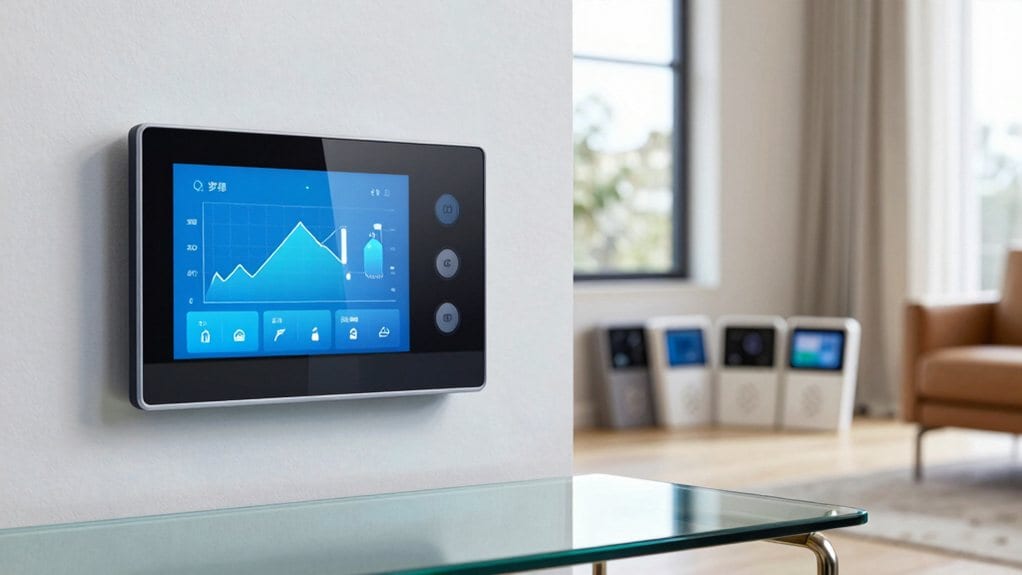
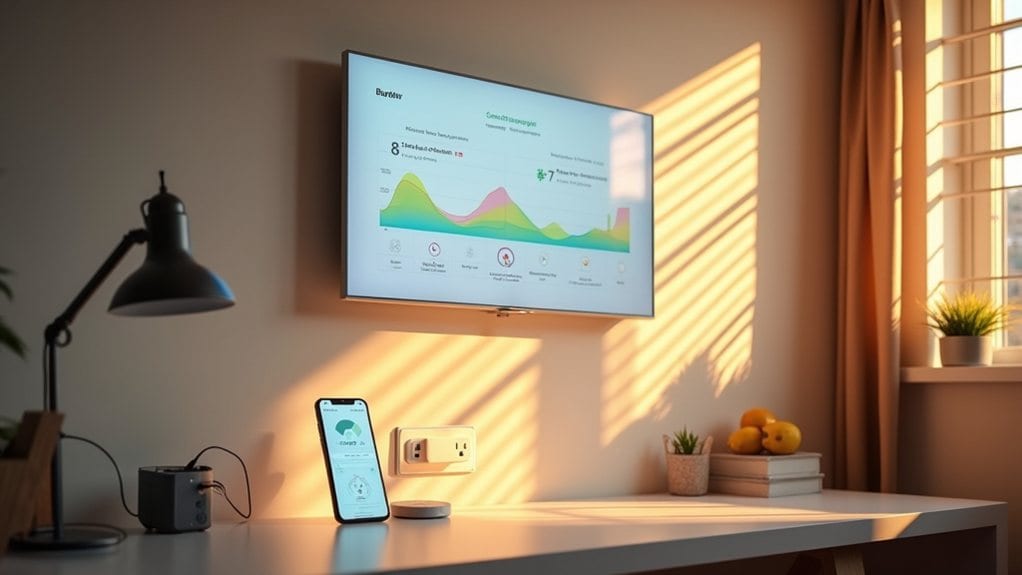
Your smartphone becomes a powerful energy management tool, offering intuitive charts and graphs that make complex usage patterns easy to understand.
This instant access to consumption data allows you to spot unusual energy use immediately, preventing waste before it impacts your bill and giving you unprecedented control over your home’s efficiency. Modern systems provide the convenience of accessing data remotely while running errands or traveling, ensuring you stay connected to your home’s energy profile regardless of location. These intelligent monitors can predict monthly bills based on your current consumption patterns, helping you budget more effectively for upcoming expenses.
Transform your living space with smart energy solutions that integrate seamlessly with your existing home automation systems for comprehensive control over your energy footprint.
The Power of Behavioral Change Through User Engagement
User engagement strategies can transform how you interact with energy data and drive meaningful behavioral changes in your home.
Through gamification elements like challenges and rewards, you’ll find yourself more motivated to reduce consumption as these features turn energy conservation into an enjoyable activity rather than a chore.
Personalized energy coaching combined with social comparison tools that show how your usage compares to neighbors creates powerful psychological incentives that have been shown to sustain long-term energy-saving habits. Effective interfaces must be designed through collaborative efforts between behavioral scientists and technologists to ensure data translates into actionable insights.
Gamification Sparks Action
Four powerful behavior change mechanisms combine to make gamification an effective catalyst for energy conservation action.
Real-time monitoring with game elements shows your immediate energy use, creating direct connections between your actions and consumption patterns.
Social competition leverages your natural desire for community recognition through leaderboards, badges, and neighborhood challenges that foster accountability and collective motivation.
Short-term competitions with frequent rewards maintain your interest through weekly updates and mini-challenges, offering both virtual and tangible incentives for participation. Programs like the “Take Charge Challenge” demonstrate how community partnerships can significantly amplify participation and energy savings.
Educational elements seamlessly blend energy literacy into your gaming experience, teaching practical conservation techniques through mission-based learning and relatable scenarios.
These approaches transform abstract energy concepts into concrete, actionable behaviors that you can implement in your daily routines. IoT-connected applications like ‘Energy Cat’ demonstrate how smart meter integration can translate virtual achievements into real-world energy savings.
Personalized Energy Coaching
Personalized energy coaching transforms how you manage household electricity consumption through individualized guidance and behavioral support. These programs deliver customized feedback based on your home’s specific energy profile, creating more effective recommendations than generic tips.
Research shows that coaching can raise your conscious engagement with energy usage in as little as 12 weeks. The transition from catabolic to anabolic energy in your daily habits leads to more sustainable consumption patterns. When coaches work collaboratively with you during installation and learning processes, you’re more likely to retain and implement energy-saving behaviors. Households with access to real-time feedback through smart devices demonstrate significantly greater reductions in both energy consumption and monthly bills.
The benefits extend beyond energy savings. About 80% of coaching clients experience increased self-confidence, which supports motivation for adopting new energy behaviors. This improved confidence also boosts communication skills, helping you better engage with energy-saving practices and technologies.
Professional certified coaches, particularly those external to energy providers, consistently deliver more reliable outcomes for sustainable behavior change.
Social Comparison Motivates
Why do we instinctively look to our neighbors when trying to gauge our own energy consumption habits? Research shows that comparing your energy use to similar households triggers a powerful motivation for change.
When you receive feedback showing how your electricity consumption stacks up against neighbors, you’re likely to reduce usage considerably. These effects aren’t temporary—households maintain lower consumption for at least two years after installing smart meters with social comparison features.
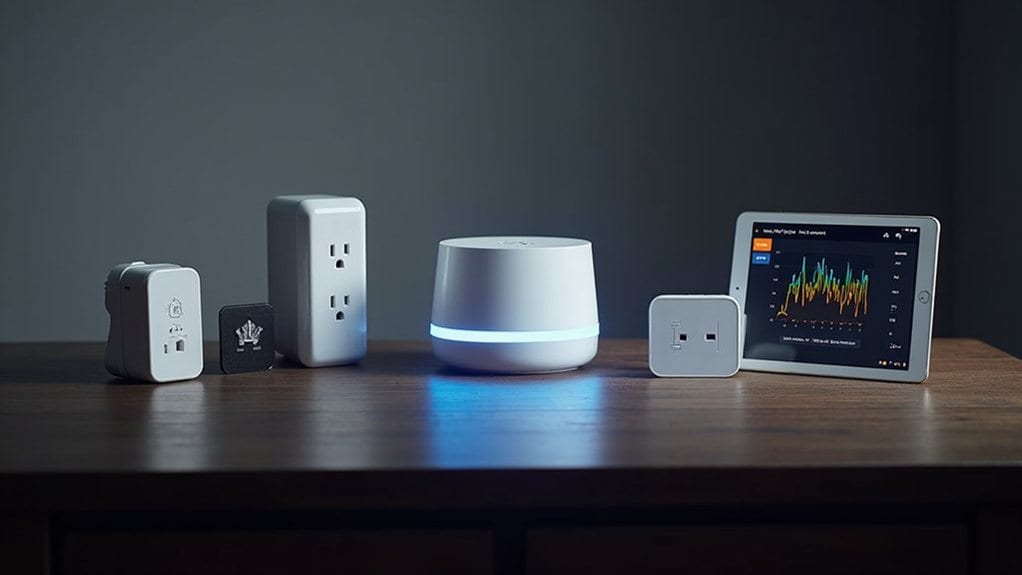
The stronger you identify with the comparison group, the more you’ll reduce your energy use. Studies have found that high consumers tend to decrease their usage when provided with normative feedback, bringing their consumption closer to the neighborhood average. Real-time data through smart plugs improves this effect by letting you make immediate adjustments when you see inefficient usage patterns.
Social comparison consistently outperforms simple personal feedback or cost information alone, activating psychological factors that foster long-term conservation behaviors.
Seamless Device Integration: Creating a Unified Energy Ecosystem
You’ll find that your smart home devices must work in harmony to create an effective energy monitoring ecosystem.
The compatibility between devices depends largely on communication protocols such as Wi-Fi, Zigbee, and Z-Wave, which allow different products to exchange data and function as a unified system.
When your devices speak the same language through standardized protocols, you can build a thorough energy management network that delivers accurate monitoring and seamless control across all connected appliances. Advanced Metering Infrastructure enables real-time data collection from your household appliances, providing granular insights for better energy decisions. This integration is increasingly important as Wi-Fi technology continues to dominate with 33.6% market share in the smart home energy monitoring sector.
Device Harmony Matters
When various smart home devices communicate effectively with each other, they create a powerful ecosystem that maximizes energy efficiency beyond what individual components can achieve alone.
This seamless communication enables real-time data sharing for dynamic energy adjustments based on actual usage patterns. Your smart devices can work together to eliminate waste automatically. When your thermostat detects no one’s home, it can signal lights to turn off, cutting unnecessary consumption.
Energy monitoring systems collect data from all integrated devices, giving you a thorough view of your home’s energy profile through a unified dashboard. This centralized control eliminates the need to manage separate apps for each device.
Smart systems can also coordinate high-energy tasks like dishwashing or EV charging to occur during off-peak hours, optimizing both costs and grid demand.
Protocols Define Compatibility
The backbone of any effective smart home energy monitoring system lies in the communication protocols that allow devices to interact seamlessly.
When selecting energy monitoring solutions, you’ll encounter standards like IEEE 2030.5 (SEP 2.0) and OpenADR, which enable secure data exchange between utilities and your devices. These protocols support not only energy usage data but also pricing and demand response events.
For in-home connectivity, you’ll find options ranging from Modbus and ZigBee to Wi-Fi and Thread. Each serves different purposes—ZigBee and Z-Wave create reliable mesh networks, while Wi-Fi offers higher bandwidth for real-time monitoring.
Cybersecurity can’t be overlooked. Modern standards incorporate TLS encryption and certificate authentication to protect your energy data.
Choosing devices that support these secure protocols guarantees your system remains both functional and protected.
Turning Numbers Into Action: Effective Data Visualization
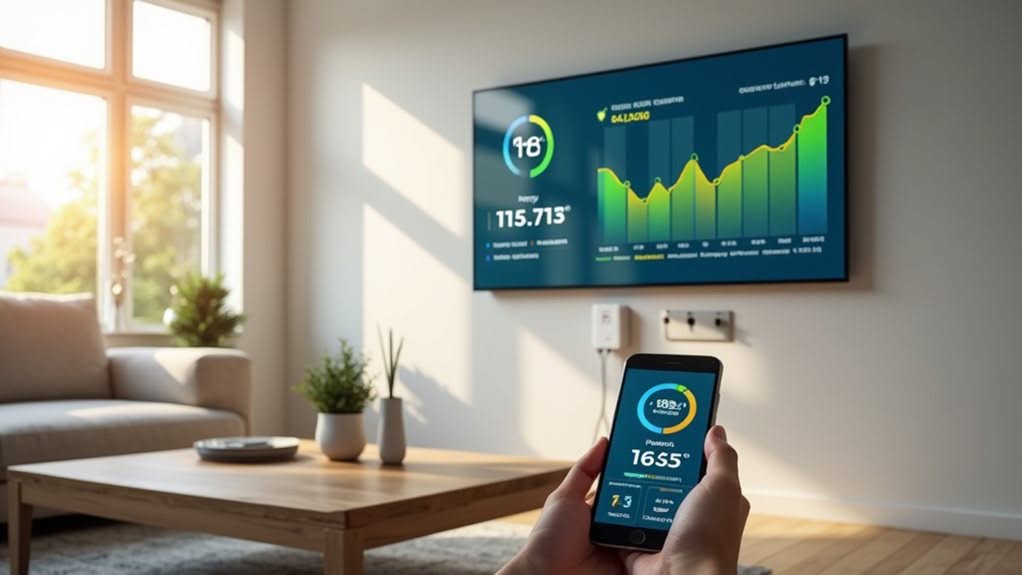
Because raw energy data can overwhelm homeowners, effective visualization transforms complex information into actionable insights. Your dashboard’s design greatly impacts your understanding and response to energy consumption patterns.
Line charts and heat maps excel at showing usage trends over time and identifying high-consumption areas in your home. Bar charts help you compare appliance usage, while scatter plots reveal correlations between variables like temperature and energy demand.
Real-time monitoring dashboards with customized alerts enable you to detect anomalies immediately, preventing waste and reducing costs. When your visualization system integrates multiple data sources—from smart meters to weather services—you’ll gain thorough context for your consumption patterns.
Well-designed visualizations support better decision-making by highlighting opportunities for efficiency improvements and tracking progress toward your energy-saving goals.
Beyond Savings: Environmental Benefits of Smart Monitoring
Smart energy monitoring delivers environmental benefits that extend far beyond your utility bill savings.
These systems directly reduce your carbon footprint by enabling more conscious energy use.
Households with smart meters typically reduce electricity consumption by 2.8% and gas usage by 2%, with corresponding drops in CO2 emissions.
Smart thermostats alone can cut heating and cooling energy use by 10-30%.
Your smart home helps stabilize the power grid by communicating usage patterns to utilities, reducing reliance on carbon-intensive peak power plants.
This grid interaction allows better integration of renewable energy sources and improves overall efficiency.
When adopted across communities, these technologies amplify environmental benefits.
Research from Carbon Trust indicates widespread implementation can reduce household energy consumption by up to 27%, making a noteworthy contribution to climate goals.
The Economics of Energy Monitoring: ROI and Cost Benefits
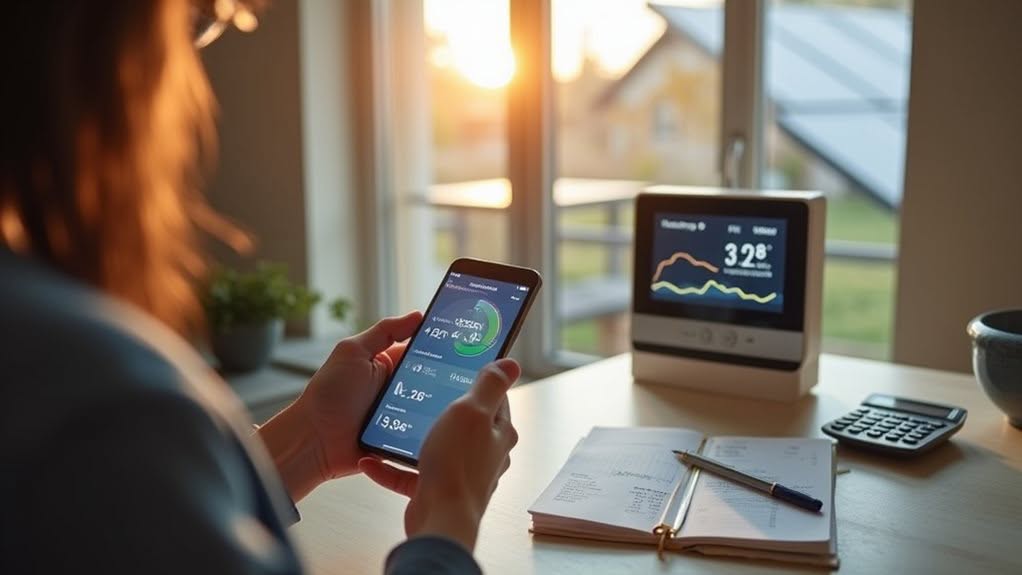
Investing in smart energy monitoring systems delivers measurable financial returns that extend well beyond simple utility bill reductions. Payback periods typically depend on your initial investment and the annual savings generated, with most systems proving cost-effective within a reasonable timeframe.
These systems can considerably increase your property value, making homes more attractive to energy-conscious buyers. You’ll also benefit from reduced maintenance costs, as early detection of inefficiencies prevents expensive repairs.
The market for smart energy monitoring is growing at an impressive 17.2% annually, reaching $8.5 billion by 2033. This growth is fueled by technological advancements and supportive regulations.
Government incentives and rebates further improve your ROI, while automated data collection and real-time insights boost operational efficiency throughout your home.
Technological Evolution: What’s Driving Smart Energy Innovation
As innovative technologies converge, today’s smart energy monitoring systems offer capabilities that were unimaginable just a decade ago.
The driving force behind this revolution is advanced AI and machine learning, which enable predictive analytics that adapt to your behavior and external factors.
The Matter protocol has transformed connectivity, guaranteeing devices from Apple, Google, and Amazon work seamlessly together.
This interoperability future-proofs your investment and simplifies system expansion.
Real-time energy monitoring through dashboards and mobile apps provides immediate visibility into consumption patterns, helping you identify inefficiencies instantly.
Smart thermostats like the Honeywell Home X2S can save up to 22% on heating costs through AI-driven scheduling.
These technologies collectively create systems that continuously learn, anticipate your needs, and optimize energy use automatically.
Overcoming Implementation Challenges for Maximum Efficiency
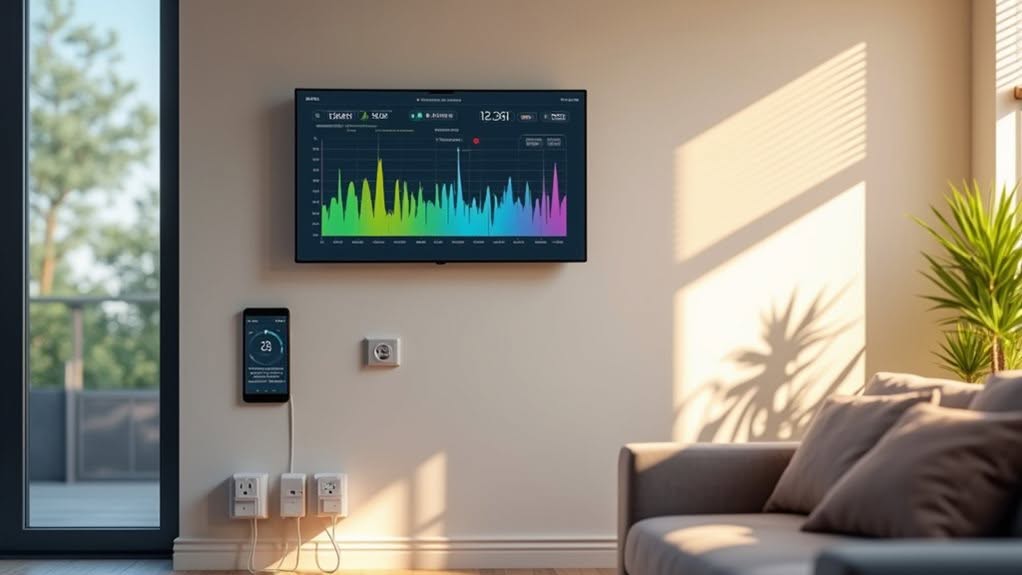
While smart home energy systems offer tremendous potential, implementing them successfully requires managing several considerable challenges.
Power outages can disrupt energy monitoring, but solutions like backup power supplies and robust HANs help maintain system functionality. You’ll need redundant infrastructure to guarantee continuous operation during grid failures.
Communication protocol issues present another hurdle. Standardization efforts led by utility companies can resolve compatibility problems between devices. Consider open platforms and modular technologies for greater flexibility.
Technical complexity often overwhelms homeowners. User-friendly interfaces and automated settings based on AI can simplify system operation. Professional assistance may be necessary for setup and maintenance.
Network limitations can be addressed through advanced infrastructure and hybrid networks. 5G integration and edge computing improve speed and reliability, while strong cybersecurity measures protect your system from vulnerabilities.
Frequently Asked Questions
How Long Does Installation Typically Take for a Complete System?
You’ll typically spend 30-60 minutes installing a complete smart home energy monitoring system. Professional electricians work faster, while DIY installations might take longer. You’ll need an additional 10-20 minutes for app setup and Wi-Fi configuration.
Are Smart Energy Monitors Vulnerable to Cybersecurity Threats?
Yes, your smart energy monitors are vulnerable to cybersecurity threats. They can face data interception, firmware exploits, and network attacks. However, many newer models use encryption and separate networks to reduce these risks.
Can Renters Install Monitoring Systems Without Landlord Modifications?
Yes, you can install non-invasive monitoring systems as a renter. Use smart plugs, portable energy monitors, or external clamp sensors that don’t require permanent modifications. These plug-in options provide valuable energy insights without altering your rental property.
Do Monitoring Systems Work During Power Outages?
Yes, they can work during outages if connected to backup power sources. Your system might use cellular networks for alerts, store data locally, or integrate with backup batteries to maintain monitoring functionality.
How Accurate Are Energy Consumption Predictions for Budgeting Purposes?
Modern prediction models can be 99.9% accurate for your budgeting needs. You’ll get precise forecasts using AI technologies like ANN, LSTM, and hybrid models that analyze your usage patterns and detect anomalies effectively.
Final Thoughts
You’re now equipped to make truly efficient energy monitoring decisions. By prioritizing real-time data, user engagement, and seamless device integration, you’ll transform how you manage home energy. The right visualization tools turn complex data into actionable insights, creating environmental and economic benefits. Though implementation challenges exist, the technological advancements driving smart energy innovation make it easier than ever to optimize your home’s efficiency and reduce costs.